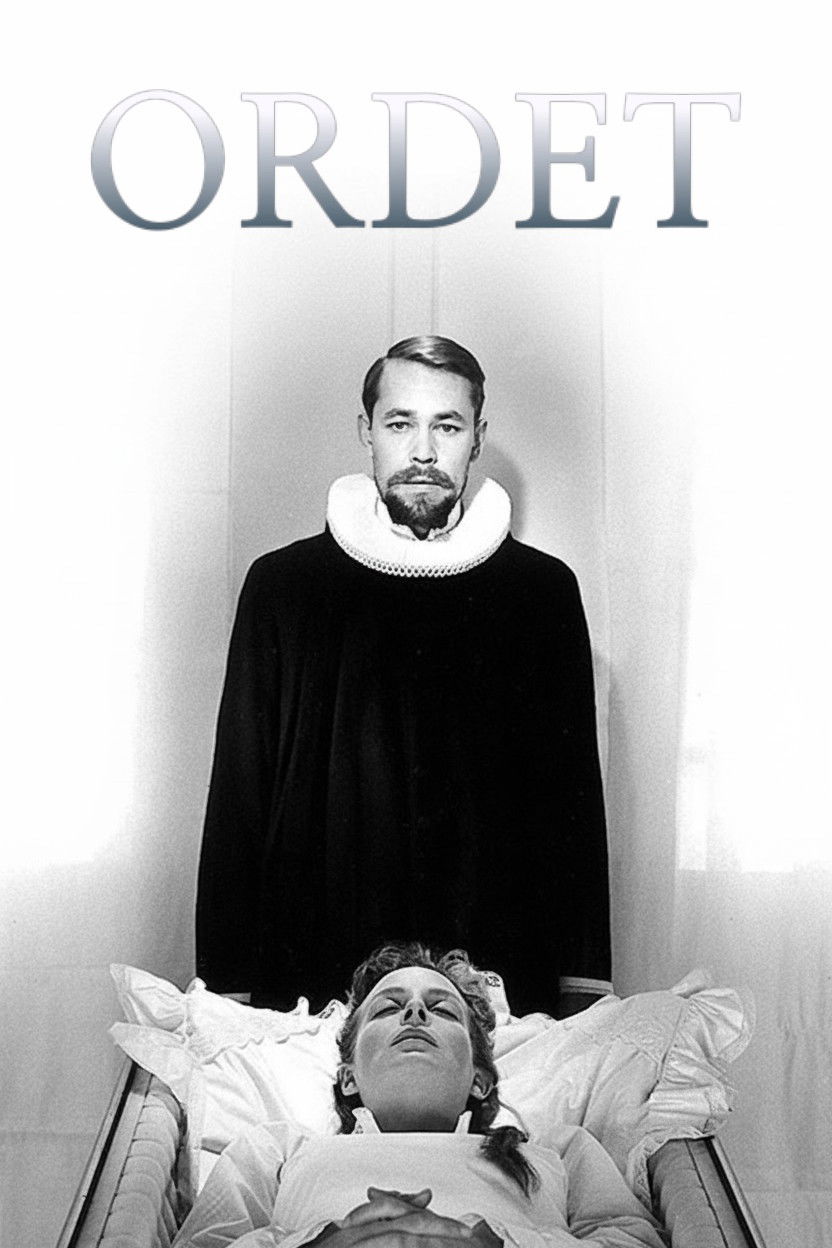
Poster from TMDB
Ordet
Sign in to saveAlso known as The Word
Ordet (, meaning "The Word" and originally released as The Word in English) is a 1955 Danish drama film, written and directed by Carl Theodor Dreyer. It is based on a play by Kaj Munk, a Danish Lutheran priest, first performed in 1932. The film won the Golden Lion at the 16th Venice International Film Festival, and was the only film by Dreyer to be both a critical and financial success.
OverviewAI-generated
Ordet is a 1955 Danish black-and-white drama film directed by Carl Theodor Dreyer, who also served as producer and co-writer alongside Kaj Munk. The film features Henrik Malberg, Emil Hass Christensen, Preben Lerdorff Rye, and Birgitte Federspiel. Its narrative is set in Denmark and centers on themes of abortion, human pregnancy, faith, religion, and religious fundamentalism. The production design was handled by Erik Aaes, with music composed by Poul Schierbeck.
The film was released in 1955 and 1957. It has a runtime of 125 to 126 minutes and was produced by Palladium. Ordet received the Golden Lion and the Bodil Award for Best Danish Film. It is part of the Vatican's list of films and is held in the Museum of Modern Art collection. The work is available via the Criterion Channel and Darkroom.
Synthesized by Vinony from 37 facts across 4 sources: Wikidata, TMDb, IMDb, Vinony collections. Generated from structured data (not the Wikipedia text) and checked against those facts — may still contain errors.
Film · TMDB
8.0The three sons of devout Danish farmer Morten have widely disparate religious beliefs. Youngest son Anders shares his father's religion, but eldest son Mikkel has lost his faith, while middle child Johannes has become delusional and proclaims that he is Jesus Christ himself. When Mikkel's wife, Inger goes into a difficult childbirth, everyone's beliefs are put to the test.
Cast
- Henrik Malberg as Morten Borgen (uncredited)
- Birgitte Federspiel as Inger Borgen (uncredited)
- Emil Hass Christensen as Mikkel Borgen (uncredited)
- Preben Lerdorff Rye as Johannes Borgen (uncredited)
- Cay Kristiansen as Anders Borgen (uncredited)
- Ejner Federspiel as Peter Petersen (uncredited)
Themes
- faith
- religion
- black and white
- religious fundamentalism
- pregnant wife
This product uses the TMDB API but is not endorsed or certified by TMDB.
Key facts
- Film.name
- Ordet
- Film.image
- Ordetposter.jpg
- Film.caption
- theatrical release poster
- Film.director
- Carl Theodor Dreyer
- Film.producer
- Carl Theodor Dreyer
- Film.screenplay
- Carl Theodor Dreyer
- Film.starring
- Henrik MalbergPreben Lerdorff RyeBirgitte FederspielEjner FederspielEmil Hass Christensen
- Film.music
- Poul Schierbeck
- Film.cinematography
- Henning Bendtsen
- Film.editing
- Edith Schlüssel
- Film.studio
- A/S Palladium
- Film.distributor
- Kaj Munk & Carl Theodor Dreyer A/S
- Film.runtime
- 126 minutes
- Film.country
- Denmark
- Film.language
- Danish
via Wikipedia infobox
Wikidata facts
- Instance of
- film
- Part of
- Vatican's list of films
- Genre
- drama film
- Country of origin
- Denmark
- Original language
- Danish
- Main subject
- human pregnancy
- Creator
- Carl Theodor Dreyer
- Collection
- Museum of Modern Art
- Director
- Carl Theodor Dreyer
- Screenwriter
- Kaj Munk
- Composer
- Poul Schierbeck
- Narrative location
- Denmark
- Duration
- 126
- FilmAffinity ID
- 489524
Show 6 more facts
- publication date
- 1957-12-15
- title
- Ordet
- production designer
- Erik Aaes
- color
- black-and-white
- film format
- 35 mm film
- review score
- 100%
Sources (9)
via Wikidata · CC0
~14 min read
Encyclopedic overview
10 sectionsContents
- Plot
- Cast
- Production
- Pre-production
- Filming
- Release and reception
- Awards
- See also
- References
- External links
Ordet (, meaning "The Word" and originally released as The Word in English) is a 1955 Danish drama film, written and directed by Carl Theodor Dreyer. It is based on a play by Kaj Munk, a Danish Lutheran priest, first performed in 1932. The film won the Golden Lion at the 16th Venice International Film Festival, and was the only film by Dreyer to be both a critical and financial success.
The film is now regarded by many critics as a masterpiece, admired particularly for its cinematography. In Sight and Sound magazine's 2012 poll on the greatest films of all time, it placed 19th in the directors' poll and 24th in the critics' poll.
Excerpted from Wikipedia’s “Ordet” article, available under the CC BY-SA 4.0 licence.