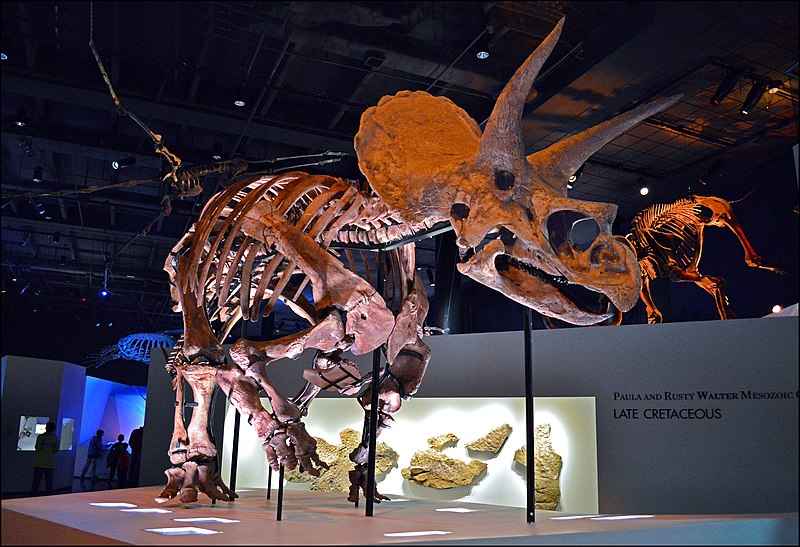
File:Triceratops_Specimen_at_the_Houston_Museum_of_Natural_Science_v01.jpg · Wikimedia Commons · See Wikimedia Commons
Ornithischia
Sign in to saveAlso known as Ornithischia (Benton Classification)
Ornithischia () is an extinct clade of mainly herbivorous dinosaurs characterized by a pelvic structure superficially similar to that of birds. The name Ornithischia, or "bird-hipped", reflects this similarity and is derived from the Greek stem ' (), meaning "bird", and ' (), meaning "hip". However, as birds are theropod dinosaurs, they are only distantly related to this group.
Ornithischia was a group of extinct dinosaurs, mostly plant-eaters, that had a hip structure resembling that of modern birds, which is why their name means "bird-hipped." Despite this similarity, birds are actually theropod dinosaurs that are only distantly related to ornithischians.
AI-generated from the Wikipedia summary — may contain errors.
Wikidata facts
Show 9 more facts
- temporal range end
- Cretaceous
- temporal range start
- Triassic
- taxon rank
- order
- taxon name
- Ornithischia
- Commons category
- Ornithischia
- topic's main category
- Category:Ornithischia
- means of locomotion
- bipedalism
- start time
- 200000000-
- end time
- 66000000-0
via Wikidata · CC0
~32 min read
Encyclopedic overview
13 sectionsContents
- Description
- Skulls
- "Bird-hip"
- Integument
- Classification
- History
- Subgroups
- Evolution
- Palaeoecology
- See also
- Notes
- References
- External links
Ornithischia () is an extinct clade of mainly herbivorous dinosaurs characterized by a pelvic structure superficially similar to that of birds. The name Ornithischia, or "bird-hipped", reflects this similarity and is derived from the Greek stem ' (), meaning "bird", and ' (), meaning "hip". However, as birds are theropod dinosaurs, they are only distantly related to this group.
Ornithischians with well known anatomical adaptations include the ceratopsians or "horn-faced" dinosaurs (e.g. Triceratops), the pachycephalosaurs or "thick-headed" dinosaurs, the armored dinosaurs (Thyreophora) such as stegosaurs and ankylosaurs, and the ornithopods. There is strong evidence that certain groups of ornithischians lived in herds, often segregated by age group, with juveniles forming their own flocks separate from adults. Some were at least partially covered in filamentous (hair- or feather- like) pelts, and there is much debate over whether these filaments found in specimens of Tianyulong, Psittacosaurus, and Kulindadromeus may have been primitive feathers.
Excerpted from Wikipedia’s “Ornithischia” article, available under the CC BY-SA 4.0 licence.
Gallery (52)
Available in 61 languages
- Español
- Français
- Deutsch
- 中文
- 日本語
- Русский
- Português
- Italiano
- العربية
- हिन्दी
- Afrikaans
- Azerbaijani
- Bahasa Indonesia
- Balinese
- Bangla
- Basque
- Belarusian
- Breton
Show 42 more
- Catalan
- Cebuano
- Croatian
- Czech
- Danish
- Esperanto
- Filipino
- Finnish
- Galician
- Georgian
- Hebrew
- Hungarian
- Icelandic
- Latvian
- Lithuanian
- Luxembourgish
- Macedonian
- Nederlands
- Norwegian
- Occitan
- Polski
- Punjabi
- Romanian
- Scots
- Serbian
- Serbian (Latin)
- simple
- Slovak
- Slovenian
- Svenska
- Tatar
- Tiếng Việt
- Türkçe
- Ukrainian
- Volapük
- Walloon
- Waray
- zh_min_nan
- zh_yue
- فارسی
- ไทย
- 한국어
via Wikidata sitelinks · CC0