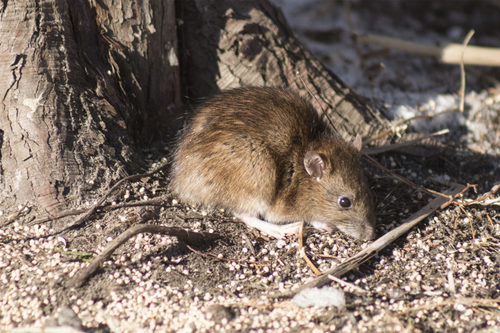
(c) Zane Roskoph, all rights reserved, uploaded by Zane Roskoph
Oryzomys
Sign in to saveOryzomys is a genus of semiaquatic rodents in the tribe Oryzomyini living in southern North America and far northern South America. It includes eight species, two of which—the marsh rice rat (O. palustris) of the United States and O. couesi of Mexico and Central America—are widespread; the six others have more restricted distributions. The species have had eventful taxonomic histories, and most species were at one time included in the marsh rice rat; additional species may be recognized in the future. The name Oryzomys was established in 1857 by Spencer Fullerton Baird for the marsh
Species
Northeastern Marsh Rice Rat
GENUS
- KingdomAnimalia
- PhylumChordata
- ClassMammalia
- OrderRodentia
- FamilyCricetidae
Rats du riz les rats du riz (Oryzomys) sont un genre de rongeurs de la famille des Cricétidés, vivant en Amérique du Nord, en Amérique centrale et au nord de l'Amérique du Sud et dont le plus connu des francophones est l'Oryzomys palustre (Oryzomys palustris). Dans la classification phylogénétique, ce genre fait partie de la tribu des Oryzomyini. Sommaire 1 Caractéristiques 2 Étymologie et nomenclature vernaculaire 2.1 Noms vernaculaires et espèces correspondantes 3 Classification 3.1 Liste d'espèces 4 Notes et références 5 Liens externes Caractéristiques Les deux espèces les plus courantes, Oryzomys couesi et Oryzomys palustris, sont des animaux nocturnes, des rats semi-aquatiques. Ils ont un pelage grossier, une longue queue, un dos brun et un ventre blanc. Ils se nourrissent de graines, de plantes et d'invertébrés. La longueur tête-corps est de 190 à 410 mm, la longueur de la queue est de 85 à 140 mm et le poids de 40 à 80 g. Ces deux espèces occupent la plupart du territoire du genre, avec O. palustris vivant dans une grande partie de l'est des États-Unis et O.couesi dans une grande partie de l'Amérique centrale et du Mexique, se prolongeant au Texas vers le nord et la Colombie
via GBIF
Museum specimens
- Specimen records
- 2,298
- With media
- 10
- Family
- Cricetidae
- Collections
- CM, IBUNAM, USNM, AMNH, MSB, MSU
- Recorded in
- United States, Mexico, French Guiana, Bolivia, Panama, Peru, Colombia, Ecuador
Wikidata facts
- Instance of
- taxon
- Parent taxon
- Sigmodontinae
- Image
- Oryzomys palustris in vegetation.jpg
Show 5 more facts
- taxon name
- Oryzomys
- Commons category
- Oryzomys
- taxon rank
- genus
- topic's main category
- Category:Oryzomys
- temporal range start
- Pleistocene
Sources (1)
via Wikidata · CC0
~34 min read
Encyclopedic overview
9 sectionsContents
- Taxonomy
- Circumscription
- Species
- Description
- Distribution, ecology, and behavior
- Human interactions
- Notes
- References
- Literature cited
Oryzomys is a genus of semiaquatic rodents in the tribe Oryzomyini living in southern North America and far northern South America. It includes eight species, two of which—the marsh rice rat (O. palustris) of the United States and O. couesi of Mexico and Central America—are widespread; the six others have more restricted distributions. The species have had eventful taxonomic histories, and most species were at one time included in the marsh rice rat; additional species may be recognized in the future. The name Oryzomys was established in 1857 by Spencer Fullerton Baird for the marsh rice rat and was soon applied to over a hundred species of American rodents. Subsequently, the genus gradually became more narrowly defined until its current contents were established in 2006, when ten new genera were established for species previously placed in Oryzomys.
Species of Oryzomys are medium-sized rats with long, coarse fur. The upperparts are gray to reddish and the underparts white to buff. The animals have broad feet with reduced or absent ungual tufts of hair around the claws and, in at least some species, with webbing between the toes. The rostrum (front part of the skull) is broad and the braincase is high. Both the marsh rice rat and O. couesi have 56 chromosomes, lack a gall bladder, and have a complex penis (as is characteristic of the Sigmodontinae) with some traits that are rare among oryzomyines; these characteristics are unknown in the other species of this genus.
Excerpted from Wikipedia’s “Oryzomys” article, available under the CC BY-SA 4.0 licence.
Gallery (6)
Available in 26 languages
- Español
- Français
- Deutsch
- 中文
- Русский
- Português
- Italiano
- العربية
- Bahasa Indonesia
- Basque
- Catalan
- Cebuano
- Egyptian Arabic
- Hungarian
- Kotava
- Lithuanian
- Nederlands
- Polski
via Wikidata sitelinks · CC0