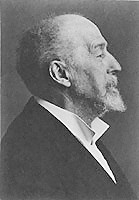
File:Otto_Wagner_photo2_retouched.jpg · Wikimedia Commons · See Wikimedia Commons
Otto Wagner
Sign in to saveAlso known as Otto Colomann Wagner, Otto Koloman Wagner
Austrian architect (1841-1918)
Otto Wagner was an influential Austrian architect who lived from 1841 to 1918 and played a key role in developing modern architecture at the turn of the 20th century. He matters because his innovative designs and ideas helped shape how buildings and cities were designed during a period of major architectural change.
AI-generated from the Wikipedia summary — may contain errors.
In the Vinony graph
Vinony's link graph records 211 inbound references to Otto Wagner, and connects out to Austrian Postal Savings Bank, Austria and Vienna.
It sits within the topics 1841 births, 1918 deaths and 19th-century Austrian architects.
Vinony links it to 51 Wikipedia language editions.
Key facts
- Born
- Otto Koloman Wagner , ( 1841-07-13 ) 13 July 1841, Vienna, Austrian Empire
- Died
- 11 April 1918 (1918-04-11) (aged 76), Vienna, Austria-Hungary
- Occupation
- Architect
- Buildings
- Nussdorf weir and lock , Karlsplatz Stadtbahn Station , Majolica House , Postal Office Savings Bank Building , Kirche am Steinhof
- Projects
- Wiener Stadtbahn
via Wikipedia infobox
Wikidata facts
- Instance of
- human
- Given name
- Otto
- Family name
- Wagner
- Gender
- male
- Citizenship
- Cisleithania
- Place of birth
- Penzing
- Place of death
- Vienna
- Occupation
- university teacher
- Educated at
- Akademisches Gymnasium
- Employer
- Academy of Fine Arts Vienna
- Languages spoken
- German
- Native language
- German
- Notable work
- Austrian Postal Savings Bank
- Movement
- Vienna Secession
- Image
- Otto Wagner (1841–1918).jpg
- Work location
- Budapest
Show 13 more facts
- Commons category
- Otto Wagner
- date of birth
- 1841-07-13
- date of death
- 1918-04-11
- Commons gallery
- Otto Wagner
- Commons Creator page
- Otto Wagner
- name in native language
- Otto Wagner
- birth name
- Otto Koloman Wagner
- cause of death
- 1918–1920 flu pandemic
- student
- Josef Hoffmann
- has works in the collection
- Stedelijk Museum Amsterdam
- described at URL
- arch-pavouk.cz/index.php/architekti/74-102-wagner-otto
- professorship
- professor
- manner of death
- natural causes
Sources (10)
via Wikidata · CC0
~24 min read
Encyclopedic overview
Otto Koloman Wagner ( German: [ˈɔto ˈkoːloman ˈvaːɡnɐ] ; 13 July 1841 – 11 April 1918) was an Austrian architect, furniture designer and urban planner. He was a leading member of the Vienna Secession movement of architecture, founded in 1897, and the broader Art Nouveau movement. Many of his works are found in his native city of Vienna, and illustrate the rapid evolution of architecture during the period. His early works were inspired by classical architecture. By mid-1890s, he had already designed several buildings in what became known as the Vienna Secession style. Beginning in 1898, with his designs of Vienna Metro stations, his style became floral and Art Nouveau, with decoration by Koloman Moser. His later works, 1906 until his death in 1918, had geometric forms and minimal ornament, more clearly expressing their modern structure and materials. Although they are considered predecessors to modern architecture they remain within the larger classical tradition of the Schinkel School in Germany and Central Europe.
Education and early career
Excerpted from Wikipedia’s “Otto Wagner” article, available under the CC BY-SA 4.0 licence.