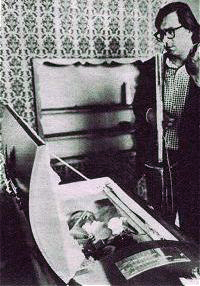
File:Féretro_Neruda.jpg · Wikimedia Commons · See Wikimedia Commons
Pablo Neruda
Sign in to saveAlso known as Nieh-lu-ta, Pamplo Nerouda, Neftalí Ricardo Reyes, Bāblū Nīrūdā, Neftalí Ricardo Reyes Basoalto, Nieluda, Neftali Ricardo Reyes Basoalto, Neftali Reyes Basualto
Chilean poet and politician (1904–1973)
OverviewAI-generated
Pablo Neruda, born Ricardo Eliécer Neftalí Reyes Basoalto on 12 July 1904 in Parral, Chile, was a poet, diplomat, politician, and lyricist. He wrote in Spanish and French, producing works in the genres of poetry and prose. His notable publications include *Sky stones*, *Altitud democrática de Chile*, and *Poesía política*. He was educated at the University of Chile and was a member of the Communist Party of Chile.
Neruda received the Nobel Prize in Literature, the National Prize for Literature (Chile), and the International Stalin Prize for Peace. He was also a member of the Modern Language Association, the Academy of Arts of the GDR, and the American Academy of Arts and Sciences. He died in Santiago on 23 September 1973.
Synthesized by Vinony from 43 facts across 7 sources: Wikidata, Open Library, MusicBrainz, Last.fm, TMDb, Nobel Prize, Vinony collections. Generated from structured data (not the Wikipedia text) and checked against those facts — may still contain errors.
Person · Open Library
- Born
- 12 July 1904
- Died
- 23 September 1973
- Works
- 638
Top works
- Sky stones
- Altitud democrática de Chile [por el] presidente de la nación, escritores y pueblo
- Prentice Hall Literature--World Masterpieces
- Para Albertina Rosa
- Poesía política
via Open Library + Wikidata
Film & TV
Linares, Maule, Chile
Pablo Neruda, pseudonym and later legal name of Ricardo Eliécer Neftalí Reyes Basoalto, was a Chilean poet and politician.
Known for
- Sara Facio: Having Been There — Material de archivo fotográfico2024
- Cantalao — Self (archive footage)2018
- Solitary Land — Self (archive footage)2017
- The Inconclusive Independence — Self (archive footage)2010
- Biografías — Self (archive footage)2002
- Neruda en el corazón — Self1993
- Memorial Train — Archive footage1975
- Venceremos, solidaridad — Self (archive footage)1973
- Langlois-Keaton à Paris — Self1962
- Ese desconocido — Himself1960
via TMDB
Music · MusicBrainz
- Type
- Person
- Gender
- Male
- Origin
- Chile
- Active from
- 1904
- Active to
- 1973
Discography
via MusicBrainz · CC0
Listeners · Last.fm
- Listeners
- 8,372
- Total plays
- 52,152
Tags
Similar artists
Pablo Neruda (Spanish: [ˈpaβ̞lo̞ ne̞ˈɾuð̞a]; July 12, 1904 – September 23, 1973) was the pen name and, later, legal name of the Chilean poet, diplomat, and politician Neftali Ricardo Reyes Basoalto. He chose his pen name after Czech poet Jan Neruda. In 1971 Neruda won the Nobel Prize for Literature. Neruda became known as a poet while still a teenager. He wrote in a variety of styles including surrealist poems, historical epics, overtly political manifestos <a href="https://www.last.fm/music/Pablo+Neruda">Read more on Last.fm</a>
Nobel Prize
- The Nobel Prize in Literature1971
“for a poetry that with the action of an elemental force brings alive a continent's destiny and dreams”
Wikidata facts
- Instance of
- human
- Given name
- Ricardo
- Gender
- male
- Citizenship
- Chile
- Place of birth
- Parral
- Place of death
- Santiago
- Spouse
- Matilde Urrutia
- Occupation
- writer
- Educated at
- University of Chile
- Political party
- Communist Party of Chile
- Languages spoken
- French
- Native language
- Spanish
- Religion
- atheism
- Field of work
- politics
- Genre
- prose
- Image
- Pablo Neruda 1963.jpg
- Political ideology
- communism
Show 18 more facts
- Commons category
- Pablo Neruda
- date of birth
- 1904-07-12
- date of death
- 1973-09-23
- Commons gallery
- Pablo Neruda
- topic's main category
- Category:Pablo Neruda
- pseudonym
- Pablo Neruda
- birth name
- Ricardo Eliécer Neftalí Reyes Basoalto
- nominated for
- Nobel Prize in Literature
- Commons Creator page
- Pablo Neruda
- name in native language
- Pablo Neruda
- start of work period
- 1922-00-00
- writing language
- Spanish
- influenced by
- Arthur Rimbaud
- interested in
- news
- on focus list of Wikimedia project
- Wikipedia:Vital articles/Level/4
- end of work period
- 1973-00-00
- has works in the collection
- Biblioteca Virtual Miguel de Cervantes
Sources (11)
via Wikidata · CC0
~40 min read
Encyclopedic overview
Pablo Neruda (/nəˈruːdə/ nə-ROO-də; Spanish: [ˈpaβlo neˈɾuða] ; born Ricardo Eliécer Neftalí Reyes Basoalto; 12 July 1904 – 23 September 1973) was a Chilean poet-diplomat and politician who won the 1971 Nobel Prize in Literature. Neruda became known as a poet when he was 13 years old and wrote in a variety of styles, including surrealist poems, historical epics, political manifestos, a prose autobiography, and passionate love poems such as the ones in his collection Twenty Love Poems and a Song of Despair (1924).
Neruda occupied many diplomatic positions in various countries during his lifetime and served a term as a senator for the Chilean Communist Party. When President Gabriel González Videla outlawed communism in Chile in 1948, a warrant was issued for Neruda's arrest. Friends hid him for months, and in 1949 he escaped through a mountain pass near Maihue Lake into Argentina; he would not return to Chile for more than three years. He was a close advisor to Chile's socialist president Salvador Allende; Neruda served as Chile's ambassador to France under his presidency. When he went back to Chile after accepting his Nobel Prize in Stockholm, Allende invited him to read at the Estadio Nacional before 70,000 people.
Excerpted from Wikipedia’s “Pablo Neruda” article, available under the CC BY-SA 4.0 licence.
Gallery (11)
Available in 128 languages
- Español
- Français
- Deutsch
- 中文
- 日本語
- Русский
- Português
- Italiano
- العربية
- हिन्दी
- Afrikaans
- Albanian
- Albanian
- Amharic
- Aragonese
- Armenian
- Assamese
- Asturian
Show 109 more
- Aymara
- azb
- Azerbaijani
- Bahasa Indonesia
- Bangla
- Banjar
- Bashkir
- Basque
- be_x_old
- Belarusian
- Bosnian
- Breton
- Bulgarian
- Catalan
- Cebuano
- Central Kurdish
- Croatian
- Czech
- Danish
- Egyptian Arabic
- Esperanto
- Estonian
- Extremaduran
- Filipino
- Finnish
- Galician
- Gan Chinese
- Georgian
- Greek
- Guarani
- Gujarati
- Hakka Chinese
- Hausa
- Hebrew
- Hungarian
- Icelandic
- Ido
- Iloko
- Irish
- Jamaican Creole English
- Javanese
- Kabyle
- Kannada
- Kazakh
- Kotava
- Kurdish
- Latin
- Latvian
- Lingala
- Lingua Franca Nova
- Lithuanian
- Lower Sorbian
- Luxembourgish
- Macedonian
- Madurese
- Malagasy
- Malay
- Malayalam
- Maltese
- Marathi
- Mazanderani
- Mingrelian
- Nederlands
- Northern Sami
- Norwegian
- Norwegian Nynorsk
- Occitan
- Pampanga
- Pashto
- Piedmontese
- Polski
- Punjabi
- Quechua
- Romanian
- Scots
- Scottish Gaelic
- Serbian
- Serbian (Latin)
- Sicilian
- simple
- Slovak
- Slovenian
- Svenska
- Swahili
- Tajik
- Tamil
- Tatar
- Telugu
- Tibetan
- Tiếng Việt
- Türkçe
- Ukrainian
- Upper Sorbian
- Urdu
- Uzbek
- Walloon
- Waray
- Welsh
- Western Frisian
- Western Mari
- Western Panjabi
- Wu Chinese
- Yoruba
- Zaza
- zh_min_nan
- zh_yue
- فارسی
- ไทย
- 한국어
via Wikidata sitelinks · CC0