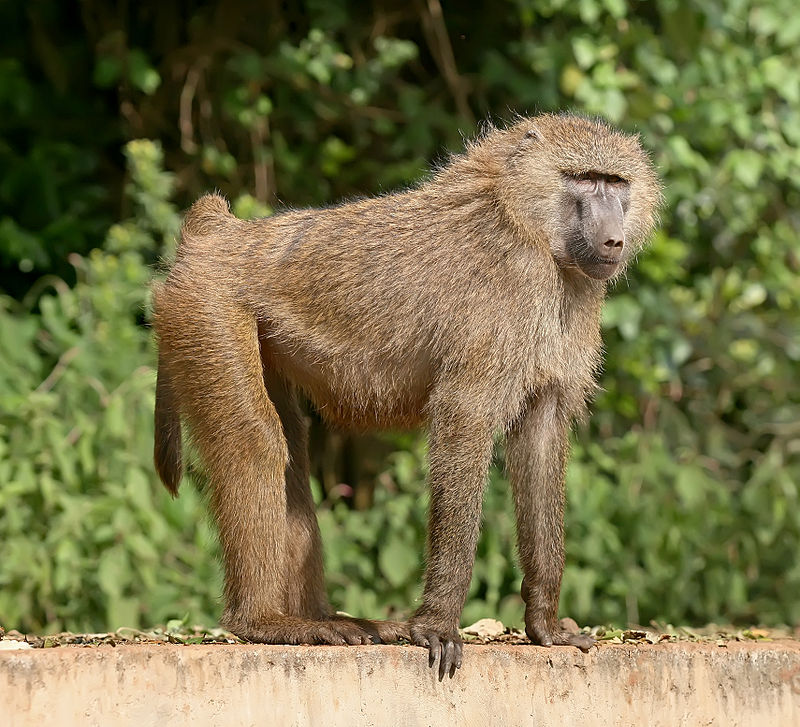
File:Olive_baboon_Ngorongoro.jpg · Wikimedia Commons · See Wikimedia Commons
Papio
Sign in to saveAlso known as baboons, baboon
Baboons are primates comprising the genus Papio, one of the 23 genera of Old World monkeys, in the family Cercopithecidae. There are six species of baboon: the hamadryas baboon, the Guinea baboon, the olive baboon, the yellow baboon, the Kinda baboon and the chacma baboon. Each species is native to one of six areas of Africa and the hamadryas baboon is also native to part of the Arabian Peninsula. Baboons are among the largest non-hominoid primates and have existed for at least two million years.
OverviewAI-generated
Papio is a genus of mammals within the family Cercopithecidae. It belongs to the kingdom Animalia, phylum Chordata, class Mammalia, and order Primates. The taxon was described by Erxleben in 1777. Its common name is Baboon. The group is part of the subfamily Cercopithecinae and the tribe Papionini.
Records of Papio have been documented in South Africa, Zimbabwe, Ethiopia, and Kenya. Institutions including UCMP, AMNH, USNM, and ROM hold these records. The genus has been referenced by 865 other encyclopedia articles. Descriptions appear in the Armenian Soviet Encyclopedia, Brockhaus and Efron Encyclopedic Dictionary, and the Encyclopædia Britannica 11th edition. The taxon originated about 2 million years ago.
Synthesized by Vinony from 34 facts across 7 sources: Wikidata, GBIF, iNaturalist, PubMed, Gbif Occ, iDigBio, Vinony graph. Generated from structured data (not the Wikipedia text) and checked against those facts — may still contain errors.
Species
Chacma Baboon
Papio
GENUS
- KingdomAnimalia
- PhylumChordata
- ClassMammalia
- OrderPrimates
- FamilyCercopithecidae
本條目介紹的是猴科動物。關於日本妖怪,請見“狒狒 (妖怪)”。 狒狒屬,猴科的一屬,是世界上體型僅次於山魈的猴,共分爲五種,都分佈于非洲地區。過去的分類法把獅尾狒以及山魈属也歸入狒狒屬,現在该两类动物已各自單獨列爲一屬。雄性凶猛,敢于和狮子对峙。属于杂食类,但也能捕获小型哺乳动物。 分类 關於狒狒屬的分類,歷來有不少爭議,這裡只列出五種狒狒: 阿拉伯狒狒 (Papio hamadryas) 幾内亞狒狒 (Papio papio) 東非狒狒 (Papio anubis) 草原狒狒 (Papio cynocephalus) 豚尾狒狒 (Papio ursinus) 取自“https://zh.wikipedia.org/w/index.php?title=狒狒屬&oldid=52724908” 分类: 獼猴亞科 狒狒屬 隐藏分类:物种微格式条目
via GBIF
Museum specimens
- Specimen records
- 386
- With media
- 17
- Family
- Cercopithecidae
- Collections
- UCMP, AMNH, USNM, ROM
- Recorded in
- South Africa, Zimbabwe, Ethiopia, Kenya
Research
13,305 papers- Myoclonia in Papio papio: are they all "epileptic"?ReviewNeural plasticity · 2000Naquet R, Valin ADOI: 10.1155/np.2000.43
- Papio Baboon Species Indicative Alu Elements.Genome biology and evolution · 2017Walker JA, Jordan VE, Steely CJ et al.DOI: 10.1093/gbe/evx130
- Parturition in baboons (PAPIO SPP.).Scientific reports · 2018Schlabritz-Loutsevitch N, Maher J, Sullivan R et al.DOI: 10.1038/s41598-018-19221-4
- Myoclonus in Papio papio.ReviewMovement disorders : official journal of the Movement Disorder Society · 1991Brailowsky SDOI: 10.1002/mds.870060203
- A missing piece of the Papio puzzle: Gorongosa baboon phenostructure and intrageneric relationships.Journal of human evolution · 2019Martinez FI, Capelli C, Ferreira da Silva MJ et al.DOI: 10.1016/j.jhevol.2019.01.007
- Hemochromatosis in Two Female Olive Baboons (Papio anubis).Comparative medicine · 2021Lamoureux LM, Coda KA, Halliday LCDOI: 10.30802/AALAS-CM-20-000070
- Osteosarcoma in Baboons (Papio spp).Comparative medicine · 2015Mezzles MJ, Dick EJ Jr, Owston MA et al.
- Categorization of vocal and nonvocal stimuli in Guinea baboons (Papio papio).American journal of primatology · 2022Ennaji FE, Fagot J, Belin PDOI: 10.1002/ajp.23387
via PubMed
Wikidata facts
Show 8 more facts
- taxon name
- Papio
- Commons category
- Papio
- taxon rank
- genus
- topic's main category
- Category:Baboons
- Commons gallery
- Papio
- taxon common name
- 人熊
- start time
- 2000000-00
- on focus list of Wikimedia project
- Wikipedia:Vital articles/Level/4
via Wikidata · CC0
~12 min read
Encyclopedic overview
16 sectionsContents
- Taxonomy
- Fossil record
- Characteristics
- Behavior and ecology
- Habitat and prey
- Predators
- Social systems
- Mating
- Birth, rearing young, and life expectancy
- Relationship with humans
- Diseases
- See also
- References
- Sources
- Further reading
- External links
Baboons are primates comprising the genus Papio, one of the 23 genera of Old World monkeys, in the family Cercopithecidae. There are six species of baboon: the hamadryas baboon, the Guinea baboon, the olive baboon, the yellow baboon, the Kinda baboon and the chacma baboon. Each species is native to one of six areas of Africa and the hamadryas baboon is also native to part of the Arabian Peninsula. Baboons are among the largest non-hominoid primates and have existed for at least two million years.
Baboons vary in size and weight depending on the species. The smallest, the Kinda baboon, is in length and weighs only , while the largest, the chacma baboon, is up to in length and weighs . All baboons have long, dog-like muzzles, heavy, powerful jaws with sharp canine teeth, close-set eyes, thick fur except on their muzzles, short tails, and nerveless, hairless pads of skin on their protruding buttocks called ischial callosities that provide for sitting comfort. Male hamadryas baboons have large white manes. Baboons exhibit sexual dimorphism in size, colour and/or canine teeth development.
Excerpted from Wikipedia’s “Papio” article, available under the CC BY-SA 4.0 licence.
Gallery (22)
Available in 97 languages
- Español
- Français
- Deutsch
- 中文
- 日本語
- Русский
- Português
- Italiano
- العربية
- हिन्दी
- Afrikaans
- Amharic
- Armenian
- Asturian
- Azerbaijani
- Bahasa Indonesia
- Balinese
- Bangla
Show 78 more
- Basque
- be_x_old
- Belarusian
- Bosnian
- Breton
- Bulgarian
- Catalan
- Cebuano
- Chuvash
- Cornish
- Croatian
- Czech
- Danish
- Egyptian Arabic
- Esperanto
- Estonian
- Filipino
- Finnish
- Galician
- Georgian
- Greek
- Hebrew
- Hungarian
- hyw
- Icelandic
- Ido
- Irish
- Kashmiri
- Kashubian
- Kazakh
- Kotava
- Kurdish
- Kyrgyz
- Latin
- Latvian
- lbe
- Lithuanian
- Malagasy
- Malay
- Manx
- Mari
- Navajo
- Nederlands
- Northern Frisian
- Norwegian
- Norwegian Nynorsk
- Odia
- Polski
- Punjabi
- Quechua
- Romanian
- Saterland Frisian
- Serbian
- Serbian (Latin)
- Shona
- simple
- Sindhi
- Slovenian
- Svenska
- Swahili
- Telugu
- Tibetan
- Tiếng Việt
- Türkçe
- Udmurt
- Ukrainian
- Urdu
- Uzbek
- Waray
- Western Mari
- Western Panjabi
- Wu Chinese
- Yoruba
- zh_yue
- Zulu
- فارسی
- ไทย
- 한국어
via Wikidata sitelinks · CC0