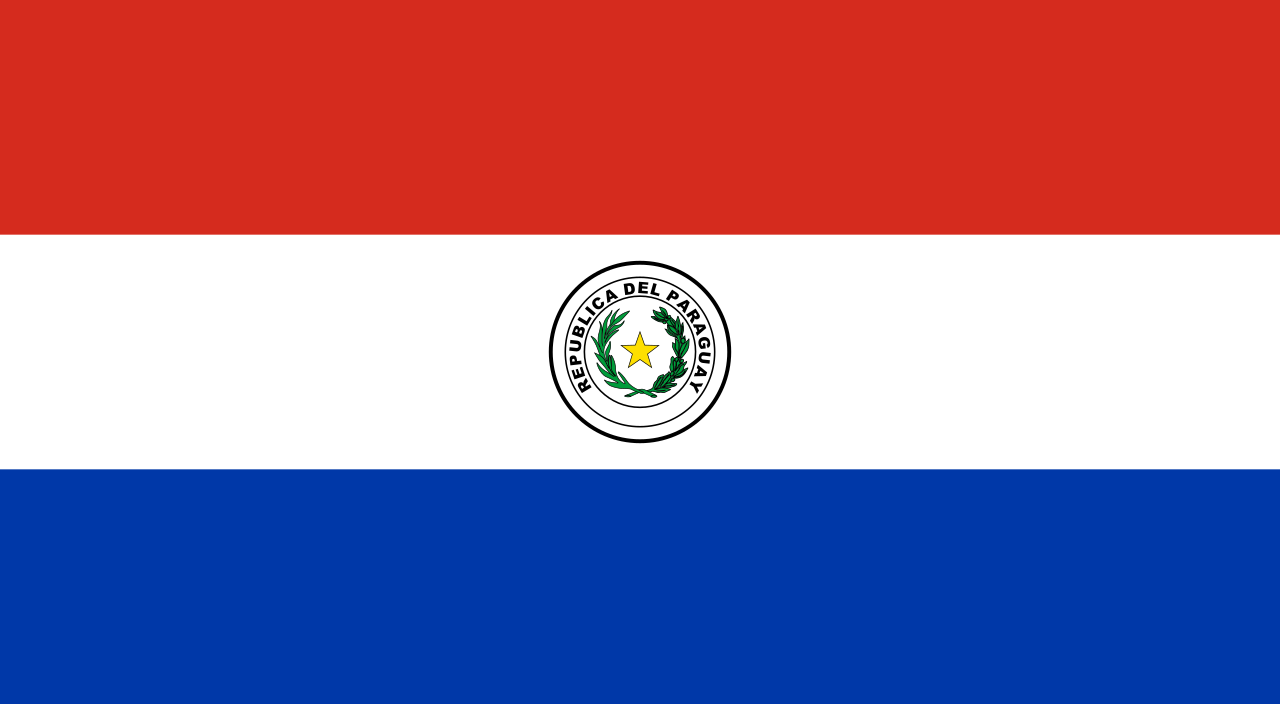
Paraguay
Sign in to saveAlso known as Republic of Paraguay, Heart of South America
Paraguay (), officially the Republic of Paraguay, is a landlocked country located in the central region of South America. It borders Bolivia to the northwest and north, Brazil to the northeast and east, and Argentina to the southeast, south, and west. Paraguay has access to the Atlantic Ocean via the Paraná–Paraguay Waterway. The country is governed as a unitary presidential republic composed of a capital district and seventeen departments. Its capital and largest city is Asunción.
OverviewAI-generated
Paraguay is a landlocked republic in South America. Its capital is Asunción. The country shares borders with Argentina, Bolivia, and Brazil. The official languages are Spanish and Guarani. The head of state is Santiago Peña Palacios. The currency is the Paraguayan guaraní, and the top-level Internet domain is .py.
The Republic of Paraguay has a population of 6,109,644. The area is 406,752. The highest point is Cerro Tres Kandú. The country contains the Alto Paraguay Department, Alto Paraná Department, Amambay Department, and Capital District. It is a member of the United Nations, Union of South American Nations, and World Trade Organization. The inception date is 1811-01-01.
Synthesized by Vinony from 68 facts across 9 sources: Wikidata, REST Countries, Open Meteo, Openweathermap, World Bank, OpenStreetMap, PubMed, Vinony graph, Geo. Generated from structured data (not the Wikipedia text) and checked against those facts — may still contain errors.
In the Vinony graph
Paraguay is indexed among the 215 entries in Vinony's Countries collection.
Vinony's link graph records 20,984 inbound references to Paraguay, and connects out to Argentina, Asunción and cassava.
The entry is geolocated on the map in city, across 6 mapped points.
It sits within the topics 1811 establishments in South America, Countries and territories where Spanish is an official language and Countries in South America.
Weather now
cached 12h ago7-day forecast
via Open-Meteo
Country

- Capital
- Asunción
- Population
- 6,109,644
- Region
- Americas · South America
- Demonym
- Paraguayan
- Currencies
- PYG (₲)
- Languages
- Guaraní, Spanish
- Calling code
- +595
- Drives on
- Right
- Gini
- 45.7 (2019)
- FIFA code
- PAR
- TLD
- .py
- Timezones
- UTC-04:00
- Borders
- ARG, BOL, BRA
via REST Countries
Indicators · World Bank
- GDP
- $44.5B(2024)
- Population
- 6,929,153(2024)
- Life expectancy
- 74 yrs(2024)
- Unemployment
- 4.8 %(2025)
- Urban population
- 69.9 %(2024)
- Internet users
- 81.6 %(2024)
- Forest area
- 38.5 %(2023)
- Renewable energy
- 58.8 %(2021)
via World Bank Open Data · CC BY 4.0
Place details
- Locality
- Pinasco
- Region
- Presidente Hayes
- Country
- Paraguay / Paraguái
via OpenStreetMap · GeoNames
Wikipedia views (30d)
85,689 totalvia Wikimedia Pageviews API
Key facts
- Country.conventional_long_name
- Republic of Paraguay
- Country.common_name
- Paraguay
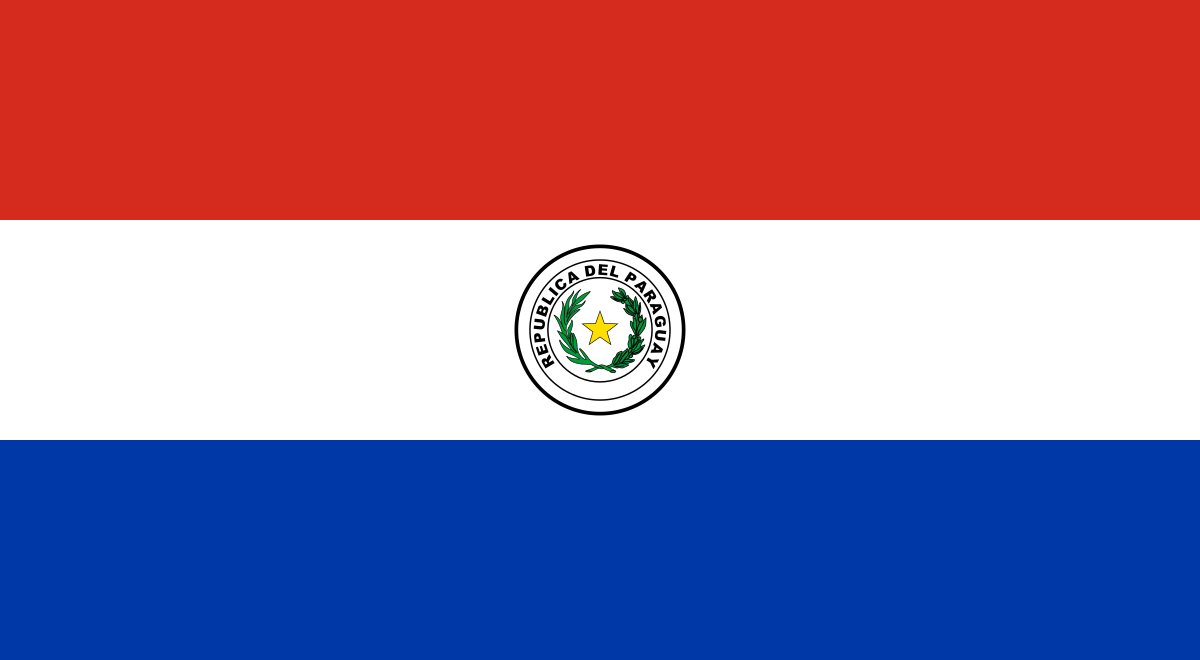
- Country.image_flag
- Flag of Paraguay.svg
- Country.image_coat
- Coat of arms of Paraguay.svg
- Country.image_map
- PRY orthographic.svg
- Country.national_motto
- "Peace and justice"
- Country.national_anthem
- "Paraguayan National Anthem"
- Country.languages_type
- Official languages
- Country.demonym
- Paraguayan
- Country.capital
- Asunción
- Country.largest_city
- Asunción
- Country.religion_year
- 2020
- Country.government_type
- Unitary presidential republic
- Country.leader_title1
- President
- Country.leader_name1
- Santiago Peña
- Country.leader_title2
- Vice President
- Country.leader_name2
- Pedro Alliana
- Country.leader_title3
- President of the Senate
via Wikipedia infobox
Research
5,956 papers- The burden of zoonoses in Paraguay: A systematic review.PLoS neglected tropical diseases · 2021Noguera Zayas LP, Rüegg S, Torgerson PDOI: 10.1371/journal.pntd.0009909
- Paraguay.Department of State publication. Background notes series · 1987United States. Department of State. Bureau of Public Affairs
- Kidney disease in Paraguay.ReviewKidney international. Supplement · 2005Santa Cruz F, Cabrera W, Barreto S et al.DOI: 10.1111/j.1523-1755.2005.09720.x
- Amid Paraguay Chikungunya Outbreak, Vaccine Candidate Safe, Immunogenic.JAMA · 2023Harris EDOI: 10.1001/jama.2023.10738
- [Dengue economic impact in Paraguay].Revista chilena de infectologia : organo oficial de la Sociedad Chilena de Infectologia · 2020Cuellar CM, Lovera D, Merlo O et al.DOI: 10.4067/S0716-10182020000400356
- Are the neglected tropical diseases under control in the tri-border region between Brazil, Argentina, and Paraguay?Journal of infection in developing countries · 2022Mendes Oliveira F, Arcêncio R, Moraes Arcoverde MA et al.DOI: 10.3855/jidc.13613
- High Burden of Dengue and Chikungunya Virus in Paraguay: Seroprevalence Findings From Blood Donors.Journal of medical virology · 2025Flichman DM, Marquez N, Pereson MJ et al.DOI: 10.1002/jmv.70388
- High HIV prevalence among transgender women in Paraguay.International journal of STD & AIDS · 2020Aguilar G, Samudio T, Lopez G et al.DOI: 10.1177/0956462420945550
via PubMed
Wikidata facts
- Instance of
- sovereign state
- Part of
- Southern Cone
- Named after
- Paraguay River
- Official name
- République du Paraguay
- Demonym
- Paraguach
- Country
- Paraguay
- Contains
- San Pedro Department
- Continent
- South America
- Capital
- Asunción
- Official language
- Spanish
- Population
- 6811297
- Area
- 406756
- Time zone
- UTC−03:00
- Head of government
- Santiago Peña Palacios
- Head of state
- Santiago Peña Palacios
- Legislature
- Congress of Paraguay
- Shares border with
- Brazil
- Highest point
- Cerro Tres Kandú
- Official website
- www.paraguay.gov.py
- Life expectancy
- 70
- Nominal GDP
- 41722295362
- Unemployment rate
- 4
- Calling code
- +595
Show 62 more facts
- Licence plate code
- PY
- Electrical plug type
- Europlug
- Mains voltage
- 220
- Motto
- Heddwch a Chyfiawnder
- Flag
- flag of Paraguay
- Coat of arms
- coat of arms of Paraguay
- topic's main Wikimedia portal
- Portal:Paraguay
- top-level Internet domain
- .py
- Commons category
- Paraguay
- topic's main category
- Category:Paraguay
- Commons gallery
- Paraguay
- inception
- 1811-01-01
- category for people who died here
- Category:Deaths in Paraguay
- category for people born here
- Category:Births in Paraguay
- category for films shot at this location
- Category:Films shot in Paraguay
- category of associated people
- Category:Paraguayan people
- diplomatic relation
- European Union
- history of topic
- history of Paraguay
- IPA transcription
- pɑɾɑˈɡuɑɪ
- lowest point
- Paraguay River
- mobile country code
- 744
- driving side
- right
- geography of topic
- Geography of Paraguay
- emergency phone number
- 911
- age of majority
- 18
- trunk prefix
- 0
- marriageable age
- 20
- office held by head of government
- President of Paraguay
- number of out-of-school children
- 287226
- office held by head of state
- President of Paraguay
- total fertility rate
- 2.542
- maritime identification digits
- 755
- native label
- Paraguái Tavakuairetã
- Unicode character
- 🇵🇾
- central bank
- Central Bank of Paraguay
- language used
- Ava Guarani
- GS1 country code
- 784
- culture
- culture of Paraguay
- VAT rate
- 10
- BTI Status Index
- 6.29
- BTI Governance Index
- 5.77
- economy of topic
- economy of Paraguay
- demographics of topic
- demographics of Paraguay
- Democracy Index
- 5.86
- Human Development Index
- 0.717
- P11012
- Mundaneum
- hashtag
- Paraguay
- on focus list of Wikimedia project
- Wikipedia:Vital articles/Level/4
- Happy Planet Index score
- 47.6
- Gini coefficient
- 43.5
- Inequality-adjusted Human Development Index
- 0.582
- P12749
- Pedro Montt
- birth rate
- 20.328
- male population
- 3402132
- death rate
- 7.437
- rural population
- 2521216
- female population
- 3378612
- urban population
- 4259528
- located in/on physical feature
- South America
- most populous urban area
- Asunción
Sources (15)
via Wikidata · CC0
Travel guide
Understand
Paraguay is often overlooked as a travel destination, even though it has been experiencing a steady increase in tourist arrivals. The majority of tourists visiting Paraguay in 2022 came from neighbouring Argentina, accounting for 76% of all visitors. Brazilians often come over to Paraguayan border towns to shop for imported goods.
Although the country is one of South America's breadbaskets, Paraguay has historically not been a wealthy country; a quarter of the population lives below the poverty line and there's an incredibly wide gap between the rich and the poor. Decades of political instability, as well as a young and largely unskilled work force have stunted prospects of growth and development.
Most Paraguayans, save the upper class, may not have a lot of material wealth and possessions, but they strive to be happy and content with what they have. Tranquility (known as tranquilo pa) is one value Paraguayans cherish the most. Nature is the heart and soul of most Paraguayans; they find absolute solace and contentment in it.
A major producer of beef, so do not be surprised to find cattle eating grass just a few centimetres from the highways, especially in the Chaco region and Misiones Department. Paraguay is the world's fifth largest exporter of soya beans, so expect to see hundreds of square kilometres of soya plantations especially in the southeast, east and northeast regions.
Get in
thumb|right|375px|Visa policy of Paraguay
thumb|Inside Silvio Petrossi International Airport thumb|Port of Asunción thumb|Donkey meets bus in Concepción
Get around
thumb|Taxi in Asunción thumb|Asunción by night thumb|Road junction in Filadelfia, with the "Faith, Unity and Labor" monument
See
thumb|The Itaipu Dam The capital Asunción hosts a large part of the country's sights. In Trinidad you can see Paraguay's only UNESCO World Heritage Site; the Jesuit Missions of La Santisima Trinidad de Paraná and Jesus de Tavarangue. There is a well in the city of Santani (San Pedro) that does not go dry. The local museum also contains a large snakeskin. The Itaipu dam near Ciudad del Este which is the largest hydroelectric dam in the world, measured by generated power. Contrary to the Brazilian side, all tours to the dam are free, just some require early registration. Also in Ciudad del Este (actually in Presidente Franco just south), you can find the impressive Salto Del Monday waterfall, and while not as large as the nearby Iguazu Falls, but definitely worth a visit. Encarnación is a laid-back city with the beautiful San Jose (river) Beach and a relaxing promenade where you can just hang around for a couple of days and enjoy the local bar culture. The Catedral Virgen de Caacupé in Caacupé is a beautiful church with a tower viewpoint not far from Asunción. The Iglesia San Buenaventura de Yaguarón (or Templo de San Buenaventure) in Yaguarón inhibits impressive baroque wood carvings inside a rather unconventional, although typical for this region, church (closed Mondays).
Do
thumb|Asunción Contrary to Argentina and Bolivia, national parks and historical sites run by the government are generally free or cheap: the three Jesuit sites near Trinidad, for instance, are just €4. On the other hand, some parks are run privately and demand steep entrance and accommodation prices, like the Mbaracayú Forest Nature Reserve. However, they might cater more specifically for tourists with the intention to deliver "results" and could be worth it.
Eat
thumb|Sopa Paraguaya thumb|Chipa
Paraguayan food is one of the most diverse in South America. Paraguayans usually enjoy typical food several times a week all year round. You'll find much of the standard South American cuisine here with some Brazilian influence as well. Paraguayan food isn't particularly spicy, so those who can't tolerate spices won't have problems here.
Paraguay has a tradition for beef which is normally good quality and cheap. Grilled meat (asado) is the thing to eat. Pasta is also popular as are the street stalls selling panchos (hot-dogs), hamburgers, empanadas and similar fast-food. Vegetables, salad and other types of meat are not that common but available. In restaurants you normally get manioc as a side dish for free (similar to bread in other countries).
Sleep
Good accommodation will certainly not be hard to find in major towns, and will seem reasonably cheap if the parameter is the dollar or the euro. Prices for cheap and decent accommodation range from GS.40,000 (in/near Asunción and Conceptión) to GS.60,000 (in Encarnación).
The exception, however, is Ciudad del Este. In Ciuded del Este the cheapest accommodation is near the bus station with doubles for less than €10, in an area that is also pleasant in the evening. Cheaper accommodation is easy to find, but if you're after something of higher quality, then you'll have better chances in Foz do Iguaçu (Brazil), just a short bus ride (R$5.50 or GS.8,000) across the bridge, or in Puerto Iguazu (Argentina). However, Brazil is easier regarding immigration, not requiring people to have a stamp if just visiting for a day and thus not checking the buses that enter or leave Brazil. This option is not available with Argentina, and this crossing is also considerably more time-consuming.
Stay safe
thumb|Ciudad del Este street scene Generally speaking, Paraguay is a safe country.
There are not many large cities and if you use some common sense and street smarts, you are unlikely to run into any trouble. The police are known to be corrupt, and if you are pulled over for any reason, you will almost certainly be expected to pay a bribe. In Asunción most cops are not corrupt. In the cities crime is common, though not as rampant as in other cities such as Rio de Janeiro, São Paulo and Buenos Aires.
Ciudad del Este is a hotspot for illicit activities, such as money laundering and counterfeiting, but that should not affect your travels. That said, you will want to keep an eye on your bags and wallet here, as you would do in any other large city. Generally, as long as you aren't involved in drug smuggling (inadvertently or otherwise), and are alert to pickpockets, you should be safe most of the time.
Southern regions of Paraguay is part of the South America Tornado Corridor, the second most tornado-prone area in the world (behind the United States Tornado Alley). Monitor local media notices and if you see that the sky is dark, the light take on a greenish-yellow cast or a loud sound that sounds like a freight train, this could be an indication of a tornado. Find shelter immediately. Refer to the tornado safety article for analysis of the issues here.
Stay healthy
Hospitals in Paraguay range from decent to unsanitary and unequipped. If you get desperately ill, try to get to the best hospital even if it takes a bit longer: you may not find surgical gloves in the worst of them. There are many stray dogs running the streets - avoid them. They usually won't bother you.
Respect
thumb|Carneval in Encarnación In general, Paraguayans are friendly, polite, and soft-spoken people. Since Paraguay is one of the least visited countries in South America, you're likely to attract attention from very curious people.
Travel guide from Wikivoyage (CC BY-SA 4.0)
~40 min read
Encyclopedic overview
37 sectionsContents
- Etymology
- History
- Pre-colonial era
- Colonial era
- Independence and rule of Rodríguez de Francia
- Rule of the López family
- Paraguayan War (1864–1870)
- 20th century
- Stroessner era, 1954–1989
- Stroessner's overthrow, post-1989
- Election of Fernando Lugo
- Present day
- Geography
- Climate
- Fauna
- Government and politics
- Administrative divisions
- Military
- Economy
- Agriculture
- Industry and manufacturing
- Social issues of the indigenous
- Transportation
- Energy
- Demographics
- Largest cities
- Languages
- Religion
- Education
- Health
- Culture
- Media
- Sports
- See also
- Notes
- References
- External links
Paraguay (Guarani: Paraguái), officially the Republic of Paraguay, is a landlocked country located in the central region of South America. It borders Bolivia to the northwest and north, Brazil to the northeast and east, and Argentina to the southeast, south, and west. Paraguay has access to the Atlantic Ocean via the Paraná–Paraguay Waterway. The country is governed as a unitary presidential republic composed of a capital district and seventeen departments. Its capital and largest city is Asunción.
The indigenous Guaraní had been living in eastern Paraguay for at least a millennium before the arrival of Spanish conquistadores in 1524. The city of Asunción was founded in 1537 as the first capital of the Governorate of the Río de la Plata within the Spanish Empire. During the 17th century, Paraguay was the center of Jesuit missions, where the natives were converted to Christianity and introduced to European culture. After the expulsion of the Jesuits from Spanish territories in 1767, Paraguay increasingly became a peripheral colony.
Excerpted from Wikipedia’s “Paraguay” article, available under the CC BY-SA 4.0 licence.
Gallery (59)
On the map
6 mapped locations
Available in 255 languages
- Español
- Français
- Deutsch
- 中文
- 日本語
- Русский
- Português
- Italiano
- العربية
- हिन्दी
- Abkhazian
- Achinese
- Adyghe
- Afrikaans
- Albanian
- Albanian
- Amharic
- ami
Show 236 more
- Angika
- Aragonese
- Armenian
- Arpitan
- Asturian
- Awadhi
- Aymara
- azb
- Azerbaijani
- Bahasa Indonesia
- Balinese
- Bangla
- Bashkir
- Basque
- bat_smg
- Batak Toba
- Bavarian
- be_x_old
- Belarusian
- Betawi
- Bhojpuri
- Bikol
- Bishnupriya
- Bislama
- Bosnian
- Breton
- Bulgarian
- Buriat
- Burmese
- Catalan
- cbk_zam
- cdo
- Cebuano
- Central Kurdish
- Chechen
- Chuvash
- Cornish
- Corsican
- Crimean Tatar
- Croatian
- Czech
- Danish
- Divehi
- dty
- Dzongkha
- Egyptian Arabic
- Esperanto
- Estonian
- Ewe
- Extremaduran
- Faroese
- Fiji Hindi
- Fijian
- Filipino
- Finnish
- fiu_vro
- Fula
- Gagauz
- Galician
- Ganda
- gcr
- Georgian
- Gilaki
- Goan Konkani
- Gothic
- Greek
- Guarani
- Gujarati
- Haitian Creole
- Hakka Chinese
- Hausa
- Hawaiian
- Hebrew
- Hungarian
- Icelandic
- Ido
- Igbo
- Iloko
- Inari Sami
- Interlingua
- Interlingue
- Irish
- Jamaican Creole English
- Javanese
- Kabyle
- Kannada
- Kanuri
- Kara-Kalpak
- Karachay-Balkar
- Kashubian
- Kazakh
- kbp
- Kinyarwanda
- Kongo
- Kotava
- Kurdish
- Kyrgyz
- Ladino
- Lao
- Latgalian
- Latin
- Latvian
- Lezghian
- Ligurian
- Limburgish
- Lingala
- Lingua Franca Nova
- Lithuanian
- lld
- Lojban
- Lombard
- Low German
- Lower Sorbian
- Luxembourgish
- Macedonian
- Madurese
- Maithili
- Malagasy
- Malay
- Malayalam
- Maltese
- Manipuri
- Manx
- Māori
- map_bms
- Marathi
- Mari
- Mazanderani
- Minangkabau
- Mingrelian
- Mirandese
- Moksha
- Mongolian
- Moroccan Arabic
- nds_nl
- Neapolitan
- Nederlands
- Nepali
- Newari
- Northern Frisian
- Northern Sami
- Norwegian
- Norwegian Nynorsk
- Novial
- Nyanja
- Occitan
- Old English
- olo
- Oromo
- Ossetic
- Pampanga
- Pangasinan
- Papiamento
- Pashto
- Pennsylvania German
- Picard
- Piedmontese
- Polski
- Punjabi
- Quechua
- rki
- Romanian
- Romansh
- Romany
- Rusyn
- Samoan
- Sanskrit
- Santali
- Sardinian
- Saterland Frisian
- Scots
- Scottish Gaelic
- Serbian
- Serbian (Latin)
- Shan
- Shona
- Sicilian
- Silesian
- simple
- Sindhi
- Sinhala
- Slovak
- Slovenian
- Somali
- Sundanese
- Svenska
- Swahili
- szy
- Tajik
- Talysh
- Tamil
- Taroko
- Tatar
- tay
- Telugu
- Tetum
- Tibetan
- Tiếng Việt
- Tigrinya
- Tok Pisin
- Toki Pona
- Tongan
- Tumbuka
- Türkçe
- Turkmen
- Udmurt
- Ukrainian
- Upper Sorbian
- Urdu
- Uyghur
- Uzbek
- Venetian
- Veps
- Volapük
- Walloon
- Waray
- Welsh
- West Flemish
- Western Frisian
- Western Mari
- Western Panjabi
- Wolof
- Wu Chinese
- Xhosa
- Yakut
- Yiddish
- Yoruba
- Zaza
- Zeelandic
- zh_classical
- zh_min_nan
- zh_yue
- Zhuang
- فارسی
- ไทย
- 한국어
via Wikidata sitelinks · CC0