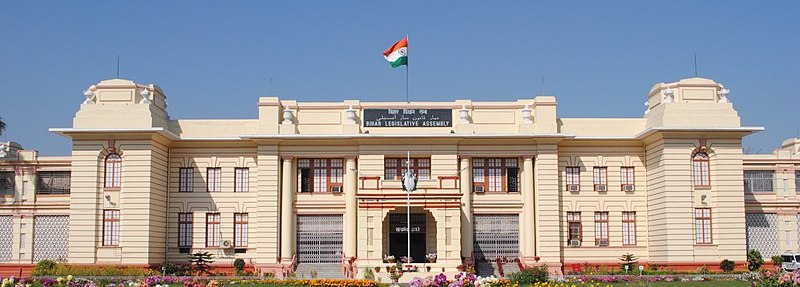
File:Vidhan-sabha-bihar.jpg · Wikimedia Commons · See Wikimedia Commons
Patna
Sign in to saveAlso known as Pataliputra, Batana, Patan, Pātaliputta, Pataliputta, Pātaliputra, Patnā
Patna (), historically known as Pāṭaliputra, is the capital and largest city of the Indian state of Bihar. According to the United Nations, as of 2018, Patna had a population of 2.35 million, making it the 19th largest city in India. Covering and over 2.5 million people, its urban agglomeration is the 18th largest in India. Patna also serves as the seat of Patna High Court. The Buddhist, Hindu and Jain pilgrimage centres of Vaishali, Rajgir, Nalanda, Bodh Gaya and Pawapuri are nearby and Patna City is a sacred city for Sikhs as the tenth Sikh Guru, Guru Gobind Singh was born here. The mod
OverviewAI-generated
Patna is a big city in India, located in the Patna district of Bihar. It serves as the capital of Bihar, the Patna district, and the Patna division. The city lies near the Ganges river at coordinates 25.61, 85.141388888889. Its elevation is recorded as 58 meters above sea level. The native labels for the place include पटना, Pataliputra, Pataligrama, and Kusumapura.
The population of Patna is listed as 1684222. The official languages are Hindi, Magahi, Bhojpuri, and Maithili. Residents are known as Patnaites or पटनबासी. The city covers an area of 99.45 square kilometers. Its postal code is 800001 and the local dialing code is 612. Patna is described in sources such as the Armenian Soviet Encyclopedia and the Encyclopædia Britannica 11th edition.
Synthesized by Vinony from 51 facts across 7 sources: Wikidata, Open Meteo, Openweathermap, OpenStreetMap, GeoNames, Vinony graph, Geo. Generated from structured data (not the Wikipedia text) and checked against those facts — may still contain errors.
Weather now
7-day forecast
via Open-Meteo
Place details
- Locality
- Patna
- Region
- Bihar
- Country
- India
- Population
- 1,684,297
- Timezone
- Asia/Kolkata
via OpenStreetMap · GeoNames
Key facts
- Settlement.name
- Patna
- Settlement.native_name
- Paṭanā
- Settlement.settlement_type
- Metropolis, State capital city
- Settlement.pushpin_map
- India Patna#Bihar#India
- Settlement.pushpin_label_position
- left
- Settlement.pushpin_relief
- yes
- Settlement.pushpin_map_caption
- Location in Patna##Location in Bihar##Location in India
- Settlement.subdivision_type
- Country
- Settlement.subdivision_type1
- State
- Settlement.subdivision_type2
- Division
- Settlement.subdivision_type3
- District
- Settlement.subdivision_name1
- Bihar
- Settlement.subdivision_name2
- Patna
- Settlement.subdivision_name3
- Patna
- Settlement.established_title
- Established
- Settlement.established_date
- 490 BCE
- Settlement.founder
- Udayin
- Settlement.government_type
- Municipal corporation
via Wikipedia infobox
Wikidata facts
- Official name
- پٹنہ
- Demonym
- Patnaite
- Country
- India
- Located in
- Bengal Presidency
- Official language
- Maithili
- Population
- 1684222
- Area
- 99.45
- Elevation
- 58
- Body of water
- Ganges
- Capital of
- Patna division
- Founded by
- Ajatashatru
- Official website
- patna.nic.in
- Image
- Aerial view, Patna (314731093).jpg
- Dialing code
- 612
Show 11 more facts
- topic's main category
- Category:Patna
- category for people born here
- Category:Births in Patna
- category for people who died here
- Category:Deaths in Patna
- Commons gallery
- पटना
- described by source
- Encyclopædia Britannica 11th edition
- category of associated people
- Category:People from Patna
- postal code
- 800001
- native label
- Kusumapura
- Commons category
- Patna
- replaces
- Pataliputra
- P12749
- Jablan
Sources (11)
via Wikidata · CC0
Travel guide
Understand
thumbnail|The Patna Museum The ancient name of Patna was "Pataliputra" and it was the capital of the Maurya and Gupta empires. With a glorious period of history spanning a thousand years (500 BCE–400 CE), Pataliputra is where India's first major kingdoms rose and fell.
Patna is on three sacred rivers, the Ganges, the Sone and the Poonpun. Legend has it that a sanctified Ganga had watched with reverence as a hallowed Buddha blessed this place to be a realm of great Kings and their Empires. Belonging to the blue family of cities with a royal heritage, it is the land where the greatest emperors of India walked, and where the greatest saints chose to preach. Guru Gobind Singh, the 10th Sikh Guru was born here. For anyone with a taste for history and religion, this place flies high.
Ajastshatru, second of the Magadh Kings, built a fort at Pataligram on the banks of the Ganges river. This later became the famous Mauryan metropolis of Pataliputra and was ruled by Chandragupta Maurya, his son Bindusara and his grandson Asoka, acclaimed for the spread of Buddhism across India. Following the fall of the Maurya Empire, the next powerful empire to have its capital in Pataliputra was the Gupta Empire, which reached its zenith under the rule of Chandra Gupta I (not to be confused with Chandragupta Maurya), his son Samudra Gupta and his grandson Chandra Gupta II. Other emperors who ruled from Pataliputra were the Pala Kings, Shershah Suri (16th century) and Azimush-Shan (18th century), th…
Get around
There are a few car rental companies available in Patna. But foreign travellers who have not driven in India may find driving the roads in Patna and Bihar a bit stressful due to the poor road conditions and the constant heavy traffic, although the road conditions have improved.
See
right|thumb|Mahatma Gandhi Setu. right|thumb|Giraffe at the Patna Zoo.
Do
You can go on excursions to the various religious and historical places in and around Patna. Do not miss a boat ride on the mighty Ganges river. When in Patna, try food typical to the region such as pua-pittha, tilkut, chiwra, makhana, the famed sattu or the farmer's staple, litti chokha, and the famous paan.
Revolving Restaurant Patna can now boast of a revolving restaurant, the biggest of its kind in the country, situated atop the tallest tower in the city on the 18th floor of Biscomaun Bhawan near Gandhi Maidan. Based on the German technique, the 5HP motor that revolves the restaurant can be fixed to take one revolution in 45, 60 or 90 minutes. Take a boat-ride in the Ganges., near Gandhi ghat
Buy
Madhubani Paintings can be bought from emporiums at Mauyra Lok, a shopping center located on "Dak- Bunglow" road. You can visit many malls around Frazer road/Dak Bunglow Crossing such as Vishal Mega Mart, Maurya Lok Complex and Patna Market on Ashok Rajpath, Hathwa Market, Bari Path & Alankar Palace and other shopping arcades near Boring Road Crossing
Relatively new malls include Patna Central Mall and P&M Mall Patliputra Kurji Road, Patliputra.
Eat
thumbnail|Pudina chicken pulao or chicken rice with curd, Patna style
Drink
Sattu-pani is among the popular drinks, lassi made of curd, dry fruits & sugar.
Country Club International, Patliputra Colony Mamta Anarkali, near Dak Bunglow Crossing Mamta Residency, near Dak Bunglow Crossing Oasis, Boring Road The Purple Lounge, SP Verma Road The Velocity, near Dak Bunglow Crossing
Sleep
Patna is a growing business city, and as such hotels tend to be overpriced for the room provided. It also means that many hotels are full most nights, giving little incentive to improve facilities.
Stay safe
There have been reports that British citizens are being discriminated against in Patna. Hotel staff may claim to have no vacancy whenever they see a guest with British passport, and direct you to the most expensive hotels in the city instead.
Patna has one of the highest rates of murder and abduction in India. While incidents typically involve local residents rather than travellers, it's still wise to remain vigilant and avoid unnecessary conflicts or confrontations.
Go next
Bodh Gaya, - The place where Buddha achieved enlightenment Buddhist Bodh circuit: Bodhgaya - Nalanda - Rajgir - Patna - Vaishali - Kesaria. Deo - City of the Sun Temple. Deoghar - A town containing a famous Babadham temple. It is 200 km from Patna By Railway (drop at Jasidih Junction on Patna Howrah Main Line) in Jharkhand State Nalanda - Location of an ancient university with a nearby museum. Pawapuri - The Place of Nirvana (Bhagwan Mahabir) - A holy site for the Jains. Kesariya - Perhaps the oldest Shanti Stupa, it is situated in East Champaran District (Motihari), 170 km from Patna. Munger - A small town on the bank of Ganga famous for Yoga. Nepal and Raxaul - Buses are available to Raxaul and Jogbani at the Nepali border, where you can hop on a bus to Kathmandu and Pokhra. These buses leave at about 07:00 from the Mithapur bus stop 3 km south of the train station. They don't leave at night during summer (tourist off season). The roads going north out of town are particularly bad - sit as far forward in the bus as you can! Rajgir - The place Vishwa Shanti Shutpa you can joy on Areial Ropeway, You can enjoy Venuvana (Beautiful Garden) Ranchi Vaishali - A town on Bank of Ganga famous for its banana, Buddhist temple and handicrafts
Travel guide from Wikivoyage (CC BY-SA 4.0)
~55 min read
Encyclopedic overview
40 sectionsContents
- Etymology
- History
- Ancient Era
- Mauryan Empire
- Gupta and Pala empire
- Mughal Empire
- Portuguese Empire
- British Empire
- Indian Independence Movement
- Post-Independence
- Geography
- Topography
- Climate
- Air pollution
- Economy
- Demographics
- Religion and language
- Administration
- Blocks
- Government
- Civic administration
- Municipal finance
- Politics
- Utility services
- Transport
- Roads
- Air transport
- Railways
- Metro
- Culture
- Tourism
- Education
- Sports
- Media
- Private FM stations
- Notable people
- See also
- References
- Further reading
- External links
Patna (), historically known as Pāṭaliputra, is the capital and largest city of the Indian state of Bihar. According to the United Nations, as of 2018, Patna had a population of 2.35 million, making it the 19th largest city in India. Covering and over 2.5 million people, its urban agglomeration is the 18th largest in India. Patna also serves as the seat of Patna High Court. The Buddhist, Hindu and Jain pilgrimage centres of Vaishali, Rajgir, Nalanda, Bodh Gaya and Pawapuri are nearby and Patna City is a sacred city for Sikhs as the tenth Sikh Guru, Guru Gobind Singh was born here. The modern city of Patna is mainly on the southern bank of the river Ganges. The city also straddles the rivers Son, Gandak and Punpun. The city is approximately in length and wide.
One of the oldest continuously inhabited places in the world, Patna was founded in 490 BCE by the king of Magadha. Ancient Patna, known as Pataliputra, was the capital of the Magadha Empire throughout the Haryanka, Nanda, Mauryan, Shunga, Gupta, and Pala dynasties. Pataliputra was a seat of learning and fine arts. It was home to many astronomers and scholars including Aryabhata, Vātsyāyana and Chanakya. During the Maurya period (around 300 BCE) its population was about 400,000. Patna served as the seat of power, and political and cultural centre of the Indian subcontinent during the Maurya and Gupta empires. With the fall of the Gupta Empire, Patna lost its glory. The British revived it again in the 17th century as a centre of international trade. Following the partition of Bengal presidency in 1912, Patna became the capital of Bihar and Orissa Province.
Excerpted from Wikipedia’s “Patna” article, available under the CC BY-SA 4.0 licence.
Gallery (32)
On the map
2 mapped locations
Available in 107 languages
- Español
- Français
- Deutsch
- 中文
- 日本語
- Русский
- Português
- Italiano
- العربية
- हिन्दी
- Afrikaans
- Akan
- Albanian
- Aragonese
- Armenian
- Assamese
- Awadhi
- Azerbaijani
Show 88 more
- Bahasa Indonesia
- Bangla
- Basque
- Belarusian
- Bhojpuri
- Bishnupriya
- Breton
- Bulgarian
- Buriat
- Burmese
- Catalan
- Cebuano
- Chechen
- Czech
- Danish
- dty
- Egyptian Arabic
- Esperanto
- Estonian
- Fiji Hindi
- Filipino
- Finnish
- Georgian
- Greek
- Gujarati
- Haitian Creole
- Hausa
- Hebrew
- Hungarian
- Interlingue
- Kannada
- kge
- Kyrgyz
- Latin
- Latvian
- Lithuanian
- lld
- Maithili
- Malagasy
- Malay
- Malayalam
- Marathi
- Mazanderani
- Mingrelian
- Nederlands
- Nepali
- Newari
- Northern Frisian
- Norwegian
- Norwegian Nynorsk
- Occitan
- Odia
- Ossetic
- Pampanga
- Pashto
- Polski
- Punjabi
- Romanian
- Sanskrit
- Santali
- Serbian
- Serbian (Latin)
- simple
- Sindhi
- Sinhala
- Slovak
- Svenska
- Swahili
- Tajik
- Talysh
- Tamil
- Tatar
- Telugu
- Tiếng Việt
- Türkçe
- Ukrainian
- Urdu
- Uyghur
- Uzbek
- Waray
- Welsh
- Western Panjabi
- Wu Chinese
- zh_min_nan
- zh_yue
- فارسی
- ไทย
- 한국어
via Wikidata sitelinks · CC0