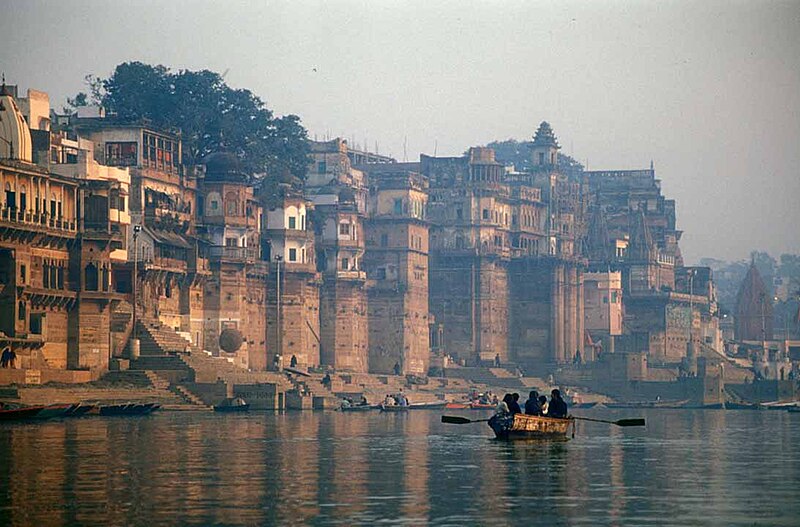
File:Varanasiganga.jpg · Wikimedia Commons · See Wikimedia Commons
Ganges
Sign in to saveAlso known as Ganga, Ganges River, River Ganges, Ganga Nadi
The Ganges ( ; in India: Ganga, ; in Bangladesh: Padma, ) is a trans-boundary river of Asia which flows through India and Bangladesh.The Ganga is the National River of India.The river rises in the western Himalayas in the Indian state of Uttarakhand. It flows south and east through the Gangetic plain of North India, receiving the right-bank tributary, the Yamuna, which also rises in the western Indian Himalayas, and several left-bank tributaries from Nepal that account for the bulk of its flow. In West Bengal, India, a feeder canal taking off from its right bank diverts 50% of its flow southwa
The Ganges is a major river that flows through India and Bangladesh, originating in the western Himalayas and traveling through North India's plains while collecting water from numerous tributaries along the way. It holds deep significance as India's National River and plays a crucial role in the region's geography and water systems.
AI-generated from the Wikipedia summary — may contain errors.
Key facts
- River.subdivision_name5
- Uttarakhand: Rishikesh & Haridwar Uttar Pradesh: Bijnor, Garhmukteshwar, Anupshahr, Farrukhabad, Fatehgarh, Kannauj, Kanpur, Fatehpur, Kunda, Prayagraj, Mirzapur, Varanasi, Mughalsarai, Ghazipur & Ballia Bihar: Chausa, Buxar, Chhapra, Danapur, Patna, Hajipur, Barh, Mokama, Begusarai, Munger, Sultanganj, Bhagalpur & Manihari Jharkhand: Sahibganj West Bengal: Murshidabad, Palashi, Nabadwip, Shantipur, Kolkata, Serampore, Chinsurah, Baranagar, Diamond Harbour, Haldia, Budge Budge, Howrah, Uluberia & Barrackpore Rajshahi Division: Rajshahi, Pabna, Ishwardi Khulna Division: Kushtia, Shilaidaha Dhaka Division: Dhaka, Narayanganj, Gazipur, Munshiganj, Faridpur Chittagong Division: Chandpur, Noakhali Barisal Division: Bhola
- River.discharge3_location
- Farakka Barrage
- River.discharge2_location
- Ganges Delta, Bay of Bengal
- River.discharge2_avg
- (Ganges without Brahmaputra and Meghna)
- River.source1
- Confluence at Devprayag, Uttarakhand of the Alaknanda river (the source stream in hydrology because of its greater length) and the Bhagirathi river (the source stream in Hindu tradition). The headwaters of the river include: Mandakini, Nandakini, Pindar and the Dhauliganga, all tributaries of the Alaknanda.
- River.source1_location
- Devprayag, the beginning of the main stem of the Ganges
- River.mouth
- Bay of Bengal
- River.mouth_location
- Ganges Delta
- River.tributaries_left
- Ramganga, Garra, Gomti, Tamsa Ghaghara, Gandak, Burhi Gandak, Koshi, Mahananda
- River.tributaries_right
- Yamuna, Tamsa (also known as Tons River), Karamnasa, Sone, Punpun, Falgu, Kiul, Chandan, Ajay, Damodar, Rupnarayan
- River.mapframe
- yes
- River.discharge1_location
- Mouth of the Ganges
- River.discharge1_avg
- Total runoff into the Bay of Bengal (Period: 1921–1985) (Period: 1990–2020) (dry period 38,129 m³/s, wet period 53,170 m³/s;)
- River.name
- Ganges (Ganga)
- River.name_etymology
- Ganga (goddess)
- River.image
- Varanasiganga.jpg
- River.image_size
- 300px
- River.image_caption
- The Ganges in Varanasi
via Wikipedia infobox
Wikidata facts
- Named after
- Gangā
- Country
- India
- Continent
- Asia
- Elevation
- 9
- Image
- View of Ghats across the Ganges, Varanasi.jpg
- Length
- 2525
Show 12 more facts
- mouth of the watercourse
- Bay of Bengal
- Commons category
- Ganges River
- topic's main category
- Category:Ganges
- category for the water basin
- Category:Ganges basin
- described by source
- Pauly–Wissowa
- watershed area
- 1060000
- discharge
- 12000
- origin of the watercourse
- Gangotri Glacier
- drainage basin
- Ganges Basin
- on focus list of Wikimedia project
- Wikipedia:Vital articles/Level/4
- basin country
- India
- different from
- Ganges
via Wikidata · CC0
~71 min read
Encyclopedic overview
36 sectionsContents
- Course
- Geology
- Hydrology
- Discharge
- History
- Bronze and Iron Age (c. 3300 – 200 BCE)
- Classical and Medieval Age (200 BCE – 1500 CE)
- Modern Age (1500 – Present)
- Religious and cultural significance
- Embodiment of sacredness
- ''Avatarana'' – Descent of Ganges
- Redemption of the Dead
- The Purifying Ganges
- Consort, Shakti, and Mother
- Ganges in classical Indian iconography
- Kumbh Mela
- Irrigation
- Canals
- Dams and barrages
- Economy
- Tourism
- Ecology and environment
- Fish
- Crocodilians and turtles
- Ganges river dolphin
- Effects of climate change
- Pollution and environmental concerns
- Water shortages
- Mining
- In art and literature
- See also
- Notes
- References
- Sources
- Further reading
- External links
The Ganges ( ; in India: Ganga, ; in Bangladesh: Padma, ) is a trans-boundary river of Asia which flows through India and Bangladesh.The Ganga is the National River of India.The river rises in the western Himalayas in the Indian state of Uttarakhand. It flows south and east through the Gangetic plain of North India, receiving the right-bank tributary, the Yamuna, which also rises in the western Indian Himalayas, and several left-bank tributaries from Nepal that account for the bulk of its flow. In West Bengal, India, a feeder canal taking off from its right bank diverts 50% of its flow southwards, artificially connecting it to the Hooghly River. The Ganges continues into Bangladesh, its name changing to the Padma. It is then joined by the Jamuna, the lower stream of the Brahmaputra, and eventually the Meghna, forming the major estuary of the Ganges Delta, and emptying into the Bay of Bengal. The Ganges–Brahmaputra–Meghna system is the second-largest river on earth by discharge.
The main stem of the Ganges begins at the town of Devprayag, at the confluence of the Alaknanda, which is the source stream in hydrology on account of its greater length, and the Bhagirathi, which is considered the source stream in Hindu mythology.
Excerpted from Wikipedia’s “Ganges” article, available under the CC BY-SA 4.0 licence.
Gallery (52)
On the map
Available in 169 languages
- Español
- Français
- Deutsch
- 中文
- 日本語
- Русский
- Português
- Italiano
- العربية
- हिन्दी
- abstract
- Afrikaans
- Albanian
- Albanian
- Amharic
- Angika
- Aragonese
- Armenian
Show 150 more
- Assamese
- Asturian
- Awadhi
- azb
- Azerbaijani
- Bahasa Indonesia
- Balinese
- Bangla
- Bashkir
- Basque
- bat_smg
- Bavarian
- be_x_old
- Belarusian
- Bhojpuri
- Bikol
- Bosnian
- Breton
- Bulgarian
- Buriat
- Burmese
- Catalan
- cdo
- Cebuano
- Central Kurdish
- Chechen
- Chuvash
- Cornish
- Corsican
- Crimean Tatar
- Croatian
- Czech
- Danish
- Divehi
- Egyptian Arabic
- Esperanto
- Estonian
- Extremaduran
- Fiji Hindi
- Filipino
- Finnish
- Galician
- Georgian
- Gorontalo
- Greek
- Guarani
- Gujarati
- Hebrew
- Hungarian
- Icelandic
- Ido
- Iloko
- Ingush
- Interlingua
- Irish
- Javanese
- Kabardian
- Kannada
- Kara-Kalpak
- Karachay-Balkar
- Kazakh
- kbp
- kge
- Khmer
- Kurdish
- Kyrgyz
- Lao
- Latin
- Latvian
- Lezghian
- Limburgish
- Lingua Franca Nova
- Lithuanian
- Lombard
- Low German
- Luxembourgish
- Macedonian
- Maithili
- Malagasy
- Malay
- Malayalam
- Manipuri
- Marathi
- Mazanderani
- Mingrelian
- Mongolian
- Nederlands
- Nepali
- Newari
- Northern Frisian
- Norwegian
- Norwegian Nynorsk
- Nyanja
- Occitan
- Odia
- Old English
- Ossetic
- Pashto
- Piedmontese
- Polski
- Punjabi
- roa_tara
- Romanian
- Rusyn
- Sanskrit
- Santali
- Serbian
- Serbian (Latin)
- Sicilian
- simple
- Sindhi
- Sinhala
- skr
- Slovak
- Slovenian
- Svenska
- Swahili
- szy
- Tajik
- Talysh
- Tamil
- Tatar
- Telugu
- Tibetan
- Tiếng Việt
- Tulu
- Türkçe
- Turkmen
- Ukrainian
- Upper Sorbian
- Urdu
- Uyghur
- Uzbek
- Venetian
- Veps
- Volapük
- Waray
- Welsh
- Western Frisian
- Western Panjabi
- Wu Chinese
- Yakut
- Yiddish
- Zaza
- zh_classical
- zh_min_nan
- zh_yue
- فارسی
- ไทย
- 한국어
via Wikidata sitelinks · CC0