File:Pellagra2.jpg · Wikimedia Commons · See Wikimedia Commons
pellagra
Sign in to saveAlso known as Niacin deficiency, Niacin-tryptophan deficiency, Pellagra (disorder)
I don't see any context provided in your message. Could you please share the context about pellagra that you'd like me to base the overview on? Once you provide it, I'll write a 2-sentence, plain-language overview for you.
AI-generated from the Wikipedia summary — may contain errors.
Key facts
- Medical condition (new).name
- Pellagra
- Medical condition (new).image
- Pellagra2.jpg
- Medical condition (new).caption
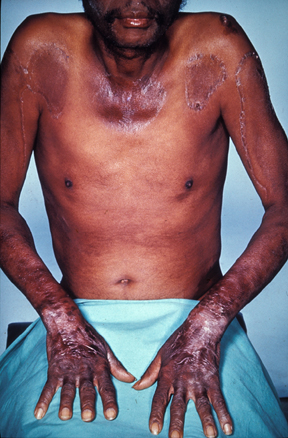
- The skin features of pellagra including peeling, redness, scaling, and thickening of sun-exposed areas.
- Medical condition (new).field
- Dermatology
- Medical condition (new).symptoms
- Inflammation of the skin, diarrhea, dementia, sores in the mouth
- Medical condition (new).types
- Primary, secondary
- Medical condition (new).causes
- Not enough niacin
- Medical condition (new).diagnosis
- Based on symptoms
- Medical condition (new).differential
- Kwashiorkor, pemphigus, photodermatitis, porphyria
- Medical condition (new).prevention
- Consuming Niacin
- Medical condition (new).treatment
- Nicotinic acid or nicotinamide supplementation.
- Medical condition (new).prognosis
- Good (with treatment), death in ~ 5 years (without treatment)
- Medical condition (new).frequency
- Rare (developed world), relatively common (developing world)
via Wikipedia infobox
Research
1,729 papersvia PubMed
Wikidata facts
- Subclass of
- nutritional deficiency disease
- Image
- Pellagra NIH.jpg
Show 8 more facts
- on focus list of Wikimedia project
- WikiProject Medicine
- health specialty
- endocrinology
- symptoms and signs
- diarrhea
- drug or therapy used for treatment
- niacinamide
- exact match
- www.orpha.net/ORDO/Orphanet_97352
- ICD-9-CM
- 265.2
- Commons category
- Pellagra
- ICPC 2 ID
- T91
Sources (6)
via Wikidata · CC0
~20 min read
Encyclopedic overview
12 sectionsContents
- Etymology
- Signs and symptoms
- Pathophysiology
- Treatment
- Epidemiology
- History
- United States
- Corn processing
- In popular culture
- References
- Further reading
- External links
Pellagra is a disease caused by a lack of the vitamin niacin (vitamin B3). Symptoms include inflamed skin, diarrhea, dementia, and sores in the mouth. Areas of the skin exposed to friction and radiation are typically affected first. Over time, affected skin may become darker, stiffen, peel, or bleed.
The two main types of pellagra are primary and secondary. Primary pellagra is due to a diet that does not contain enough niacin and tryptophan. Secondary pellagra is due to a poor ability to use the niacin within the diet. This can occur as a result of alcoholism, long-term diarrhea, carcinoid syndrome, Hartnup disease, and a number of medications such as isoniazid. Diagnosis is typically based on symptoms and may be assisted by urine testing.
Excerpted from Wikipedia’s “pellagra” article, available under the CC BY-SA 4.0 licence.