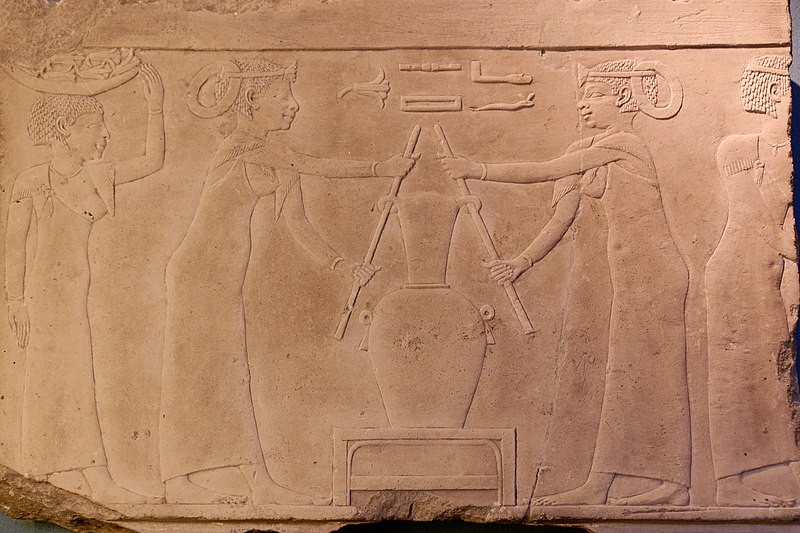
File:Lily_perfume_Louvre_E11162.jpg · Wikimedia Commons · See Wikimedia Commons
perfume
Sign in to saveAlso known as parfum, fragrance
Perfume (, ) is a mixture of fragrant essential oils or aroma compounds (fragrances), fixatives and solvents, usually in liquid form, used to give the human body, animals, food, objects, and living-spaces an agreeable scent. Perfumes can be defined as substances that emit and diffuse a pleasant and fragrant odor. They consist of artificial mixtures of aromatic chemicals and essential oils. The 1939 Nobel Laureate for Chemistry, Leopold Ružička stated in 1945 that "right from the earliest days of scientific chemistry up to the present time, perfumes have substantially contributed to the develop
Perfume is a liquid mixture of fragrant oils, chemicals, and solvents designed to add pleasant scents to people, animals, objects, and spaces. It matters because these aromatic substances have played a significant role in the development of chemistry as a scientific field.
AI-generated from the Wikipedia summary — may contain errors.
Research
5,583 papers- Perfume and Flavor Engineering: A Chemical Engineering Perspective.ReviewMolecules (Basel, Switzerland) · 2021Rodrigues AE, Nogueira I, Faria RPVDOI: 10.3390/molecules26113095
- Review on perfume and present status of its associated allergens.ReviewJournal of cosmetic dermatology · 2021Kumar M, Devi A, Sharma M et al.DOI: 10.1111/jocd.13507
- Age-dependent perfume development in male orchid bees, Euglossa imperialis.The Journal of experimental biology · 2024Henske J, Eltz TDOI: 10.1242/jeb.246995
- Frequency of perfume in 398 children's cosmetics.Jornal de pediatria · 2024Uber M, Morgan MAP, Schneider MC et al.DOI: 10.1016/j.jped.2023.11.002
- Perfume allergy.Journal of the American Academy of Dermatology · 1981Rapaport MDOI: 10.1016/s0190-9622(81)80100-4
- Perfume, perfume everywhere.Environmental science & technology · 2007Booth B
- Bullous impetigo-like irritant contact dermatitis caused by perfume.Pediatric dermatology · 2022Zhong LS, Huang BQ, Tang WT et al.DOI: 10.1111/pde.14918
- [Perfume allergy is not only a luxury problem].Ugeskrift for laeger · 1999Andersen KE
via PubMed
Wikidata facts
- Image
- Perfume set from Sovjetunio cca 1965.jpg
- Has use
- hiding
Show 9 more facts
- Commons category
- Perfumes
- Commons gallery
- Perfume
- exact match
- wordnet-rdf.princeton.edu/wn30/03916031-n
- topic has template
- Template:Infobox fragrance
- different from
- body odor
- topic's main category
- Category:Perfumes
- P8168
- Rec 3: Genesis
- on focus list of Wikimedia project
- Wikipedia:Vital articles/Level/4
- studied by
- perfumery
via Wikidata · CC0
~61 min read
Encyclopedic overview
41 sectionsContents
- History
- Dilution classes and terminologies
- Imprecise terminology
- History of the terms and concentrations
- Solvent types
- Applying fragrances
- Describing a perfume
- Fragrance notes
- Olfactive families
- Traditional categories
- Modern
- Fragrance wheel
- Aromatics sources
- Plant sources
- Animal sources
- Other natural sources
- Synthetic sources
- Characteristics
- Obtaining natural odorants
- Fragrant extracts
- Composing perfumes
- The perfumer
- Technique
- Basic framework
- Fragrance bases
- Reverse engineering
- Copyright
- Numbered perfumery, "analogs"
- Health and environmental issues
- Immunological; asthma and allergy
- Carcinogenicity
- Environmental
- Pollution
- Species endangerment
- Safety regulations
- Preserving perfume
- Lists of perfumes
- See also
- References
- Further reading
- External links
Perfume (, ) is a mixture of fragrant essential oils or aroma compounds (fragrances), fixatives and solvents, usually in liquid form, used to give the human body, animals, food, objects, and living-spaces an agreeable scent. Perfumes can be defined as substances that emit and diffuse a pleasant and fragrant odor. They consist of artificial mixtures of aromatic chemicals and essential oils. The 1939 Nobel Laureate for Chemistry, Leopold Ružička stated in 1945 that "right from the earliest days of scientific chemistry up to the present time, perfumes have substantially contributed to the development of organic chemistry as regards methods, systematic classification, and theory."
Ancient texts and archaeological excavations show the use of perfumes in some of the earliest human civilizations. Modern perfumery began in the late 19th century with the commercial synthesis of aroma compounds such as vanillin and coumarin, which allowed for the composition of perfumes with smells previously unattainable solely from natural aromatics.
Excerpted from Wikipedia’s “perfume” article, available under the CC BY-SA 4.0 licence.
Gallery (52)
Available in 100 languages
- Español
- Français
- Deutsch
- 中文
- 日本語
- Русский
- Português
- Italiano
- العربية
- हिन्दी
- Afrikaans
- Albanian
- Albanian
- Aragonese
- Armenian
- Asturian
- Azerbaijani
- Bahasa Indonesia
Show 81 more
- Bangla
- Basque
- Bikol
- Bosnian
- Bulgarian
- Burmese
- Catalan
- Central Kurdish
- Croatian
- Czech
- Danish
- Egyptian Arabic
- eml
- Esperanto
- Estonian
- Extremaduran
- Fiji Hindi
- Filipino
- Finnish
- Georgian
- Greek
- Haitian Creole
- Hausa
- Hebrew
- Hungarian
- hyw
- Icelandic
- Ido
- Interlingua
- Irish
- Javanese
- Kannada
- Kazakh
- Kurdish
- Kyrgyz
- Latin
- Latvian
- Lithuanian
- Macedonian
- Malay
- Malayalam
- Minangkabau
- Nederlands
- Nepali
- Norwegian
- Norwegian Nynorsk
- Occitan
- Odia
- Polski
- Punjabi
- Romanian
- Serbian
- Serbian (Latin)
- Sicilian
- simple
- Sinhala
- Slovak
- Slovenian
- Somali
- Sundanese
- Svenska
- Swahili
- Tajik
- Telugu
- Tiếng Việt
- Türkçe
- Ukrainian
- Urdu
- Uzbek
- Waray
- Welsh
- Western Panjabi
- Wu Chinese
- Yiddish
- Zaza
- zh_min_nan
- zh_yue
- Zulu
- فارسی
- ไทย
- 한국어
via Wikidata sitelinks · CC0