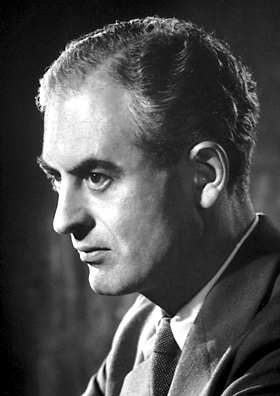
File:Peter_Brian_Medawar.jpg · Wikimedia Commons · See Wikimedia Commons
Peter Medawar
Sign in to saveAlso known as P.B. Medawar, P. B. Medawar, Sir Peter Medawar, Sir Peter Brian Medawar
English-brazilian biologist (1915–1987)
Peter Medawar was an English-Brazilian biologist who lived from 1915 to 1987 and made important contributions to the field of biology. His work helped advance our understanding of biological processes and earned him recognition as a significant scientific figure of the twentieth century.
AI-generated from the Wikipedia summary — may contain errors.
Nobel Prize
- The Nobel Prize in Physiology or Medicine1960
“for discovery of acquired immunological tolerance”
Shared · 1/2 portion
Wikidata facts
- Instance of
- human
- Given name
- Peter
- Gender
- male
- Citizenship
- United States
- Place of birth
- Petrópolis
- Place of death
- London
- Spouse
- Jean Medawar
- Occupation
- researcher
- Educated at
- University of Oxford
- Employer
- University of Birmingham
- Languages spoken
- English language
- Religion
- atheism
- Award
- Order of Merit
- Doctoral student
- Avrion Mitchison
- Field of work
- zoology
- Image
- Peter Brian Medawar.jpg
Show 10 more facts
- member of
- National Academy of Sciences
- date of birth
- 1915-02-28
- date of death
- 1987-10-02
- Commons category
- Peter Medawar
- described by source
- The Times
- honorific prefix
- Sir
- has written for
- The New York Review of Books
- name in native language
- Peter Brian Medawar
- archives at
- Wellcome Library
- interested in
- immunology
Sources (12)
via Wikidata · CC0
~24 min read
Encyclopedic overview
Sir Peter Brian Medawar OM CH CBE FRS (/ˈmɛdəwər/; 28 February 1915 – 2 October 1987) was a Brazilian-born biologist and writer of Lebanese-British descent who, from a succession of research and teaching posts (Oxford through the Royal Institution), and senior U.K. biomedical leadership positions (MRC and RPMC), contributed seminal discoveries in immunology, including one honored by a Nobel Prize to him and Australian Mac Burnet in 1960. Medawar's works on the discovery of acquired immune tolerance, and on graft rejection, have been fundamental to the medical practice of tissue and organ transplants. For his scientific work, he has been termed the "father of transplantation". He is remembered, as well, for his wit, both in person and in his popular writings. Richard Dawkins referred to him as "the wittiest of all scientific writers"; Stephen Jay Gould as "the cleverest man I have ever known".
Medawar was the child of a Lebanese father and a British mother, ther youngest child, and both a Brazilian and British citizen by birth. He prepared for university admission at a public secondary school, Marlborough College, about which he had ill feelings generally, but was positive with regard to his biology teacher, Ashley Gordon Lowndes. He then pursued his university training in zoology under John Young at Magdalen College, Oxford; after a scholarship and fellowship there, he went on to hold named professorial positions in zoology at the University of Birmingham and University College London. Until he was partially disabled by a cerebral infarction, he was Director of the National Institute for Medical Research (at Mill Hill).
Excerpted from Wikipedia’s “Peter Medawar” article, available under the CC BY-SA 4.0 licence.