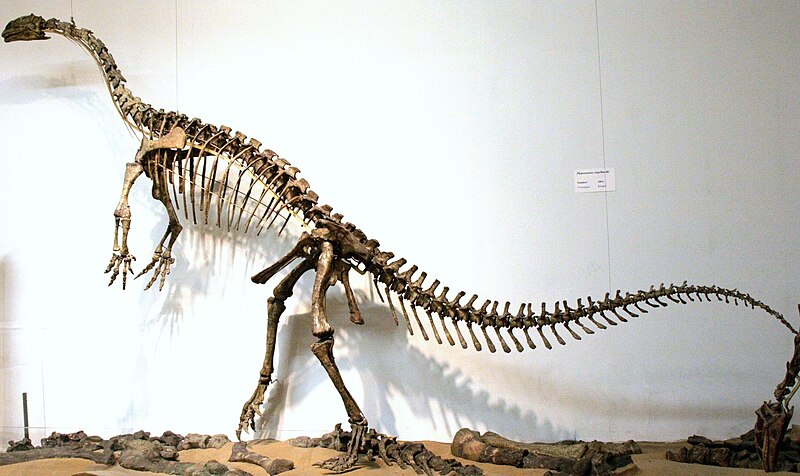
File:Plateosaurus_Skelett_2.jpg · Wikimedia Commons · See Wikimedia Commons
Plateosaurus
Sign in to saveAlso known as Sellosaurus, Dimodosaurus
Plateosaurus (probably meaning "broad lizard", often mistranslated as "flat lizard") is a genus of plateosaurid dinosaur that lived during the Late Triassic epoch of the Triassic period, around 214 to 204 million years ago, in what is now Central and Northern Europe. Plateosaurus is a basal (early) sauropodomorph dinosaur, a so-called "prosauropod". The type species is Plateosaurus trossingensis; before 2019, that honor was given to Plateosaurus engelhardti, but it was ruled as undiagnostic (i.e. indistinguishable from other dinosaurs) by the ICZN. Currently, there are three valid species; in
Wikidata facts
- Parent taxon
- Plateosauridae
- Image
- Plateo Leiden.JPG
- Length
- 7.0
Show 10 more facts
- taxon name
- Plateosaurus
- Commons category
- Plateosaurus
- taxon rank
- genus
- Commons gallery
- Plateosaurus
- taxon common name
- 板龍
- start time
- 214000000-
- end time
- 204000000-
- time period
- Late Triassic
- location of discovery
- France
- main food source
- herbivore
Sources (2)
via Wikidata · CC0
~39 min read
Encyclopedic overview
17 sectionsContents
- Discovery and history
- Etymology
- Valid species
- Description
- Classification
- Distribution
- Palaeobiology
- Posture and gait
- Palaeoecology
- Palaeopathology
- Life history and metabolism
- Taphonomy
- Earlier interpretations
- Mud-miring trap
- Notes
- References
- External links
Plateosaurus (probably meaning "broad lizard", often mistranslated as "flat lizard") is a genus of plateosaurid dinosaur that lived during the Late Triassic epoch of the Triassic period, around 214 to 204 million years ago, in what is now Central and Northern Europe. Plateosaurus is a basal (early) sauropodomorph dinosaur, a so-called "prosauropod". The type species is Plateosaurus trossingensis; before 2019, that honor was given to Plateosaurus engelhardti, but it was ruled as undiagnostic (i.e. indistinguishable from other dinosaurs) by the ICZN. Currently, there are three valid species; in addition to P. trossingensis, P. longiceps and P. gracilis are also known. However, others have been assigned in the past, and there is no broad consensus on the species taxonomy of plateosaurid dinosaurs. Similarly, there are a plethora of synonyms (invalid duplicate names) at the genus level.
Discovered in 1834 by Johann Friedrich Engelhardt and described three years later by Hermann von Meyer, Plateosaurus was the fifth named dinosaur genus that is still considered valid. Although it had been described before Richard Owen formally named Dinosauria in 1842, it was not one of the three genera used by Owen to define the group, because at the time, it was poorly known and difficult to identify as a dinosaur. It is now among the dinosaurs best known to science: over 100 skeletons have been found, some of them nearly complete. The abundance of its fossils in Swabia, Germany, has led to the nickname Schwäbischer Lindwurm (Swabian lindworm).
Excerpted from Wikipedia’s “Plateosaurus” article, available under the CC BY-SA 4.0 licence.