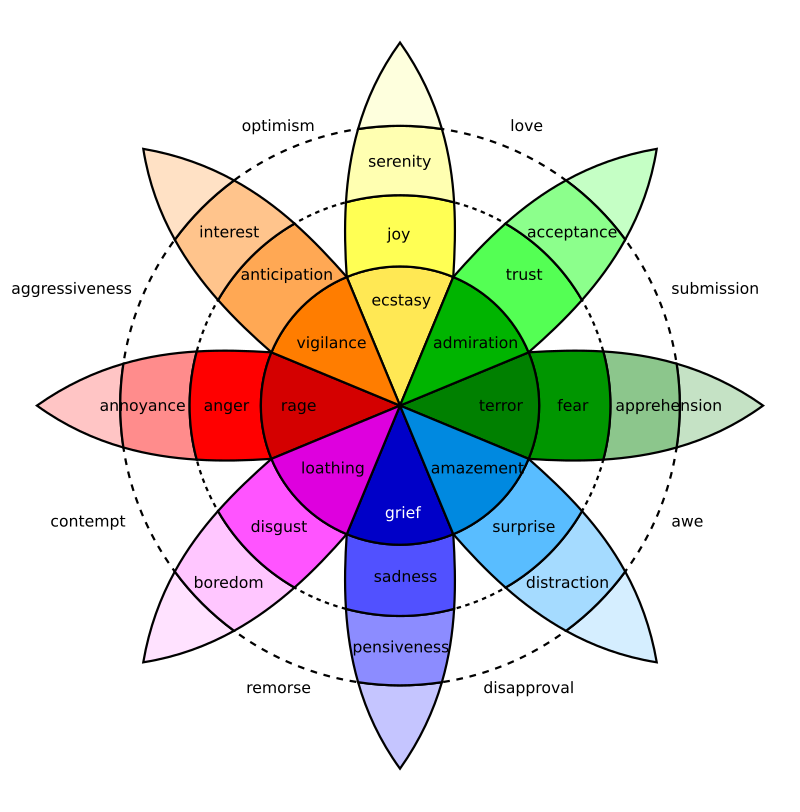
File:Plutchik-wheel.svg · Wikimedia Commons · See Wikimedia Commons
pleasure
Sign in to savePleasure is an experience that feels good, that involves the enjoyment of something. It contrasts with pain or suffering, which are forms of feeling bad. It is closely related to value, desire and action: humans and other conscious animals find pleasure enjoyable, positive or worthy of seeking. A great variety of activities may be experienced as pleasurable, such as eating, having sex, listening to music or playing games. Pleasure is part of various other mental states such as ecstasy, euphoria and flow. Happiness and well-being are closely related to pleasure but not identical with it. There
Pleasure is a feeling of enjoyment that makes experiences feel good, and it motivates humans and other conscious animals to seek out activities like eating, socializing, or listening to music. It matters because it's closely connected to what we value and desire, and it plays an important role in our overall happiness and well-being.
AI-generated from the Wikipedia summary — may contain errors.
Research
14,454 papers- Pleasure systems in the brain.ReviewNeuron · 2015Berridge KC, Kringelbach MLDOI: 10.1016/j.neuron.2015.02.018
- Pleasure, addiction, and hypocretin (orexin).ReviewHandbook of clinical neurology · 2021McGregor R, Thannickal TC, Siegel JMDOI: 10.1016/B978-0-12-820107-7.00022-7
- Social pleasure in daily life: A meta-analysis of experience sampling studies in schizophrenia.ReviewSchizophrenia research · 2023Abel DB, Minor KSDOI: 10.1016/j.schres.2023.08.009
- Orgasms, sexual pleasure, and opioid reward mechanisms.ReviewSexual medicine reviews · 2025Pfaus JGDOI: 10.1093/sxmrev/qeaf023
- Thinking with pleasure: Experimenting with drugs and drug research.ReviewThe International journal on drug policy · 2017Race KDOI: 10.1016/j.drugpo.2017.07.019
- [Pleasure: Neurobiological conception and Freudian conception].ReviewL'Encephale · 2014Chenu A, Tassin JPDOI: 10.1016/j.encep.2013.06.003
- Pleasure junkies all around! Why it matters and why 'the arts' might be the answer: a biopsychological perspective.ReviewProceedings. Biological sciences · 2017Christensen JFDOI: 10.1098/rspb.2016.2837
- Pleasure-Inclusive Sex Education, Sexual Agency, and Sexual Well-Being in Adolescents and Young Adults: A Scoping Review.Archives of sexual behavior · 2025van Ditzhuijzen J, Overeem ADOI: 10.1007/s10508-025-03103-8
via PubMed
Wikidata facts
- Subclass of
- emotion
- Image
- Flock of Seagulls (eschipul).jpg
Show 4 more facts
- opposite of
- pain
- topic's main category
- Category:Pleasure
- Commons category
- Pleasure
- on focus list of Wikimedia project
- Wikipedia:Vital articles/Level/4
via Wikidata · CC0
~23 min read
Encyclopedic overview
30 sectionsContents
- Definition
- Related concepts
- Sources and types
- Sources
- Types
- Theories of pleasure
- Quality theories
- Attitude theories
- Dispositional theories
- Roles in philosophy
- Hedonism
- Ethics
- Value
- Beauty
- History of analysis of pleasure
- Hellenistic philosophy
- Medieval philosophy
- Schopenhauer
- Psychology
- Pleasure and belief
- Motivation and behavior
- Cognitive biases
- Reward system
- Pleasure centers
- Motivation
- Animal pleasure
- See also
- References
- Further reading
- External links
Pleasure is an experience that feels good, that involves the enjoyment of something. It contrasts with pain or suffering, which are forms of feeling bad. It is closely related to value, desire and action: humans and other conscious animals find pleasure enjoyable, positive or worthy of seeking. A great variety of activities may be experienced as pleasurable, such as eating, having sex, listening to music or playing games. Pleasure is part of various other mental states such as ecstasy, euphoria and flow. Happiness and well-being are closely related to pleasure but not identical with it. There is no general agreement as to whether pleasure should be understood as a sensation, a quality of experiences, an attitude to experiences or otherwise. Pleasure plays a central role in the family of philosophical theories known as hedonism.
== Definition == "Pleasure" refers to experience that feels good, that involves the enjoyment of something. The term is primarily used in association with sensory pleasures like the enjoyment of sex or food. But in its most general sense, it includes all types of positive or pleasant experiences including the enjoyment of sports, seeing a beautiful sunset or engaging in an intellectually satisfying activity.
Excerpted from Wikipedia’s “pleasure” article, available under the CC BY-SA 4.0 licence.
Gallery (2)
Available in 70 languages
- Español
- Français
- Deutsch
- 中文
- 日本語
- Русский
- Português
- Italiano
- العربية
- हिन्दी
- Albanian
- Armenian
- Asturian
- Azerbaijani
- Bahasa Indonesia
- Bangla
- Basque
- be_x_old
Show 51 more
- Belarusian
- Bikol
- Bishnupriya
- Bulgarian
- Catalan
- Central Kurdish
- Chuvash
- Croatian
- Esperanto
- Estonian
- Filipino
- Finnish
- Galician
- Greek
- Guarani
- Hebrew
- Hungarian
- Icelandic
- Ido
- Interlingua
- Javanese
- Latin
- Lingua Franca Nova
- Macedonian
- Malagasy
- Nederlands
- Newari
- Novial
- Occitan
- Polski
- Sanskrit
- Serbian
- Serbian (Latin)
- simple
- Sindhi
- Sinhala
- Slovak
- Somali
- Svenska
- Tiếng Việt
- Türkçe
- Ukrainian
- Urdu
- Uzbek
- Volapük
- Wu Chinese
- Yiddish
- zh_yue
- فارسی
- ไทย
- 한국어
via Wikidata sitelinks · CC0