(c) Mindy Morales, some rights reserved (CC BY-NC), uploaded by Mindy Morales · cc-by-nc
Pleurotaenium
Sign in to savePleurotaenium is a genus of green algae, specifically of the desmids (Desmidiaceae). It is a cosmopolitan genus, with about 50 species. Members of Pleurotaenium are found in freshwater habitats, and may be found in acidic, neutral or alkaline waters.
In the Vinony graph
Vinony's link graph records 7 inbound references to Pleurotaenium, and connects out to plant, International Standard Book Number and species.
It sits within the topics Charophyta genera and Desmidiaceae.
Vinony links it to 5 Wikipedia language editions.
Species
GENUS
- KingdomPlantae
- PhylumCharophyta
- ClassConjugatophyceae
- OrderDesmidiales
- FamilyDesmidiaceae
via GBIF
Museum specimens
- Specimen records
- 63
- With media
- 47
- Family
- Desmidiaceae
- Collections
- MARY, NY, UHM, US, FH, IPA/SP
- Recorded in
- United States, Germany, Indonesia, Brasil
Wikidata facts
- Instance of
- taxon
- Parent taxon
- Desmidiaceae
- Image
- Pleurotaenium.jpg
Show 5 more facts
- taxon common name
- コウガイチリモ属
- taxon name
- Pleurotaenium
- taxon rank
- genus
- Commons category
- Pleurotaenium
Sources (1)
via Wikidata · CC0
~2 min read
Encyclopedic overview
4 sectionsContents
- Description
- Taxonomy
- References
- External links
Pleurotaenium is a genus of green algae, specifically of the desmids (Desmidiaceae). It is a cosmopolitan genus, with about 50 species. Members of Pleurotaenium are found in freshwater habitats, and may be found in acidic, neutral or alkaline waters.
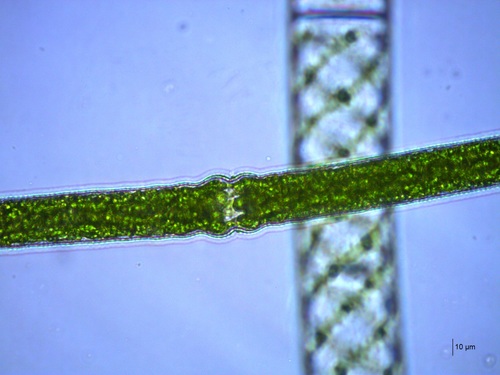
==Description== Pleurotaenium consists of long, cylindrical, bilaterally symmetrical cells with blunt ends; they are typically solitary, but occasionally joined end-to-end to form filaments. There is a shallow median constriction (an isthmus), where the two halves (called semicells) of the cells are joined. Semicells are widened at the base and truncate at the apex. At each apex, there is a vacuole filled with small granules. The cell wall is covered in fine pores, and may have mammillate protuberances, or spines. Cells have multiple chloroplasts, which are parietal bands from base to apex; these typically have several pyrenoids. The nucleus is at the isthmus.
Excerpted from Wikipedia’s “Pleurotaenium” article, available under the CC BY-SA 4.0 licence.