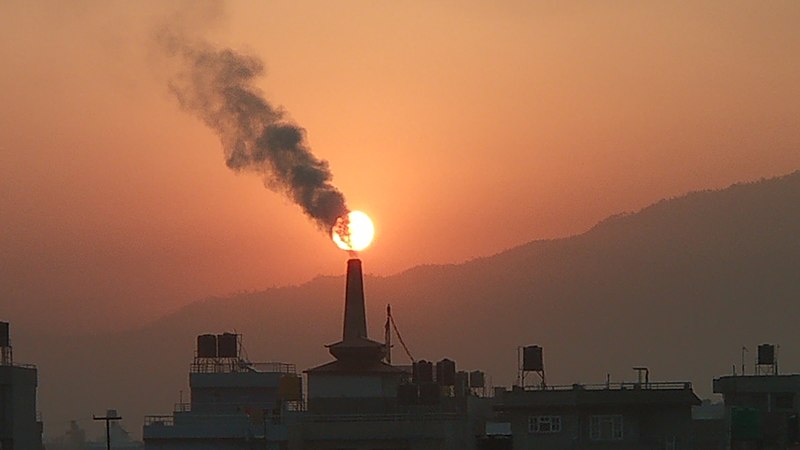
File:Air_pollution3.jpg · Wikimedia Commons · See Wikimedia Commons
pollution
Sign in to savePollution is the introduction of contaminants into the natural environment that cause harm. Pollution can take the form of any substance (solid, liquid, or gas) or energy (such as radioactivity, heat, sound, or light). Pollutants, the components of pollution, can be either foreign substances/energies or naturally occurring contaminants.
Pollution is the release of harmful substances or energy—like chemicals, waste, radiation, or excessive heat and noise—into the environment where they don't belong. It matters because these contaminants can damage natural ecosystems and affect the health of living things, including humans.
AI-generated from the Wikipedia summary — may contain errors.
Wikidata facts
- Instance of
- human impact on the environment
- Subclass of
- externality
- Image
- Factory.gif
Show 10 more facts
- topic has template
- Template:Pollution sidebar
- Commons category
- Pollution
- topic's main category
- Category:Pollution
- Commons gallery
- Pollution
- has cause
- pollutant
- has effect
- respiratory disease
- contributing factor of
- biodiversity loss
- on focus list of Wikimedia project
- Wikipedia:Vital articles/Level/4
- different from
- pollutant
Sources (8)
via Wikidata · CC0
~36 min read
Encyclopedic overview
24 sectionsContents
- Definitions and types
- Natural causes
- Human generation
- Effects
- Human health
- Socio economic impacts
- Environment
- Regulation and monitoring
- {{anchor|Pollution control}}Control
- Practices
- Devices
- Cost
- Dirtiest industries
- Textile industry
- Fossil fuel related industries
- Socially optimal level
- History
- Prior to 19th century
- 19th century
- 20th and 21st century
- See also
- References
- Further reading
- External links
Pollution is the introduction of contaminants into the natural environment that cause harm. Pollution can take the form of any substance (solid, liquid, or gas) or energy (such as radioactivity, heat, sound, or light). Pollutants, the components of pollution, can be either foreign substances/energies or naturally occurring contaminants.
Although environmental pollution can be caused by natural events, the word pollution generally implies that the contaminants have a human source, such as manufacturing, extractive industries, poor waste management, transportation or agriculture. Pollution is often classed as point source (coming from a highly concentrated specific site, such as a factory, mine, construction site), or nonpoint source pollution (coming from widespread distributed sources, such as microplastics or agricultural runoff).
Excerpted from Wikipedia’s “pollution” article, available under the CC BY-SA 4.0 licence.
Gallery (42)
Available in 111 languages
- Español
- Français
- Deutsch
- 中文
- 日本語
- Русский
- Português
- Italiano
- العربية
- हिन्दी
- Afrikaans
- Akan
- Albanian
- Aramaic
- Armenian
- Assamese
- Asturian
- Azerbaijani
Show 92 more
- Bahasa Indonesia
- Bangla
- Bashkir
- Basque
- Belarusian
- Bhojpuri
- Bikol
- Bulgarian
- Burmese
- Catalan
- Central Kurdish
- Croatian
- Czech
- dag
- Danish
- Esperanto
- Estonian
- Faroese
- Filipino
- Finnish
- Galician
- Gan Chinese
- gcr
- Georgian
- Greek
- Guarani
- Gujarati
- Haitian Creole
- Hausa
- Hebrew
- Hungarian
- Icelandic
- Igbo
- Interlingua
- Irish
- Jamaican Creole English
- Kannada
- Kazakh
- Kyrgyz
- Latgalian
- Latin
- Latvian
- Lithuanian
- Luxembourgish
- Macedonian
- Malagasy
- Malay
- Malayalam
- Maltese
- Marathi
- Nederlands
- Nepali
- Newari
- Northern Sami
- Norwegian
- Norwegian Nynorsk
- Occitan
- Odia
- Oromo
- Pashto
- Polski
- Punjabi
- Quechua
- Romanian
- Sanskrit
- Serbian
- Serbian (Latin)
- simple
- Sindhi
- Sinhala
- Slovak
- Slovenian
- Svenska
- Swahili
- Tamil
- Telugu
- Tibetan
- Tiếng Việt
- Türkçe
- Ukrainian
- Urdu
- Uzbek
- Walloon
- Waray
- Welsh
- Western Frisian
- Wu Chinese
- zh_yue
- Zulu
- فارسی
- ไทย
- 한국어
via Wikidata sitelinks · CC0