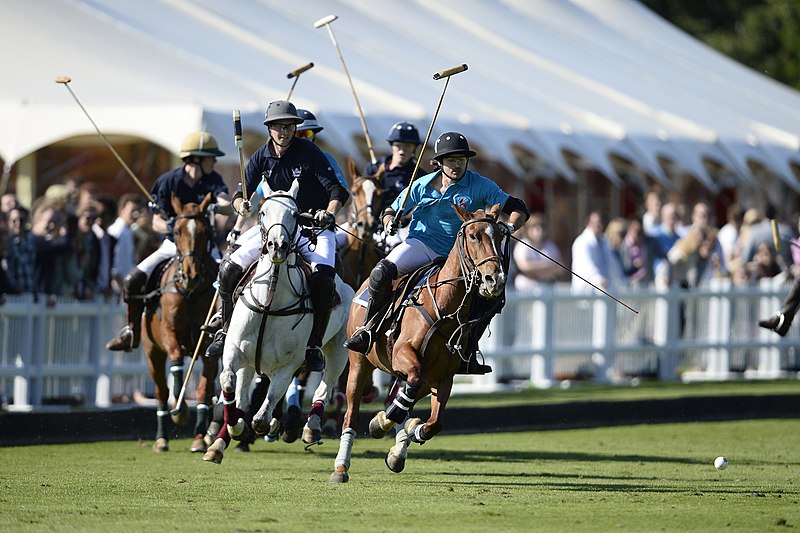
File:Varsity_Polo_2013.jpg · Wikimedia Commons · See Wikimedia Commons
polo
Sign in to saveAlso known as equestrian polo
Polo is a stick and ball game that is played on horseback as a traditional field sport. One of the oldest known team sports in the world, it originated as Chovgan (Persian: چوگان) in greater Iran and central Asia over two millennia ago, and was later adopted by the Western world from its modern form developed in India.
Polo is a team sport played on horseback where players use sticks to hit a ball across a field, making it one of the world's oldest known team sports. The game originated in ancient Persia and Central Asia over two thousand years ago before being adopted by the Western world through its modern form developed in India.
AI-generated from the Wikipedia summary — may contain errors.
Key facts
- Sport.name
- Polo
- Sport.image
- File:Varsity Polo 2013.jpg
- Sport.caption
- Players playing polo
- Sport.union
- Federation of International Polo
- Sport.nickname
- The Sport of Kings
- Sport.firstlabel
- Origin
- Sport.first
- Greater Iran
- Sport.clubs
- 90+
- Sport.contact
- Yes
- Sport.mgender
- Yes
- Sport.category
- Equestrian, ball game, team sport
- Sport.equipment
- Polo pony, mallet, ball, protective wear
- Sport.venue
- Polo field or arena
- Sport.country/region
- Worldwide
- Sport.olympic
- Formerly (1900, 1908, 1920–1924 and 1936)
via Wikipedia infobox
Wikidata facts
- Subclass of
- equestrian sport
- Image
- Varsity Polo 2013.jpg
Show 5 more facts
- Commons category
- Polo
- topic's main category
- Category:Polo
- Unicode character
- 🏇
- described by source
- Encyclopædia Britannica 11th edition
- on focus list of Wikimedia project
- Wikipedia:Vital articles/Level/4
Sources (1)
via Wikidata · CC0
~40 min read
Encyclopedic overview
40 sectionsContents
- History
- Origins and etymology
- Middle Ages and Early Modern era
- Modern era
- India and Britain
- Ireland
- Argentina
- United States
- Contemporary polo
- Argentina
- High season vs. Low season
- East and Southeast Asia
- West Asia
- India
- Ireland
- Pakistan
- United Kingdom
- United States
- Rest of the Americas
- Rules
- Players
- Ball
- Equipment
- Mallet
- The field
- Outdoor polo game structure
- Polo ponies
- Saddle
- Indoor or arena polo
- Clubs and tournament
- Variants
- Played on vehicles or other animals
- On other animals
- On vehicles
- Horse simulacrum
- Popular culture
- See also
- Notes
- References
- Further reading
Polo is a stick and ball game that is played on horseback as a traditional field sport. One of the oldest known team sports in the world, it originated as Chovgan (Persian: چوگان) in greater Iran and central Asia over two millennia ago, and was later adopted by the Western world from its modern form developed in India.
Polo has been called "The Sport of Kings" and has become a spectator sport for equestrians and high society, often supported by sponsorship. The progenitor of polo and its variants existed from the 6th century BCE to the 1st century CE, as an equestrian game played in Persia (Iran). From Iran, where the sport evolved and developed, the game became popular around the world. Today there are well over 100 member countries in the Federation of International Polo, and it is played professionally in 16 countries; it was also an Olympic sport from 1900 to 1936.
Excerpted from Wikipedia’s “polo” article, available under the CC BY-SA 4.0 licence.
Gallery (52)
Available in 78 languages
- Español
- Français
- Deutsch
- 中文
- 日本語
- Русский
- Português
- Italiano
- العربية
- हिन्दी
- Afrikaans
- Armenian
- Azerbaijani
- Bahasa Indonesia
- Bangla
- Bashkir
- Basque
- btm
Show 59 more
- Bulgarian
- Burmese
- Catalan
- Central Kurdish
- Chuvash
- Croatian
- Czech
- Danish
- Egyptian Arabic
- Esperanto
- Estonian
- Finnish
- Galician
- Greek
- Haitian Creole
- Hebrew
- Hungarian
- Ido
- Kannada
- Kashmiri
- Kazakh
- Latvian
- Limburgish
- Lithuanian
- Macedonian
- Malay
- Marathi
- Minangkabau
- Mongolian
- Nederlands
- Nepali
- Norwegian
- Norwegian Nynorsk
- nup
- Occitan
- Piedmontese
- Polski
- Punjabi
- Romanian
- Sanskrit
- Scots
- Scottish Gaelic
- Serbian
- Serbian (Latin)
- simple
- Slovak
- Svenska
- Tajik
- Tamil
- Tibetan
- Tiếng Việt
- Türkçe
- Ukrainian
- Urdu
- Western Panjabi
- Wu Chinese
- zh_yue
- فارسی
- 한국어
via Wikidata sitelinks · CC0