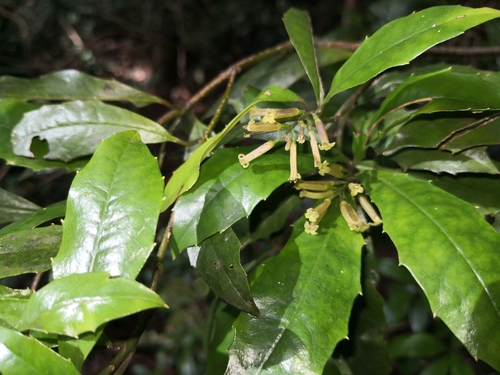
(c) Nick Lambert, some rights reserved (CC BY-NC-SA), uploaded by Nick Lambert · cc-by-nc-sa
Polyosma
Sign in to savePolyosma is a genus of about 90 species of trees native to south-east Asia. They occur from China south through south-east Asia to the east coast of Australia, New Guinea, the Solomon Islands and New Caledonia.
Species
Featherwood
GENUS
- KingdomPlantae
- PhylumTracheophyta
- ClassMagnoliopsida
- OrderEscalloniales
- FamilyEscalloniaceae
Царство: Растения Подцарство: Зелёные растения Отдел: Цветковые Класс: Двудольные[1] Надпорядок: Asteranae Порядок: Эскаллониецветные (Escalloniales Doweld, 2001) Семейство: Эскаллониевые Род: Полиосма Международное научное название Polyosma Blume (1825) Изображенияна Викискладе NCBI 124853EOL 2887105GRIN g:9718IPNI 37128-1FW 319974 Полиосма (лат. Polyosma) — род деревянистых растений семейства Эскаллониевые (Escalloniaceae). Содержание 1 Описание 2 Виды 3 Примечания 4 Литература Описание Вечнозелёные прямостоячие кустарники (0,5—3 м высотой) или деревья до 25 м высотой. Виды Род включает около 80 видов, некоторые из них: Polyosma brachyantha Merr. Polyosma cunninghamii Benn. Polyosma dentata Schltr. Polyosma finisterrae Schltr. Polyosma illicifolia Blume typus Polyosma integrifolia Blume Polyosma mutabilis C.B.Clarke Polyosma occulta Reeder Polyosma serrulata Blume Polyosma subalpina Schulze-Menz ex P.Royen Примечания ↑ Об условности указания класса двудольных в качестве вышестоящего таксона для описываемой в данной статье группы растений см. раздел «Системы APG» статьи «Двудольные».
via GBIF · Kew POWO
Museum specimens
- Specimen records
- 1,258
- With media
- 1,008
- Family
- Escalloniaceae
- Collections
- NY, A, GH
- Recorded in
- Malaysia/Sabah, Malaysia, Indonesia, Brunei, Papua New Guinea
Wikidata facts
- Instance of
- taxon
- Parent taxon
- Polyosmaceae
- Image
- Polyosma cunninghamii at Mount Banda Banda.jpg
Show 7 more facts
- taxon rank
- genus
- taxon name
- Polyosma
- Commons category
- Polyosma
- topic's main category
- Category:Polyosma
- taxon common name
- 多香木属
- fruit color
- blue
Sources (3)
via Wikidata · CC0
~3 min read
Encyclopedic overview
1 sectionsContents
- References
Polyosma is a genus of about 90 species of trees native to south-east Asia. They occur from China south through south-east Asia to the east coast of Australia, New Guinea, the Solomon Islands and New Caledonia.
Its taxonomic placement has long been uncertain: it was traditionally placed in Grossulariaceae, but in the APG II system it was given its own family, Polyosmaceae, which was unplaced as to order within the euasterids II (campanulids) clade. However, the current APG IV system places the genus in the family Escalloniaceae.
Excerpted from Wikipedia’s “Polyosma” article, available under the CC BY-SA 4.0 licence.
Gallery (4)
Available in 13 languages
via Wikidata sitelinks · CC0