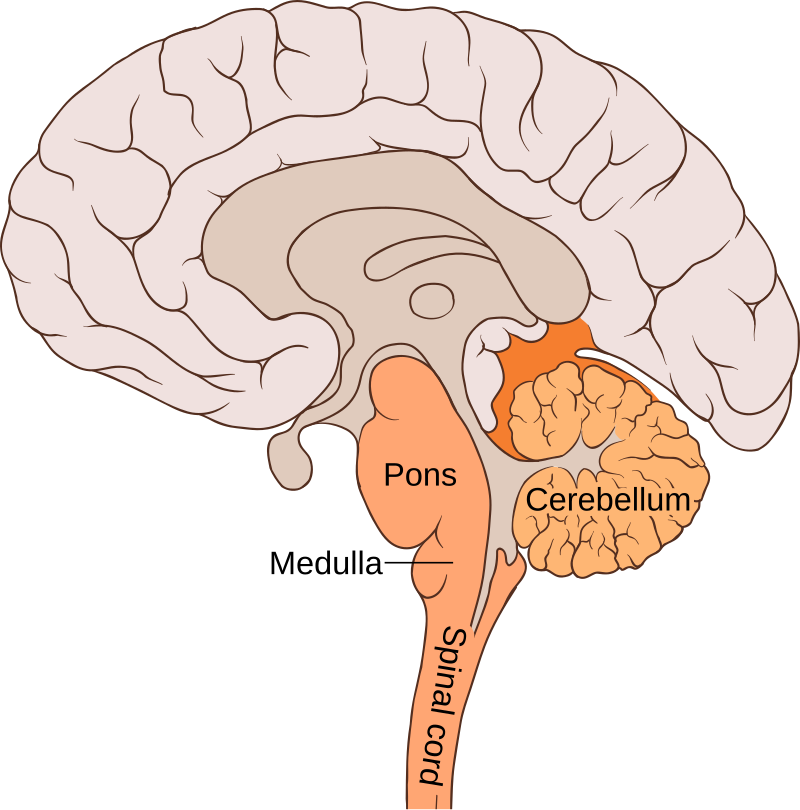
File:Brain_bulbar_region.svg · Wikimedia Commons · See Wikimedia Commons
pons
Sign in to saveThe pons (from Latin ) is the part of the brainstem that, in humans and other mammals, lies inferior to the midbrain, superior to the medulla oblongata, and anterior to the cerebellum.
Key facts
- Brain.Name
- Pons
- Brain.Image
- Brain bulbar region.svg
- Brain.Caption
- Pons in the brainstem
- Brain.Image2
- Gray679.png
- Brain.Caption2
- Anteroinferior view of the medulla oblongata and pons
- Brain.IsPartOf
- Brain stem
- Brain.Artery
- Pontine arteries
- Brain.Vein
- Transverse and lateral pontine veins
via Wikipedia infobox
Research
44,188 papers- Tumors of the pons.Neurosurgery clinics of North America · 1993
- The rhombencephalon and breathing: a view from the pons.Respiratory physiology & neurobiology · 2004
- [Brainstem infarction (pons)].Nihon rinsho. Japanese journal of clinical medicine · 2006
- Pons Anteroposterior and Cerebellar Vermis Craniocaudal Diameters in Fetuses With Down Syndrome.Journal of ultrasound in medicine : official journal of the American Institute of Ultrasound in Medicine · 2021
- Sudden deafness.Current opinion in neurology · 2006
via PubMed
Wikidata facts
- Part of
- brain stem
- Image
- Pons.gif
Show 6 more facts
- Commons category
- Pons
- topic's main category
- Category:Pons
- arterial supply
- pontine arteries
- anatomical location
- brain stem
- different from
- Most
- native label
- pons Varolii
via Wikidata · CC0
~5 min read
Encyclopedic overview
11 sectionsContents
- Structure
- Vasculature
- Development
- Nuclei
- Function
- Clinical significance
- Other animals
- Evolution
- Additional images
- References
- External links
The pons (from Latin ) is the part of the brainstem that, in humans and other mammals, lies inferior to the midbrain, superior to the medulla oblongata, and anterior to the cerebellum.
The pons is also called the ('bridge of Variolus'), after the Italian anatomist and surgeon Costanzo Varolio (1543–1575). The pons contains neural pathways and nerve tracts that conduct signals from the brain down to the cerebellum and medulla, as well as pathways that carry the sensory signals up into the thalamus.
Excerpted from Wikipedia’s “pons” article, available under the CC BY-SA 4.0 licence.