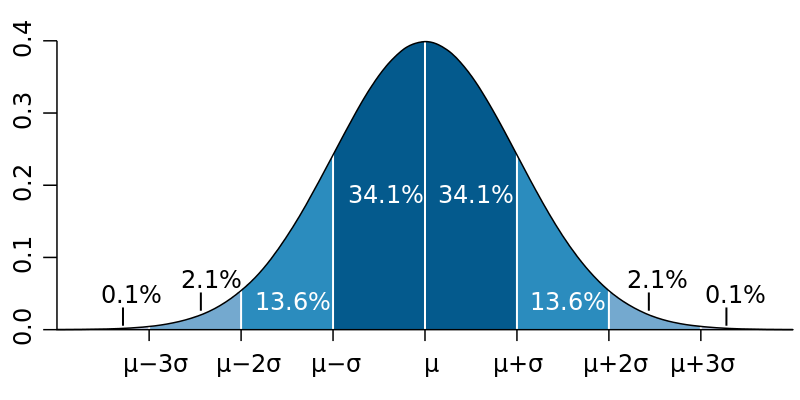
File:Standard_deviation_diagram_micro.svg · Wikimedia Commons · See Wikimedia Commons
probability distribution
Sign in to saveAlso known as distribution, statistical distribution
mathematical function that describes the probability of occurrence of different possible outcomes in an experiment
A probability distribution is a mathematical tool that shows how likely different outcomes are when something uncertain happens, like rolling a die or measuring rainfall. It matters because it helps us understand and predict what's likely to occur in real situations, from weather forecasting to quality control in manufacturing.
AI-generated from the Wikipedia summary — may contain errors.
Research
189,677 papers- Coffee.ReviewIARC monographs on the evaluation of carcinogenic risks to humans · 1991
- July-August 2020 Issue.PDA journal of pharmaceutical science and technology · 2020Levy RDOI: 10.5731/pdajpst.2019.001120
- Tea.ReviewIARC monographs on the evaluation of carcinogenic risks to humans · 1991
- Donor malignancies.Transplantation · 2015Hutchinson JDOI: 10.1097/TP.0000000000000623
- Modern heroes.Nature · 2011DOI: 10.1038/473420a
- RU 486.American journal of public health · 1992Rosenfield ADOI: 10.2105/ajph.82.10.1325
- Chronic pancreatitis.ReviewSouthern medical journal · 1993Holt SDOI: 10.1097/00007611-199302000-00012
- Fentanyl in the US heroin supply: A rapidly changing risk environment.The International journal on drug policy · 2017Ciccarone DDOI: 10.1016/j.drugpo.2017.06.010
via PubMed
Wikidata facts
- Subclass of
- distribution
- Image
- Standard deviation diagram.svg
Show 10 more facts
- Commons category
- Probability distributions
- topic's main category
- Category:Probability distributions
- facet of
- statistics
- topic has template
- Template:Probability distributions
- studied by
- probability theory
- has characteristic
- coefficient of skewness
- on focus list of Wikimedia project
- Wikipedia:Vital articles/Level/4
- maintained by WikiProject
- WikiProject Mathematics
- Commons gallery
- Probability distribution
via Wikidata · CC0
~40 min read
Encyclopedic overview
In probability theory and statistics, a probability distribution describes how probabilities are assigned to the possible results of a random phenomenon—more precisely, to events, which are sets of possible outcomes of a probabilistic experiment. Informally, a probability distribution tells us how likely different results are. Formally, it is a probability measure: a function that assigns probabilities to events in a way that satisfies the axioms of probability.
Probability distributions are closely linked to random variables. A random variable is a function that assigns a value to each outcome of a probabilistic experiment; it induces a probability distribution on the set of values it can take. For example, the result of a coin toss can be represented by a random variable X that equals 1 for heads and 0 for tails. If the coin is fair, this distribution assigns probability 1/2 to X = 1 and probability 1/2 to X = 0. Viewed as a probability measure, the distribution of X assigns ℙ(X ∈ A) to each set A ⊆ {0,1}; for a fair coin, ℙ(X ∈ {1}) = ℙ(X ∈ {0}) = 1/2, ℙ(X ∈ {0,1}) = 1, and ℙ(X ∈ ∅) = 0.
Excerpted from Wikipedia’s “probability distribution” article, available under the CC BY-SA 4.0 licence.