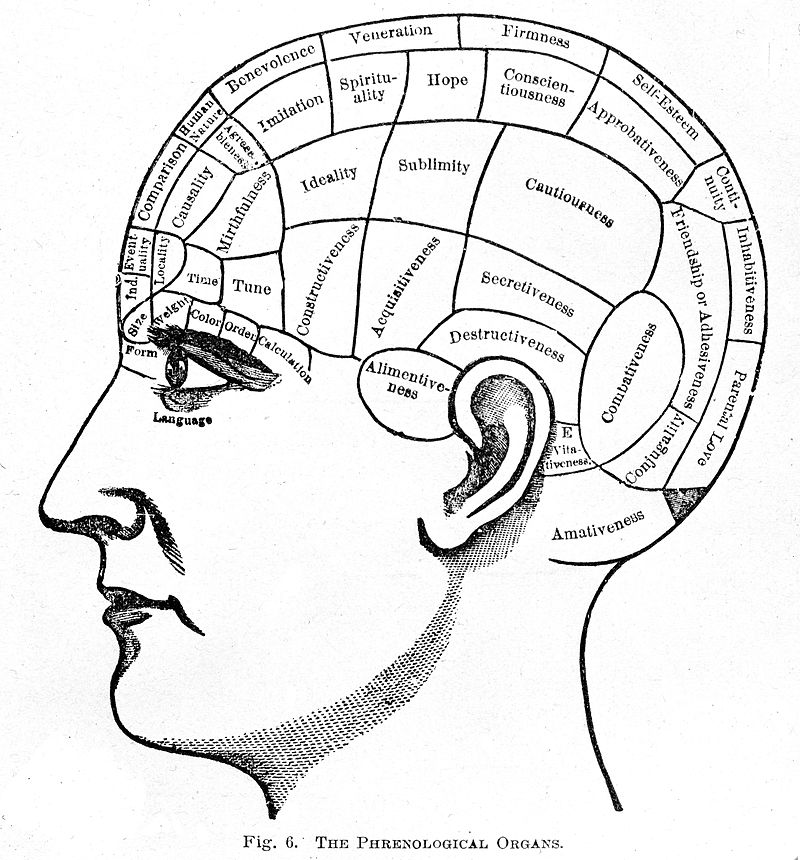
File:Phrenological_organs,_1887_Wellcome_L0001965.jpg · Wikimedia Commons · See Wikimedia Commons
pseudoscience
Sign in to saveAlso known as pseudo-science, fake science
thumb|upright=1.35|A typical 19th-century phrenology chart: during the 1820s, phrenologists claimed the mind was located in areas of the brain, and were attacked for doubting that mind came from the nonmaterial soul. Their idea of reading "bumps" in the skull to predict personality traits was later discredited. Phrenology was first termed a pseudoscience in 1843 and continues to be considered so.
Pseudoscience refers to ideas or practices that claim to be scientific but lack the rigorous evidence and methods of genuine science, such as phrenology's discredited claim that skull bumps could predict personality traits. It matters because pseudoscientific claims can mislead people into accepting false beliefs, as happened when phrenology was widely accepted before being proven wrong.
AI-generated from the Wikipedia summary — may contain errors.
Research
447 papers- Pseudoscience and fraudulent products for COVID-19 management.ReviewEnvironmental science and pollution research international · 2022Chavda VP, Sonak SS, Munshi NK et al.DOI: 10.1007/s11356-022-21967-4
- Editorial: The Psychology of Pseudoscience.Frontiers in psychology · 2022Blancke S, Edis T, Braeckman J et al.DOI: 10.3389/fpsyg.2022.935645
- Pseudoscience, Subterfuge, and Civil Resistance.The Milbank quarterly · 2025Cohen ABDOI: 10.1111/1468-0009.70074
- [Pseudoscience].Enfermeria clinica · 2009Uriel Latorre PDOI: 10.1016/j.enfcli.2009.03.006
- Pseudoscience.Science (New York, N.Y.) · 1974Abelson PHDOI: 10.1126/science.184.4143.1233
- Living with COVID-19-triggered pseudoscience and conspiracies.ReviewInternational journal of public health · 2020Desta TT, Mulugeta TDOI: 10.1007/s00038-020-01412-4
- Science and pseudoscience during the COVID-19 pandemic.Turk pediatri arsivi · 2020Kasapçopur ÖDOI: 10.14744/TurkPediatriArs.2020.35902
- The reanimation of pseudoscience in machine learning and its ethical repercussions.ReviewPatterns (New York, N.Y.) · 2024Andrews M, Smart A, Birhane ADOI: 10.1016/j.patter.2024.101027
via PubMed
Wikidata facts
Show 14 more facts
- partially coincident with
- misinformation
- Commons category
- Pseudoscience
- topic's main category
- Category:Pseudoscience
- topic has template
- Template:Pseudoscience
- does not have characteristic
- Mertonian norms
- different from
- junk science
- history of topic
- history of pseudoscience
- has contributing factor
- anecdotal evidence
- on focus list of Wikimedia project
- Wikipedia:Vital articles/Level/4
- studied by
- multidisciplinarity
- has characteristic
- pejorative
- used by
- charlatan
- facet of
- demarcation problem
via Wikidata · CC0
~46 min read
Encyclopedic overview
34 sectionsContents
- Etymology
- Relationship to science
- Scientific method
- Falsifiability
- Mertonian norms
- Refusal to acknowledge problems
- Criticism of the term
- Alternative definition
- History
- Indicators of possible pseudoscience
- Use of vague, exaggerated or untestable claims
- Improper collection of evidence
- Lack of openness to testing by other experts
- Absence of progress
- Personalization of issues
- Use of misleading language
- Prevalence of pseudoscientific beliefs
- Countries
- Racism
- Explanations
- Psychology
- Education and scientific literacy
- Boundaries with science
- Classification
- Philosophy
- Politics, health, and education
- Political implications
- Health and education implications
- See also
- Notes
- References
- Bibliography
- Works cited
- Further reading
thumb|upright=1.35|A typical 19th-century phrenology chart: during the 1820s, phrenologists claimed the mind was located in areas of the brain, and were attacked for doubting that mind came from the nonmaterial soul. Their idea of reading "bumps" in the skull to predict personality traits was later discredited. Phrenology was first termed a pseudoscience in 1843 and continues to be considered so.
Pseudoscience consists of statements, beliefs, or practices that claim to be scientific or factual but are inherently incompatible with the scientific method. Pseudoscience is often characterized by contradictory, exaggerated or unfalsifiable claims; reliance on confirmation bias rather than rigorous attempts at refutation; lack of openness to evaluation by other experts; absence of systematic practices when developing hypotheses; and continued adherence long after the pseudoscientific hypotheses have been experimentally discredited. It is not the same as junk science.
Excerpted from Wikipedia’s “pseudoscience” article, available under the CC BY-SA 4.0 licence.
Gallery (13)
Available in 92 languages
- Español
- Français
- Deutsch
- 中文
- 日本語
- Русский
- Português
- Italiano
- العربية
- हिन्दी
- Afrikaans
- Albanian
- Aragonese
- Assamese
- Asturian
- Azerbaijani
- Bahasa Indonesia
- Bangla
Show 73 more
- Basque
- be_x_old
- Belarusian
- Betawi
- Bhojpuri
- Bikol
- Bosnian
- Bulgarian
- Catalan
- Central Kurdish
- Croatian
- Czech
- Danish
- Esperanto
- Estonian
- Faroese
- Fijian
- Filipino
- Finnish
- Galician
- Greek
- Gujarati
- Hebrew
- Hungarian
- Icelandic
- Ido
- Interlingua
- Kazakh
- Latin
- Latvian
- Lingua Franca Nova
- Lithuanian
- Macedonian
- Malay
- Malayalam
- Marathi
- Moroccan Arabic
- nah
- Nederlands
- Norwegian
- Norwegian Nynorsk
- Occitan
- Oromo
- Piedmontese
- Polski
- Punjabi
- Quechua
- Romanian
- Rusyn
- Serbian
- Serbian (Latin)
- Silesian
- simple
- Sinhala
- Slovak
- Slovenian
- Svenska
- Swahili
- Tajik
- Tamil
- Tiếng Việt
- Türkçe
- Ukrainian
- Urdu
- Uzbek
- Welsh
- Western Frisian
- Wu Chinese
- zh_min_nan
- zh_yue
- فارسی
- ไทย
- 한국어
via Wikidata sitelinks · CC0