Pseudotrillium · Kew POWO · Kew Plants of the World Online
Pseudotrillium
Sign in to savePseudotrillium is a monotypic genus in the bunchflower family Melanthiaceae. Its sole species, the flowering plant Pseudotrillium rivale, is commonly known as the brook wakerobin. It is endemic to the Siskiyou Mountains of southern Oregon and northern California. The Latin specific epithet rivale means "growing by streams", a reference to a preferred habitat.
Species
GENUS
- KingdomPlantae
- PhylumTracheophyta
- ClassLiliopsida
- OrderLiliales
- FamilyMelanthiaceae
via GBIF · Kew POWO
Museum specimens
- Specimen records
- 3
- With media
- 1
- Family
- Melanthiaceae
- Collections
- UCSB, BRIT
- Recorded in
- United States
Wikidata facts
- Instance of
- taxon
- Parent taxon
- Melanthiaceae
- Image
- Pseudotrillium rivale.jpg
Show 5 more facts
- taxon name
- Pseudotrillium
- taxon rank
- genus
- Commons gallery
- Pseudotrillium
- Commons category
- Pseudotrillium
Sources (1)
via Wikidata · CC0
~4 min read
Encyclopedic overview
8 sectionsContents
- Description
- Taxonomy
- Distribution
- Ecology
- Uses
- References
- Bibliography
- External links
Pseudotrillium is a monotypic genus in the bunchflower family Melanthiaceae. Its sole species, the flowering plant Pseudotrillium rivale, is commonly known as the brook wakerobin. It is endemic to the Siskiyou Mountains of southern Oregon and northern California. The Latin specific epithet rivale means "growing by streams", a reference to a preferred habitat.
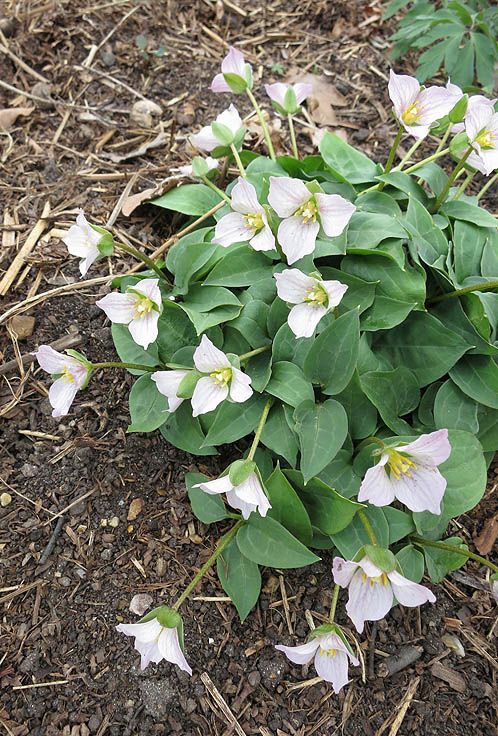
==Description== Pseudotrillium rivale is a perennial, herbaceous, flowering plant that persists by means of an underground rhizome. In general appearance, it is similar to a Trillium (and at one time, it belonged to that genus). It has a whorl of three bracts (leaves) and a single trimerous flower with three sepals, three petals, two whorls of three stamens each, and three carpels (fused into a single ovary with three stigmas). It differs from Trillium in that it has spotted petals, leathery leaves with a cordate base, and a continuously elongating pedicel. At the onset of anthesis, the pedicel rises above the leaves, but once the flower is pollinated, the pedicel elongates and declines below the leaves.
Excerpted from Wikipedia’s “Pseudotrillium” article, available under the CC BY-SA 4.0 licence.