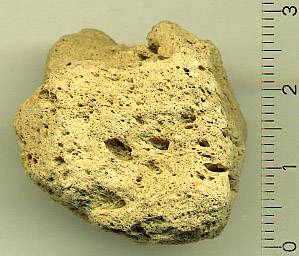
File:Teidepumice.jpg · Wikimedia Commons · See Wikimedia Commons
pumice
Sign in to saveAlso known as pumice stone
thumb|Kutkhiny Baty, a pumice rock formation outcrop located 4 km from the source of the Ozyornaya (Sea of Okhotsk)|Ozyornaya River (Lake Kurile), near the southern tip of the [[Kamchatka Peninsula, Russia]]
Pumice is a light, porous volcanic rock that forms when lava with trapped gas cools and solidifies. It matters because it's useful for various practical applications and its presence in geological formations, like the Kutkhiny Baty outcrop in Russia, helps scientists understand volcanic activity and Earth's geology.
AI-generated from the Wikipedia summary — may contain errors.
Key facts
- Rock.name
- Pumice
- Rock.type
- Igneous
- Rock.image
- Teidepumice.jpg
- Rock.caption
- Specimen of highly porous pumice from Teide volcano on Tenerife, Canary Islands. Density of specimen approximately 0.25 g/cm3; scale in centimeters.
- Rock.composition
- Volcanic glass
- Rock.composition_secondary
- Alkali feldspar, quartz, biotite, sanidine, zircon, magnetite and hornblende
- Rock.class
- Felsic to intermediate
- Rock.texture
- Vesicular with matrix being glassy or aphanitic, sometimes porphyritic
via Wikipedia infobox
Wikidata facts
- Subclass of
- tephra
- Image
- Raflinoer32-Museum Geologi-Batu apung.jpg
Show 3 more facts
- Commons category
- Pumice
- described by source
- Encyclopædia Britannica 11th edition
- exact match
- purl.obolibrary.org/obo/ENVO_01000663
Sources (7)
via Wikidata · CC0
~25 min read
Encyclopedic overview
21 sectionsContents
- Properties
- Comparison with scoria
- Gallery
- Etymology
- Distribution
- Asia
- Europe
- North America
- South America
- Africa
- New Zealand
- Mining
- Use in volcanology
- Other uses
- Early medicine
- Personal care
- Cleaning
- Horticulture
- Construction
- References
- External links
thumb|Kutkhiny Baty, a pumice rock formation outcrop located 4 km from the source of the Ozyornaya (Sea of Okhotsk)|Ozyornaya River (Lake Kurile), near the southern tip of the [[Kamchatka Peninsula, Russia]]
Pumice (), called pumicite in its powdered or dust form, is a volcanic rock that consists of extremely vesicular rough-textured volcanic glass, which may or may not contain crystals. It is typically light-colored. Scoria is another vesicular volcanic rock that differs from pumice in having larger vesicles, thicker vesicle walls, and being dark colored and denser.
Excerpted from Wikipedia’s “pumice” article, available under the CC BY-SA 4.0 licence.
Gallery (20)
Available in 67 languages
- Español
- Français
- Deutsch
- 中文
- 日本語
- Русский
- Português
- Italiano
- العربية
- हिन्दी
- Armenian
- Bahasa Indonesia
- Bangla
- Basque
- Belarusian
- Bulgarian
- Burmese
- Catalan
Show 48 more
- Cornish
- Croatian
- Czech
- Danish
- Esperanto
- Estonian
- Finnish
- Georgian
- Greek
- Hausa
- Hebrew
- Hungarian
- Icelandic
- Ido
- Irish
- Javanese
- Kazakh
- Khmer
- Kyrgyz
- Latin
- Lithuanian
- Macedonian
- Malay
- Nederlands
- Norwegian
- Norwegian Nynorsk
- Ossetic
- Polski
- Romanian
- Serbian
- Serbian (Latin)
- Sicilian
- simple
- Slovak
- Slovenian
- Sundanese
- Svenska
- Swahili
- Tiếng Việt
- Türkçe
- Ukrainian
- Urdu
- Uzbek
- Welsh
- Western Panjabi
- Wu Chinese
- فارسی
- 한국어
via Wikidata sitelinks · CC0