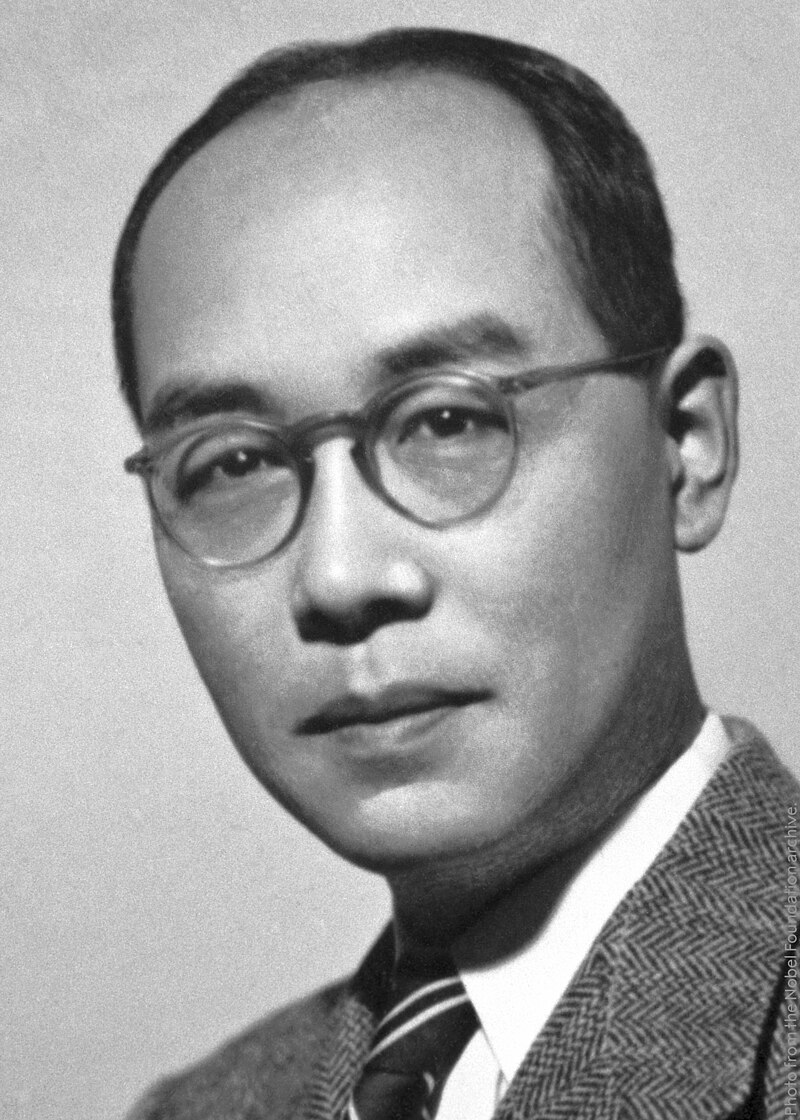
File:Yukawa.jpg · Wikimedia Commons · See Wikimedia Commons
Hideki Yukawa
Sign in to saveJapanese theoretical physicist (1907-1981)
Nobel Prize
- The Nobel Prize in Physics1949
“for his prediction of the existence of mesons on the basis of theoretical work on nuclear forces”
Wikidata facts
- Instance of
- human
- Gender
- male
- Citizenship
- Empire of Japan
- Place of birth
- Azabu
- Place of death
- Kyoto
- Occupation
- university teacher
- Educated at
- University of Osaka
- Employer
- University of Osaka
- Languages spoken
- Japanese
- Award
- Pour le Mérite
- Notable work
- Yukawa interaction
- Field of work
- physics
- Image
- Yukawa.jpg
Show 14 more facts
- member of
- Accademia Nazionale dei Lincei
- name in kana
- ゆかわ ひでき
- Commons category
- Hideki Yukawa
- date of birth
- 1907-01-23
- date of death
- 1981-09-08
- Commons gallery
- Hideki Yukawa
- nominated for
- Nobel Prize in Physics
- influenced by
- Enrico Fermi
- name in native language
- 湯川 秀樹
- significant person
- Shin'ichirō Tomonaga
- ethnic group
- Japanese people
- maintained by WikiProject
- WikiProject Mathematics
- place of burial
- Chion-in Temple
- interested in
- physics
Sources (8)
via Wikidata · CC0
~7 min read
Encyclopedic overview
Hideki Yukawa (Japanese: 湯川 秀樹; né Ogawa; 23 January 1907 – 8 September 1981) was a Japanese theoretical physicist who received the Nobel Prize in Physics in 1949 "for his prediction of the existence of mesons on the basis of theoretical work on nuclear forces."
Early life and education
Excerpted from Wikipedia’s “Hideki Yukawa” article, available under the CC BY-SA 4.0 licence.
Gallery (2)
Available in 86 languages
- Español
- Français
- Deutsch
- 中文
- 日本語
- Русский
- Português
- Italiano
- العربية
- हिन्दी
- Afrikaans
- Armenian
- azb
- Azerbaijani
- Bahasa Indonesia
- Bangla
- Basque
- Belarusian
Show 67 more
- Bosnian
- Breton
- Bulgarian
- Catalan
- Central Kurdish
- Chuvash
- Croatian
- Czech
- Danish
- Egyptian Arabic
- Esperanto
- Estonian
- Finnish
- Galician
- Georgian
- Greek
- Gujarati
- Hakka Chinese
- Hebrew
- Hungarian
- Ido
- Irish
- Kannada
- Kazakh
- Kurdish
- Latin
- Latvian
- Lithuanian
- Macedonian
- Malay
- Malayalam
- Maltese
- Marathi
- Mazanderani
- Mingrelian
- Mongolian
- Nederlands
- Newari
- Norwegian
- Norwegian Nynorsk
- Occitan
- Polski
- Punjabi
- pwn
- Romanian
- Sanskrit
- Serbian
- Serbian (Latin)
- Slovak
- Slovenian
- Svenska
- Swahili
- Tamil
- Tatar
- Tiếng Việt
- Türkçe
- Ukrainian
- Urdu
- Uzbek
- Western Panjabi
- Wu Chinese
- Yoruba
- zh_min_nan
- zh_yue
- فارسی
- ไทย
- 한국어
via Wikidata sitelinks · CC0