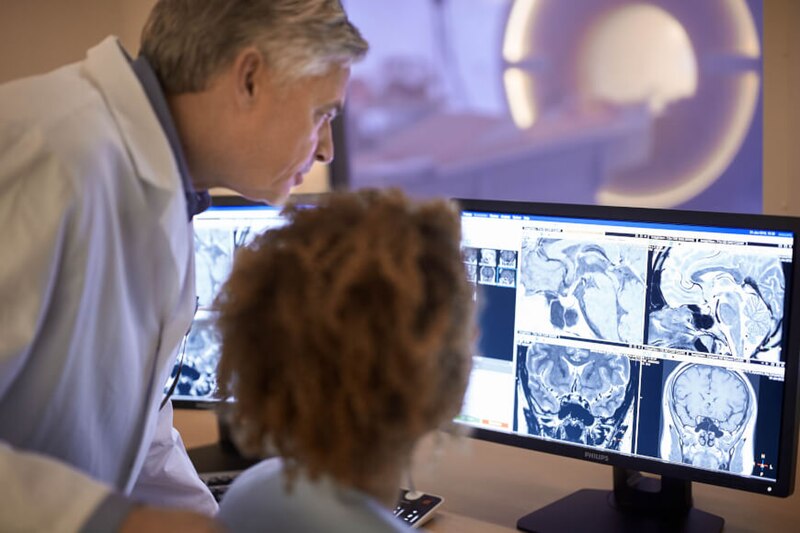
File:Radiologist_interpreting_MRI.jpg · Wikimedia Commons · See Wikimedia Commons
radiology
Sign in to saveRadiology ( ) is the medical specialty that uses medical imaging to diagnose diseases and guide treatment within the bodies of humans and other animals. It began with radiography (which is why its name has a root referring to radiation), but today it includes all imaging modalities. This includes technologies that use no ionizing electromagnetic radiation, such as ultrasonography and magnetic resonance imaging (MRI), as well as others that do use radiation, such as computed tomography (CT), fluoroscopy, and nuclear medicine including positron emission tomography (PET). Interventional radiology
Radiology is a medical specialty that uses imaging technologies to see inside the human body and diagnose diseases and plan treatments. It started with X-rays but now includes many different imaging methods, some using radiation (like CT scans) and others that don't (like ultrasound and MRI).
AI-generated from the Wikipedia summary — may contain errors.
Key facts
- Occupation.formation
- Doctor of Medicine (M.D.) Doctor of Osteopathic medicine (D.O.) * Bachelor of Arts (B.A.) or Bachelor of Science (B.S.) – typical undergraduate degrees prior to medical school in the United States and Canada Doctor of Medicine (M.D.) or Doctor of Osteopathic Medicine (D.O.) – medical degrees in the United States Bachelor of Medicine, Bachelor of Surgery (M.B.B.S. or MBChB) – medical degrees in many Commonwealth countries
- Occupation.employment_field
- Hospitals, Clinics
- Occupation.name
- Radiologist
- Occupation.image
- Radiologist interpreting MRI.jpg
- Occupation.caption
- A radiologist interpreting magnetic resonance imaging
- Occupation.official_names
- Radiologist Physician Roentgenologist
- Occupation.type
- Specialty
- Occupation.activity_sector
- Medicine
via Wikipedia infobox
Research
1,869,346 papers- "New Normal" Radiology.ReviewInternational dental journal · 2022MacDonald D, Reitzik SDOI: 10.1016/j.identj.2022.05.002
- Endometriosis MRI lexicon: consensus statement from the society of abdominal radiology endometriosis disease-focused panel.Abdominal radiology (New York) · 2020Jha P, Sakala M, Chamie LP et al.DOI: 10.1007/s00261-019-02291-x
- Dental radiology.ReviewTopics in companion animal medicine · 2009Woodward TMDOI: 10.1053/j.tcam.2008.12.005
- Interventional radiology. Introduction.Techniques in vascular and interventional radiology · 2010Sidhu MDOI: 10.1053/j.tvir.2010.04.001
- [Catheter-based interventional radiology].ReviewUgeskrift for laeger · 2026Gehr J, Clausen C, Lönn L et al.DOI: 10.61409/V10250813
- Thoracic Radiology: Recent Developments and Future Trends.Radiology · 2023McLoud TC, Little BPDOI: 10.1148/radiol.223121
- Dentomaxillofacial Radiology in 2020-Exciting developments ahead.Dento maxillo facial radiology · 2020Schulze RKDOI: 10.1259/dmfr.20209001
- Health Care Disparities in Radiology-A Review of the Current Literature.ReviewJournal of the American College of Radiology : JACR · 2022DeBenedectis CM, Spalluto LB, Americo L et al.DOI: 10.1016/j.jacr.2021.08.024
via PubMed
Wikidata facts
- Instance of
- medical specialty
- Subclass of
- medicine
- Part of
- medicine
- Has part
- interventional radiology
- Image
- Medical X-Ray imaging TIN07 nevit.jpg
- Said to be same as
- roentgenology
Show 5 more facts
- Commons category
- Radiology
- OpenStreetMap tag
- healthcare:speciality=radiology
- topic's main category
- Category:Radiology
- practiced by
- radiographer
- on focus list of Wikimedia project
- Wikipedia:Vital articles/Level/4
via Wikidata · CC0
~34 min read
Encyclopedic overview
24 sectionsContents
- Diagnostic imaging modalities
- Projection (plain) radiography
- Fluoroscopy
- Computed tomography
- Ultrasound
- Magnetic resonance imaging
- Nuclear medicine
- Interventional radiology
- Analysis of images
- Plain, or general, radiography
- Teleradiology
- Patient interaction
- Professional training
- United States
- United Kingdom
- Germany
- Italy
- The Netherlands
- India
- Singapore
- Specialty training for interventional radiology
- See also
- References
- External links
Radiology ( ) is the medical specialty that uses medical imaging to diagnose diseases and guide treatment within the bodies of humans and other animals. It began with radiography (which is why its name has a root referring to radiation), but today it includes all imaging modalities. This includes technologies that use no ionizing electromagnetic radiation, such as ultrasonography and magnetic resonance imaging (MRI), as well as others that do use radiation, such as computed tomography (CT), fluoroscopy, and nuclear medicine including positron emission tomography (PET). Interventional radiology is the performance of usually minimally invasive medical procedures with the guidance of imaging technologies such as those mentioned above.
The modern practice of radiology involves a team of several different healthcare professionals. A radiologist, who is a medical doctor with specialized post-graduate training, interprets medical images, communicates these findings to other physicians through reports or verbal communication, and uses imaging to perform minimally invasive medical procedures The nurse is involved in the care of patients before and after imaging or procedures, including administration of medications, monitoring of vital signs and monitoring of sedated patients. The radiographer, also known as a radiologic technologist in countries such as the United States and Canada, is a specialized healthcare professional who performs radiographic procedures and radiation therapy for the diagnosis and treatment of diseases such as cancer. The images produced through radiographic procedures are used for interpretation by radiologists, and depending on their education, training, and the regulations of the country in which they practice, radiographers in some regions also have an extended role in image interpretation and reporting.
Excerpted from Wikipedia’s “radiology” article, available under the CC BY-SA 4.0 licence.
Gallery (13)
Available in 79 languages
- Español
- Français
- Deutsch
- 中文
- 日本語
- Русский
- Português
- Italiano
- العربية
- हिन्दी
- Albanian
- Aragonese
- Armenian
- Asturian
- azb
- Azerbaijani
- Bahasa Indonesia
- Bangla
Show 60 more
- Basque
- be_x_old
- Belarusian
- Bishnupriya
- Bosnian
- Bulgarian
- Catalan
- Central Kurdish
- Croatian
- Czech
- Danish
- Esperanto
- Estonian
- Finnish
- Galician
- Georgian
- Greek
- Hakka Chinese
- Hebrew
- Ido
- Interlingua
- Irish
- Javanese
- Kannada
- Kashmiri
- Kazakh
- Kyrgyz
- Lao
- Latin
- Latvian
- Lithuanian
- Macedonian
- Malay
- Malayalam
- Mingrelian
- Nederlands
- Norwegian
- Pashto
- Polski
- Romanian
- Serbian
- Serbian (Latin)
- simple
- Slovak
- Slovenian
- Svenska
- Swahili
- Tamil
- Telugu
- Tiếng Việt
- Türkçe
- Ukrainian
- Urdu
- Uzbek
- Waray
- Wu Chinese
- zh_yue
- فارسی
- ไทย
- 한국어
via Wikidata sitelinks · CC0