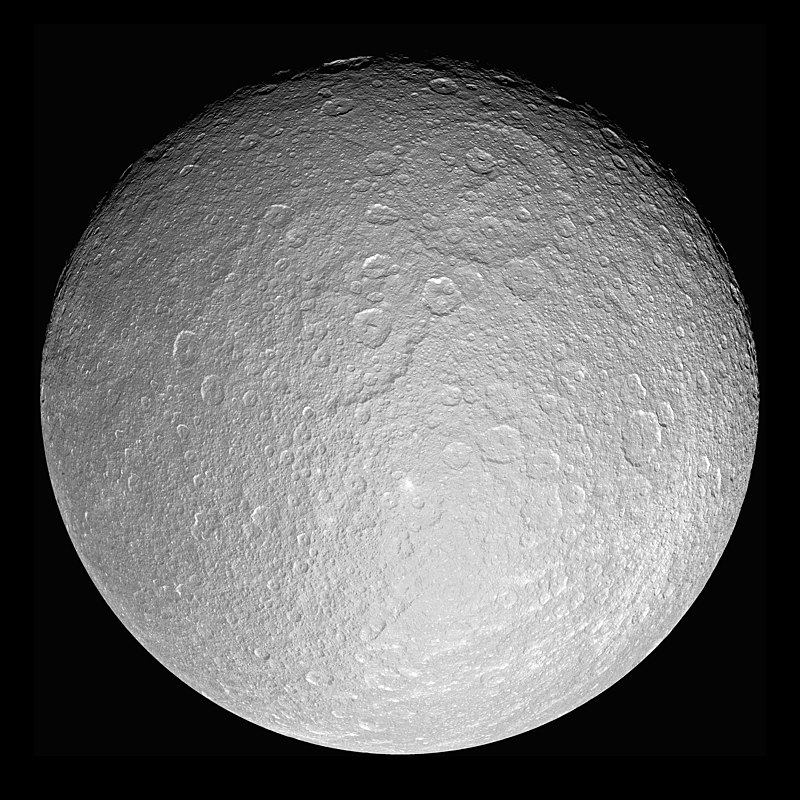
File:PIA07763_Rhea_full_globe5.jpg · Wikimedia Commons · See Wikimedia Commons
Rhea is the second-largest moon orbiting Saturn, a giant ice and rock body located in the outer solar system. It matters because studying it helps scientists understand the composition and history of Saturn's moon system and the early solar system itself.
AI-generated from the Wikipedia summary — may contain errors.
Wikidata facts
- Instance of
- regular moon
- Named after
- Rhea
- Area
- 7325342
- Parent body
- Saturn
- Child body
- rings of Rhea
- Diameter
- 1527
- Radius
- 764.30
- Mass
- 2.3065
- Orbital period
- 4.518
- Image
- PIA07763 Rhea full globe5.jpg
Show 13 more facts
- described by source
- Brockhaus and Efron Encyclopedic Dictionary
- albedo
- 0.65
- Commons category
- Rhea (moon)
- time of discovery or invention
- 1672-00-00
- discoverer or inventor
- Giovanni Domenico Cassini
- topic's main category
- Category:Rhea (moon)
- apparent magnitude
- 10
- orbital eccentricity
- 0.001
- semi-major axis of an orbit
- 527070
- density
- 1.237
- orbital inclination
- 0.345
- name
- Saturn V
- surface gravity
- 0.26
Sources (10)
via Wikidata · CC0
~15 min read
Encyclopedic overview
Apparent magnitude 10
Rhea (/ˈreɪ.ə/) is the second-largest natural satellite of Saturn and the ninth-largest moon in the Solar System, with a diameter of 1,528 kilometres (949 mi). Rhea is the smallest body in the Solar System that is confirmed to be in hydrostatic equilibrium. It has a nearly circular orbit around Saturn, but it is also tidally locked, like Saturn's other major moons. It rotates with the same period it revolves or orbits. Thus, one hemisphere always faces towards the planet.
Excerpted from Wikipedia’s “Rhea” article, available under the CC BY-SA 4.0 licence.
Gallery (9)
Available in 80 languages
- Español
- Français
- Deutsch
- 中文
- 日本語
- Русский
- Português
- Italiano
- العربية
- हिन्दी
- Afrikaans
- Aragonese
- Armenian
- azb
- Bahasa Indonesia
- Basque
- Belarusian
- Bosnian
Show 61 more
- Bulgarian
- Burmese
- Catalan
- cdo
- Central Kurdish
- Corsican
- Croatian
- Czech
- Danish
- Esperanto
- Estonian
- Filipino
- Finnish
- Galician
- Georgian
- Greek
- Hebrew
- Hungarian
- Icelandic
- Irish
- Kazakh
- Komi
- Kyrgyz
- Latin
- Latvian
- Lithuanian
- Luxembourgish
- Macedonian
- Malay
- Malayalam
- Mirandese
- Nederlands
- Norwegian
- Norwegian Nynorsk
- Odia
- Polski
- Romanian
- Scots
- Serbian
- Serbian (Latin)
- Sicilian
- simple
- Sindhi
- Slovak
- Slovenian
- Svenska
- Tiếng Việt
- Türkçe
- Ukrainian
- Urdu
- Uzbek
- Waray
- Welsh
- Western Panjabi
- Wu Chinese
- zh_classical
- zh_min_nan
- zh_yue
- فارسی
- ไทย
- 한국어
via Wikidata sitelinks · CC0