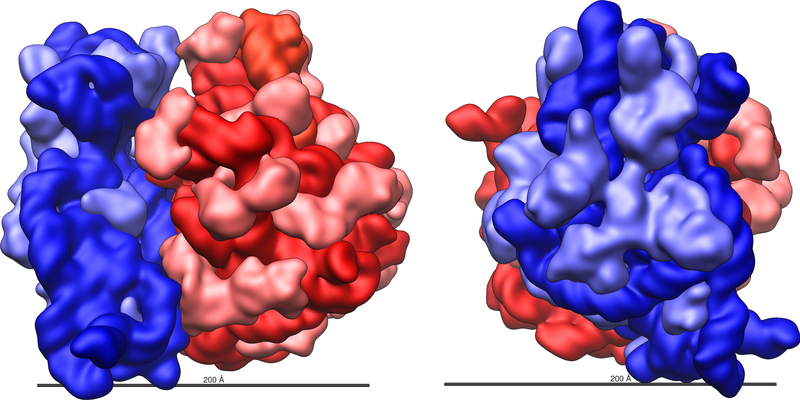
File:Ribosome_shape.png · Wikimedia Commons · See Wikimedia Commons
ribosome
Sign in to saveAlso known as GO:0005840, ribosomes
A ribosome () is a ribonucleoprotein particle found in all cells, both prokaryotic and eukaryotic, responsible for the synthesis of proteins. A ribosome functions as a molecular machine in the translation of strands of messenger RNA (mRNA) and production of a protein. A ribosome links amino acids together in the order specified by the codons of mRNA molecules to form polypeptide chains. A ribosome is made up of a large and a small subunit, each consisting of one or more ribosomal RNA molecules and many ribosomal proteins. The ribosomes and associated molecules are also known as the translation
A ribosome is a tiny molecular machine found in all living cells that reads instructions from messenger RNA and assembles proteins by linking amino acids together in a specific order. Ribosomes are essential for life because they're responsible for making all the proteins that cells need to function.
AI-generated from the Wikipedia summary — may contain errors.
Key facts
- Microanatomy.Name
- Ribosome
- Microanatomy.Image
- Ribosome shape.png
- Microanatomy.Caption
- Large (red) and small (blue) subunits of a ribosome
- Microanatomy.PartOf
- Cell (biology)
via Wikipedia infobox
Research
247,690 papers- Eukaryotic Ribosome Assembly.ReviewAnnual review of biochemistry · 2024Vanden Broeck A, Klinge SDOI: 10.1146/annurev-biochem-030222-113611
- Eukaryotic Ribosome Assembly.ReviewAnnual review of biochemistry · 2019Baßler J, Hurt EDOI: 10.1146/annurev-biochem-013118-110817
- Ribosome Biogenesis: A Central Player in Cancer Metastasis and Therapeutic Resistance.ReviewCancer research · 2022Elhamamsy AR, Metge BJ, Alsheikh HA et al.DOI: 10.1158/0008-5472.CAN-21-4087
- Ribosome Assembly and Repair.ReviewAnnual review of cell and developmental biology · 2024Yang YM, Karbstein KDOI: 10.1146/annurev-cellbio-111822-113326
- Ribosome Specialization in Protozoa Parasites.ReviewInternational journal of molecular sciences · 2023Rodríguez-Almonacid CC, Kellogg MK, Karamyshev AL et al.DOI: 10.3390/ijms24087484
- The ribosome as a platform to coordinate mRNA decay.ReviewNucleic acids research · 2025Müller MBD, Becker T, Denk T et al.DOI: 10.1093/nar/gkaf049
- Ribosome heterogeneity and specialization in development.ReviewWiley interdisciplinary reviews. RNA · 2021Norris K, Hopes T, Aspden JLDOI: 10.1002/wrna.1644
- Ribosome Stoichiometry: From Form to Function.ReviewTrends in biochemical sciences · 2019Emmott E, Jovanovic M, Slavov NDOI: 10.1016/j.tibs.2018.10.009
via PubMed
Wikidata facts
- Has part
- ribosomal proteins
Show 3 more facts
- Commons category
- Ribosomes
- exact match
- purl.obolibrary.org/obo/GO_0005840
- topic's main category
- Category:Ribosome
via Wikidata · CC0
~27 min read
Encyclopedic overview
24 sectionsContents
- Overview
- Discovery
- Structure
- Prokaryotic
- Bacteria
- Archaea
- Eukaryote
- Plastoribosomes and mitoribosomes
- Making use of the differences
- Common properties
- High-resolution structure
- Function
- Translation
- Cotranslational folding
- Addition of translation-independent amino acids
- Ribosome locations
- Free ribosomes
- Membrane-bound ribosomes
- Biogenesis
- Origin
- Heterogeneous ribosomes
- See also
- References
- External links
A ribosome () is a ribonucleoprotein particle found in all cells, both prokaryotic and eukaryotic, responsible for the synthesis of proteins. A ribosome functions as a molecular machine in the translation of strands of messenger RNA (mRNA) and production of a protein. A ribosome links amino acids together in the order specified by the codons of mRNA molecules to form polypeptide chains. A ribosome is made up of a large and a small subunit, each consisting of one or more ribosomal RNA molecules and many ribosomal proteins. The ribosomes and associated molecules are also known as the translational apparatus.
Ribosome biogenesis is the process of making ribosomes. This is an energy-consuming, dynamic process, requiring the synthesis of around 200 proteins in the processing of ribosomal RNAs and assembling them with ribosomal proteins to make the ribosomes subunits.
Excerpted from Wikipedia’s “ribosome” article, available under the CC BY-SA 4.0 licence.
Gallery (23)
Available in 94 languages
- Español
- Français
- Deutsch
- 中文
- 日本語
- Русский
- Português
- Italiano
- العربية
- हिन्दी
- Afrikaans
- Albanian
- Aragonese
- Armenian
- Azerbaijani
- Bahasa Indonesia
- Bangla
- Basque
Show 75 more
- Belarusian
- Bosnian
- Bulgarian
- Catalan
- Central Kurdish
- Croatian
- Czech
- Danish
- Esperanto
- Estonian
- Faroese
- Filipino
- Finnish
- Galician
- Georgian
- Greek
- Haitian Creole
- Hebrew
- Hungarian
- Icelandic
- Interlingua
- Irish
- Javanese
- Kannada
- Kashmiri
- Kazakh
- Kurdish
- Kyrgyz
- Latin
- Latvian
- Lingua Franca Nova
- Lithuanian
- Low German
- Luxembourgish
- Macedonian
- Malay
- Malayalam
- Manx
- Mingrelian
- Mongolian
- Nederlands
- Northern Frisian
- Norwegian
- Norwegian Nynorsk
- Occitan
- Pashto
- Polski
- Romanian
- Rusyn
- Scots
- Serbian
- Serbian (Latin)
- simple
- Sinhala
- Slovak
- Slovenian
- Sundanese
- Svenska
- Tajik
- Tamil
- Tatar
- Telugu
- Tiếng Việt
- Türkçe
- Ukrainian
- Urdu
- Uzbek
- Welsh
- Western Panjabi
- Wu Chinese
- zh_min_nan
- zh_yue
- فارسی
- ไทย
- 한국어
via Wikidata sitelinks · CC0