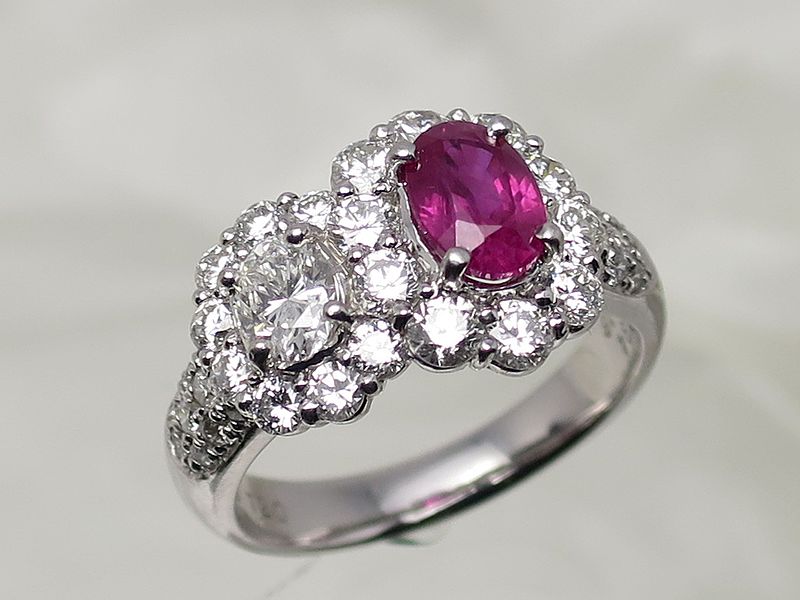
File:Ring_Ruby.jpg · Wikimedia Commons · See Wikimedia Commons
ring
Sign in to savecircular object worn as a type of ornamental jewellery
A ring is a circular piece of jewelry designed to be worn, typically on the fingers. Rings matter to people because they serve as personal adornments that can express style, mark important life events, or hold sentimental value.
AI-generated from the Wikipedia summary — may contain errors.
Wikidata facts
- Subclass of
- jewelry
- Image
- Roman - Crouching Venus - Walters 421007 - Three Quarter.jpg
Show 4 more facts
- Unicode character
- 💍
- Commons category
- Rings (jewellery)
- topic's main category
- Category:Rings (jewellery)
- P8168
- remifentanil
via Wikidata · CC0
~11 min read
Encyclopedic overview
Ruby ring A ring is a round band, usually made of metal, worn as ornamental jewelry. The term "ring" by itself denotes jewellery worn on the finger; when worn as an ornament elsewhere, the body part is specified within the term, e.g., earrings, neck rings, arm rings, and toe rings. Rings fit snugly around or in the part of the body they ornament, so bands worn loosely, like a bracelet, are not rings. Rings may be made of almost any hard material: wood, bone, stone, metal, glass, jade, gemstone or plastic. They may be set with gemstones (diamond, ruby, sapphire or emerald) or with other types of stone or glass.
Although some people wear rings as mere ornaments or as conspicuous displays of wealth, rings have symbolic functions respecting marriage, exceptional achievement, high status or authority, membership in an organization, and the like. Rings can be made to sport insignia which may be impressed on a wax seal or outfitted with a small compartment in which to conceal things.
Excerpted from Wikipedia’s “ring” article, available under the CC BY-SA 4.0 licence.
Gallery (12)
Available in 115 languages
- Español
- Français
- Deutsch
- 中文
- 日本語
- Русский
- Português
- Italiano
- العربية
- हिन्दी
- Albanian
- Amharic
- Angika
- Aragonese
- Armenian
- Assamese
- Asturian
- Aymara
Show 96 more
- azb
- Bahasa Indonesia
- Balinese
- Bangla
- Banjar
- Basque
- Belarusian
- Bikol
- Breton
- Bulgarian
- Burmese
- Catalan
- cdo
- Cebuano
- Central Dusun
- Central Kurdish
- Chuvash
- Croatian
- Czech
- Danish
- Esperanto
- Estonian
- Fijian
- Filipino
- Finnish
- Galician
- Gan Chinese
- Georgian
- Greek
- Guarani
- Haitian Creole
- Hakka Chinese
- Hausa
- Hebrew
- Hungarian
- Iban
- Icelandic
- Ido
- Irish
- Javanese
- Kannada
- Kara-Kalpak
- Kashmiri
- Kazakh
- Kurdish
- Kyrgyz
- Latin
- Latvian
- Lingala
- Lithuanian
- lld
- Low German
- Macedonian
- Malay
- Malayalam
- Marathi
- Mongolian
- Nederlands
- Nepali
- Norwegian
- Pashto
- Polski
- Quechua
- Romanian
- Serbian
- Serbian (Latin)
- Shona
- Sicilian
- simple
- Sindhi
- Slovak
- Sundanese
- Svenska
- Swahili
- syl
- Telugu
- Tibetan
- Tiếng Việt
- Tulu
- Türkçe
- Tuvinian
- Tyap
- Ukrainian
- Upper Sorbian
- Urdu
- Uzbek
- Wayuu
- Western Panjabi
- Wu Chinese
- Zaza
- zh_min_nan
- zh_yue
- Zhuang
- فارسی
- ไทย
- 한국어
via Wikidata sitelinks · CC0