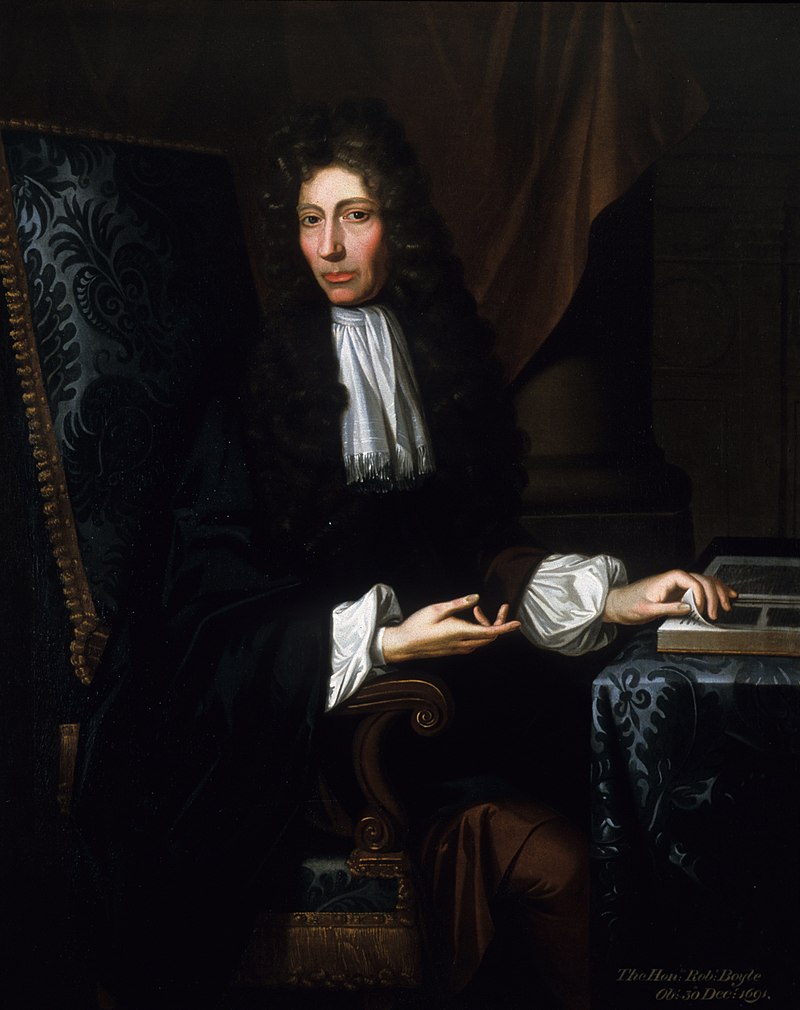
File:The_Shannon_Portrait_of_the_Hon_Robert_Boyle.jpg · Wikimedia Commons · See Wikimedia Commons
Robert Boyle
Sign in to saveAlso known as Sir Robert Boyle, Hon. Robert Boyle, The Hon. Robert Boyle
Anglo-Irish natural philosopher, chemist, physicist, and inventor
OverviewAI-generated
Robert Boyle was a physicist, chemist, philosopher, and naturalist from the Kingdom of England. He was educated at Eton College and worked as an employee of the University of Oxford. Boyle was a member of the Royal Society and the Invisible College, and he is recognized in the Royal Society collection. His field of work included physics, chemistry, and philosophy.
Born in 1627, Boyle was the son of Richard Boyle, 1st Earl of Cork. He had siblings Roger Boyle, 1st Earl of Orrery; Katherine Jones, Viscountess Ranelagh; and Richard Boyle, 1st Earl of Burlington. He was influenced by Galileo Galilei, René Descartes, Francis Bacon, and Cornelis Drebbel. Boyle resided in County Waterford and England, and his religious worldview was Anglicanism. He spoke English, French, Latin, and Irish.
Boyle authored 379 works, including *Some motives and incentives to the love of God*, *A discourse concerning pulick oaths, and the lawfulness of swearing in judicial proceedings*, *Memoirs for the natural history of humane blood*, *The aerial noctiluca, or, Some new phœnomena, and a process of a factitious self-shining substance*, and *An essay of the great effects of even languid and unheeded motion*. He died on December 31, 1691, in London and was buried at St Martin-in-the-Fields.
Synthesized by Vinony from 26 facts across 3 sources: Wikidata, Open Library, Vinony collections. Generated from structured data (not the Wikipedia text) and checked against those facts — may still contain errors.
Person · Open Library
- Born
- 1627
- Died
- 1691
- Works
- 379
Top works
- Experimenta et considerationes de coloribus
- Some motives and incentives to the love of God
- The origine of formes and qualities, (according to the corpuscular philosophy) illustrated by considerations and experimemts[!]
- Paradoxa hydrostatica novis experimentis (maximam partem physicis ac facilibus) evicta, et Regiae Britanniarvm societati exhibita
- A discourse concerning pulick oaths, and the lawfulness of swearing in judicial proceedings
via Open Library + Wikidata
Wikidata facts
- Instance of
- human
- Given name
- Robert
- Family name
- Boyle
- Gender
- male
- Citizenship
- Kingdom of England
- Place of birth
- Lismore Castle
- Place of death
- London
- Occupation
- philosopher
- Educated at
- Eton College
- Employer
- University of Oxford
- Languages spoken
- Irish
- Religion
- Anglicanism
- Notable work
- The Sceptical Chymist
- Doctoral student
- Robert Hooke
- Field of work
- philosophy
- Image
- Robert Boyle portrait shifted.jpg
- Residence
- England
Show 14 more facts
- member of
- Invisible College
- Commons category
- Robert Boyle
- date of birth
- 1626-01-25
- date of death
- 1691-12-31
- topic's main category
- Category:Robert Boyle
- influenced by
- Ibn Tufayl
- name in native language
- Robert Boyle
- place of burial
- St Martin-in-the-Fields
- writing language
- English language
- honorific prefix
- The Honourable
- on focus list of Wikimedia project
- Wikipedia:Vital articles/Level/4
- different from
- Robert F. Boyle
- student
- Robert Hooke
- P8168
- Valerian Vasilyev
Sources (11)
via Wikidata · CC0
~29 min read
Encyclopedic overview
Robert Boyle (/bɔɪl/; 25 January 1627 – 31 December 1691) was an Anglo-Irish natural philosopher, chemist, physicist, alchemist and inventor. Boyle is largely regarded today as the first modern chemist, and therefore one of the founders of modern chemistry, and one of the pioneers of modern experimental scientific method.
He is best known for Boyle's law, which describes the inversely proportional relationship between the absolute pressure and volume of a gas, if the temperature is kept constant within a closed system.
Excerpted from Wikipedia’s “Robert Boyle” article, available under the CC BY-SA 4.0 licence.
Gallery (12)
Available in 102 languages
- Español
- Français
- Deutsch
- 中文
- 日本語
- Русский
- Português
- Italiano
- العربية
- हिन्दी
- Afrikaans
- Albanian
- Aragonese
- Armenian
- Asturian
- azb
- Azerbaijani
- Bahasa Indonesia
Show 83 more
- Balinese
- Bangla
- Basque
- be_x_old
- Belarusian
- Bosnian
- Bulgarian
- Burmese
- Catalan
- Croatian
- Czech
- Danish
- Egyptian Arabic
- Esperanto
- Estonian
- Filipino
- Finnish
- Fula
- Galician
- Georgian
- Greek
- Guarani
- Haitian Creole
- Hebrew
- Hungarian
- Icelandic
- Ido
- Irish
- Javanese
- Kazakh
- Kurdish
- Kyrgyz
- Latin
- Latvian
- Lithuanian
- Luxembourgish
- Macedonian
- Malagasy
- Malay
- Malayalam
- Manx
- Marathi
- Mingrelian
- Moroccan Arabic
- Nederlands
- Nepali
- Norwegian
- Norwegian Nynorsk
- Novial
- Occitan
- Piedmontese
- Polski
- Punjabi
- Quechua
- Romanian
- Scots
- Scottish Gaelic
- Serbian
- Serbian (Latin)
- simple
- Sinhala
- Slovak
- Slovenian
- Svenska
- Swahili
- Tajik
- Tamil
- Telugu
- Tiếng Việt
- Türkçe
- Ukrainian
- Urdu
- Uzbek
- Waray
- Welsh
- Western Panjabi
- Wu Chinese
- Yoruba
- zh_min_nan
- zh_yue
- فارسی
- ไทย
- 한국어
via Wikidata sitelinks · CC0