
File:Rubiks_cube_solved.jpg · Wikimedia Commons · See Wikimedia Commons
Rubik's Cube
Sign in to saveAlso known as Magic cube, 3x3x3 cube, 3×3×3 cube, 3x3 cube
3-D combination puzzle with many different permutations
A Rubik's Cube is a three-dimensional puzzle made up of colored squares that can be twisted and turned in many different ways. It's a popular puzzle that challenges people to arrange all the colored squares so each side matches, which requires solving one of countless possible combinations.
AI-generated from the Wikipedia summary — may contain errors.
Official website
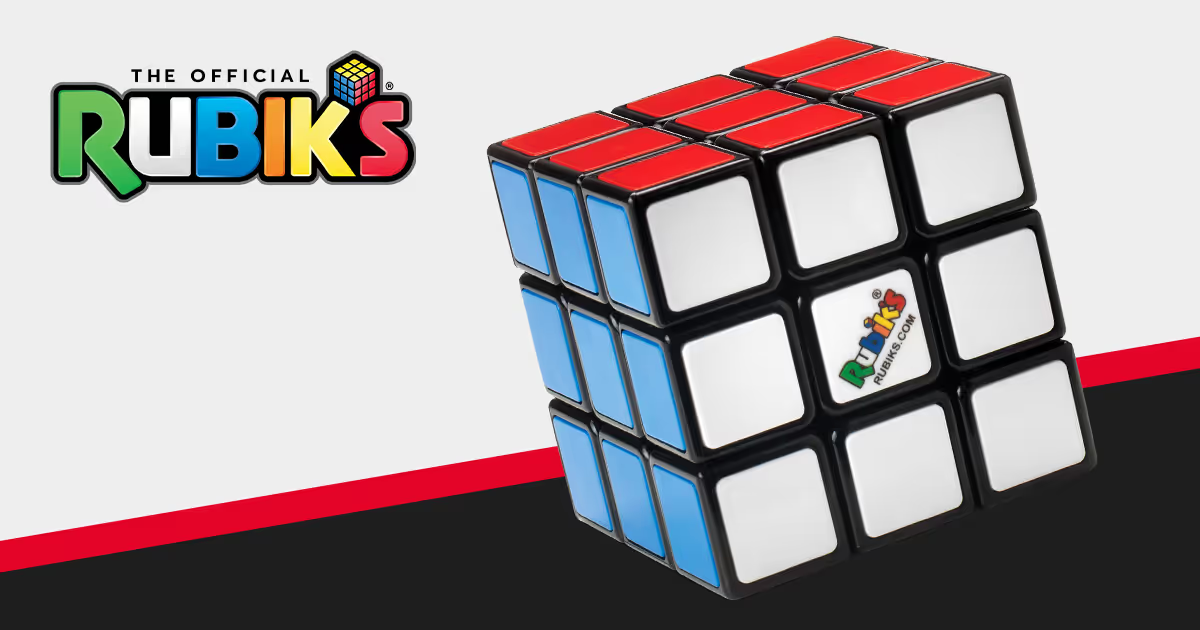
The Official Rubik’s Cube | Make Your Move
There is only one Rubik’s Cube and it changed the world. Make your Move today and start your Rubik’s Cube journey! Find everything you need to know about the Rubik’s Cube right here.
rubiks.com →Link to the official site · 2,183 chars · not written by Vinony
Wikidata facts
- Instance of
- abstract strategy game
- Subclass of
- combination puzzle
- Named after
- Ernő Rubik
- Country
- Hungary
- Publisher
- Spin Master
- Developer
- Ernő Rubik
- Official website
- rubiks.com
- Image
- Rubiks cube.svg
Show 12 more facts
- maintained by WikiProject
- WikiProject Mathematics
- topic's main category
- Category:Rubik's Cube
- native label
- Rubik-kocka
- maximum number of players
- 1
- minimum number of players
- 1
- Commons category
- Rubik's Cube
- inception
- 1974-05-19
- discoverer or inventor
- Ernő Rubik
- shape
- cube
- Commons gallery
- Rubik's Cube
- social media followers
- 27930
- on focus list of Wikimedia project
- Wikipedia:Vital articles/Level/4
via Wikidata · CC0
~40 min read
Encyclopedic overview
An illustration of an unsolved Rubik's Cube
The Rubik's Cube is a 3D combination puzzle invented in 1974 by Hungarian sculptor and professor of architecture Ernő Rubik. Originally called the Magic Cube, the puzzle was licensed by Rubik to be sold by Pentangle Puzzles in the UK in 1978, and then by Ideal Toy Corp in 1980 via businessman Tibor Laczi and Seven Towns founder Tom Kremer. The cube was released internationally in 1980 and became one of the most recognised icons in popular culture. It won the 1980 German Game of the Year special award for Best Puzzle. As of January 2024, around 500 million cubes had been sold worldwide, making it the world's bestselling puzzle game and bestselling toy. The Rubik's Cube was inducted into the US National Toy Hall of Fame in 2014.
Excerpted from Wikipedia’s “Rubik's Cube” article, available under the CC BY-SA 4.0 licence.
Gallery (13)
Available in 95 languages
- Español
- Français
- Deutsch
- 中文
- 日本語
- Русский
- Português
- Italiano
- العربية
- हिन्दी
- Afrikaans
- Albanian
- Armenian
- Assamese
- Asturian
- Azerbaijani
- Bahasa Indonesia
- Bangla
Show 76 more
- Bashkir
- Basque
- be_x_old
- Belarusian
- Bhojpuri
- Bikol
- Bosnian
- Bulgarian
- Burmese
- Catalan
- Central Kurdish
- Croatian
- Czech
- Danish
- Egyptian Arabic
- Esperanto
- Estonian
- Filipino
- Finnish
- Galician
- Georgian
- Greek
- Hebrew
- Hungarian
- hyw
- Irish
- Kannada
- Kazakh
- Khmer
- Kotava
- Kyrgyz
- Latin
- Latvian
- Lingua Franca Nova
- Lithuanian
- Luxembourgish
- Macedonian
- Malay
- Malayalam
- Mazanderani
- Minangkabau
- Mingrelian
- Mongolian
- Nederlands
- Norwegian
- Norwegian Nynorsk
- Polski
- Romanian
- Rusyn
- Serbian
- Serbian (Latin)
- Sicilian
- simple
- Sinhala
- skr
- Slovak
- Slovenian
- Svenska
- Tamil
- Telugu
- Tiếng Việt
- Toki Pona
- Türkçe
- Ukrainian
- Urdu
- Uzbek
- Waray
- Welsh
- Western Panjabi
- Wu Chinese
- Yiddish
- zh_classical
- zh_yue
- فارسی
- ไทย
- 한국어
via Wikidata sitelinks · CC0