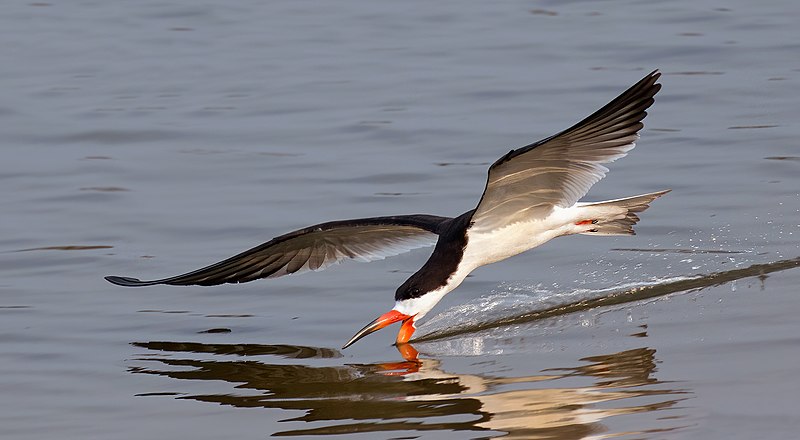
File:Black_skimmer_(Rynchops_niger)_in_flight.jpg · Wikimedia Commons · See Wikimedia Commons
Rynchops
Sign in to saveAlso known as the Skimmer genus, the Skimmers, skimmers
The skimmers, forming the genus Rynchops (from Ancient Greek ῥύγχος (rhúnkhos), meaning "beak", and ὄψ (óps), meaning "face"), are tern-like birds in the family Laridae. The genus comprises three species found in South Asia, Africa, and the Americas. They were formerly known as the scissorbills.
OverviewAI-generated
Rynchops is a genus of birds within the class Aves and phylum Chordata. It belongs to the order Charadriiformes. Taxonomic classifications place this genus in the family Laridae, while the World Register of Marine Species lists it under the family Rynchopidae. The genus was described by Linnaeus in 1758 and holds an accepted status.
The habitat for this taxon is marine. Records from iDigBio indicate that specimens are held by institutions including CUMV and MNHN, with occurrences in the United States and Venezuela. The genus has 657,835 recorded occurrences in the Global Biodiversity Information Facility database.
Synthesized by Vinony from 28 facts across 6 sources: Wikidata, GBIF, Gbif Occ, WoRMS, iDigBio, Vinony graph. Generated from structured data (not the Wikipedia text) and checked against those facts — may still contain errors.
Species
GENUS
- KingdomAnimalia
- PhylumChordata
- ClassAves
- OrderCharadriiformes
- FamilyLaridae
Rynchops Rynchops albicollis Rynchops est un genre d'oiseaux de la famille des Laridae. Ils ont pour nom normalisé bec-en-ciseaux. Dans certaines classifications scientifiques (Handbook of the Birds of the World, Clements), ce genre est placé dans sa propre famille, celle des Rynchopidae. Mais selon d'autres (Howard & Moore, COI), elle ne constitue qu'une sous-famille, les Rynchopinae, intégrée au sein de la famille des Laridae. Si cette sous-famille était élevée au rang de famille, cela rendrait la famille des Laridae paraphylétique.
via GBIF
Museum specimens
- Specimen records
- 4
- Family
- Laridae
- Collections
- CUMV, MNHN
- Recorded in
- United States, Venezuela
Wikidata facts
- Instance of
- taxon
- Image
- Blackskimmer64.jpg
Show 4 more facts
- Commons category
- Rynchops
- taxon name
- Rynchops
- taxon rank
- genus
- topic's main category
- Category:Rynchops
Sources (2)
via Wikidata · CC0
~3 min read
Encyclopedic overview
6 sectionsContents
- Description
- Taxonomy
- Species
- Notes
- References
- External links
The skimmers, forming the genus Rynchops (from Ancient Greek ῥύγχος (rhúnkhos), meaning "beak", and ὄψ (óps), meaning "face"), are tern-like birds in the family Laridae. The genus comprises three species found in South Asia, Africa, and the Americas. They were formerly known as the scissorbills.
==Description== The three species are the only birds with distinctive uneven bills, where the lower mandible is conspicuously longer than the upper. This remarkable adaptation allows them to fish in a unique way, flying low and fast over lakes, streams, and lagoons. Their lower mandible skims or slices over the water's surface, ready to snap shut any small fish unable to dart clear. The skimmers are now included within the gull and tern family Laridae, where they are positioned as a sister group of the terns and noddies. Skimmers also have an additional adaptation in being the only genus of birds known to have vertical slit-shaped pupils. The forehead, ends of the secondaries, tail feathers and under parts are white, the rest of the plumage is black and the basal half of the bill is crimson. Their bills fall within their field of binocular vision, which enables them to carefully position their bill and capture prey. They are agile in flight and gather in large flocks along rivers and coastal sand banks.
Excerpted from Wikipedia’s “Rynchops” article, available under the CC BY-SA 4.0 licence.
Gallery (6)
Available in 45 languages
- Français
- Deutsch
- 中文
- 日本語
- Русский
- Português
- Italiano
- العربية
- azb
- Azerbaijani
- Bahasa Indonesia
- Belarusian
- Breton
- Catalan
- Cebuano
- Croatian
- Czech
- Egyptian Arabic
Show 26 more
via Wikidata sitelinks · CC0