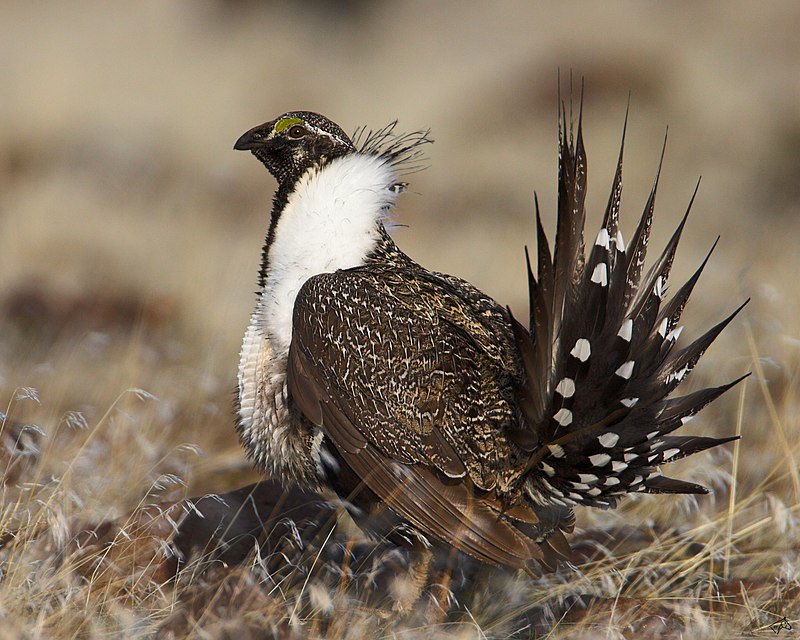
File:Centrocercus_urophasianus_-USA_-male-8.jpg · Wikimedia Commons · See Wikimedia Commons
Sage Grouse
Sign in to saveAlso known as Centrocercus urophasianus, Greater sage-grouse, Sagehen
species of bird
Species
Vulnerablevia IUCN
Wikidata facts
- Instance of
- taxon
- Parent taxon
- Centrocercus
- Mass
- 1.7
- Image
- Centrocercus urophasianus -USA -male-8.jpg
Show 8 more facts
- taxon rank
- species
- IUCN conservation status
- Vulnerable
- taxon name
- Centrocercus urophasianus
- Commons category
- Centrocercus urophasianus
- Commons gallery
- Centrocercus urophasianus
- taxon common name
- galo-das-artemísias-grande
- diel cycle
- diurnality
- temporal range start
- Early Pleistocene
via Wikidata · CC0
~29 min read
Encyclopedic overview
The greater sage-grouse (Centrocercus urophasianus), also known as the sagehen, is the largest grouse in North America. Its range is sagebrush country in the western United States and southern Alberta and Saskatchewan, Canada. It was known as simply the sage grouse until the Gunnison sage-grouse was recognized as a separate species in 2000. The Mono Basin population of sage grouse may also be distinct.
The greater sage-grouse is a permanent resident in its breeding grounds but may move short distances to lower elevations during winter. It makes use of a complex lek system in mating and nests on the ground under sagebrush or grass patches. It forages on the ground, mainly eating sagebrush but also other plants and insects. Greater sage-grouse do not have a muscular crop and are not able to digest hard seeds like other grouse.
Excerpted from Wikipedia’s “Sage Grouse” article, available under the CC BY-SA 4.0 licence.