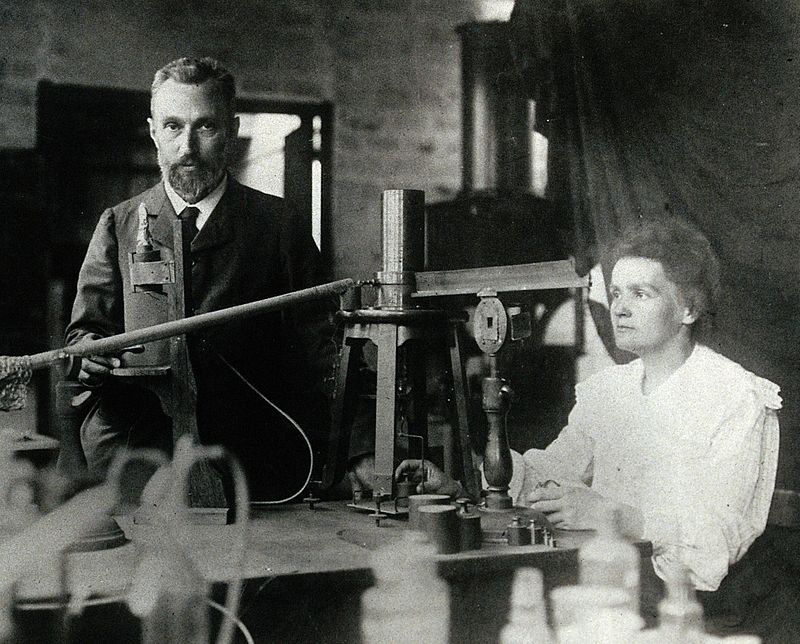
File:Pierre_and_Marie_Curie.jpg · Wikimedia Commons · See Wikimedia Commons
scientist
Sign in to saveAlso known as natural philosopher
A scientist is an expert who conducts scientific research to advance knowledge in science.
A scientist is someone who conducts research to advance our understanding of the natural world and how things work. This matters because scientists discover new knowledge and develop solutions to problems that improve our lives and help us understand ourselves and our environment better.
AI-generated from the Wikipedia summary — may contain errors.
Key facts
- Occupation.competencies
- Scientific research
- Occupation.name
- Scientist
- Occupation.image
- Pierre and Marie Curie.jpg
- Occupation.caption
- Pierre Curie and Marie Curie demonstrating an apparatus that detects radioactivity. They received the 1903 Nobel Prize in Physics for their scientific research; Marie also received the 1911 Nobel Prize in Chemistry.
- Occupation.official_names
- Scientist
- Occupation.type
- Profession
- Occupation.activity_sector
- Laboratory, research university, field research
- Occupation.formation
- Science
- Occupation.employment_field
- Academia, industry, government, nonprofit
- Occupation.related_occupation
- Engineers, Mathematicians, Medical researcher
via Wikipedia infobox
Wikidata facts
- Image
- Researchers in laboratory.jpg
Show 5 more facts
- male form of label
- scientifique
- Commons category
- Scientists
- equivalent class
- dbpedia.org/ontology/Scientist
- female form of label
- عالمة
- NCI Thesaurus ID
- C28249
via Wikidata · CC0
~22 min read
Article
27 sectionsContents
- History
- Classical antiquity
- Middle Ages
- Renaissance
- Age of Enlightenment
- 19th century
- 20th century
- Profession
- Education
- Career
- Research interests
- By specialization
- Natural science
- Physical science
- Life science
- Social science
- Formal science
- Applied
- Interdisciplinary
- By employer
- Demography
- By country
- United States
- By gender
- See also
- References
- External articles
A scientist is an expert who conducts scientific research to advance knowledge in science.
In classical antiquity, there was no real ancient analog of a modern scientist. Instead, philosophers engaged in the philosophical study of nature called natural philosophy. Though Thales ( 624–545 BC) was arguably the first scientist for describing how cosmic events may be seen as natural, not necessarily caused by gods, it was not until the 19th century that the term scientist came into regular use: it was coined by the theologian, philosopher, and historian of science William Whewell in 1833 to describe Mary Somerville.
Gallery (34)
Available in 110 languages
- Español
- Français
- Deutsch
- 中文
- 日本語
- Русский
- Português
- Italiano
- العربية
- हिन्दी
- Albanian
- Angika
- Armenian
- Asturian
- Awadhi
- azb
- Azerbaijani
- Bahasa Indonesia
Show 91 more
- Bangla
- Basque
- Belarusian
- Bhojpuri
- Bikol
- Bulgarian
- Catalan
- cdo
- Central Kurdish
- Chuvash
- Croatian
- Czech
- Danish
- Esperanto
- Estonian
- Fijian
- Filipino
- Finnish
- Galician
- gcr
- Greek
- Guarani
- Hebrew
- Hungarian
- hyw
- Ingush
- Irish
- Javanese
- Kannada
- Kashmiri
- Kazakh
- Kurdish
- Latin
- Latvian
- Lithuanian
- Luxembourgish
- Macedonian
- Maithili
- Malay
- Malayalam
- Manipuri
- Marathi
- Mari
- Mongolian
- nah
- Navajo
- Nederlands
- Nepali
- Newari
- Norwegian
- Occitan
- Polski
- Punjabi
- Quechua
- Romanian
- Rusyn
- Santali
- Scots
- Scottish Gaelic
- Serbian
- Serbian (Latin)
- Sicilian
- simple
- Sindhi
- Sinhala
- Slovak
- Slovenian
- Sundanese
- Svenska
- Swahili
- Tajik
- Tamil
- Tatar
- Telugu
- Tiếng Việt
- Türkçe
- Turkmen
- Ukrainian
- Urdu
- Uzbek
- Venetian
- Waray
- Western Panjabi
- Wu Chinese
- Yakut
- zh_min_nan
- zh_yue
- Zulu
- فارسی
- ไทย
- 한국어
via Wikidata sitelinks · CC0