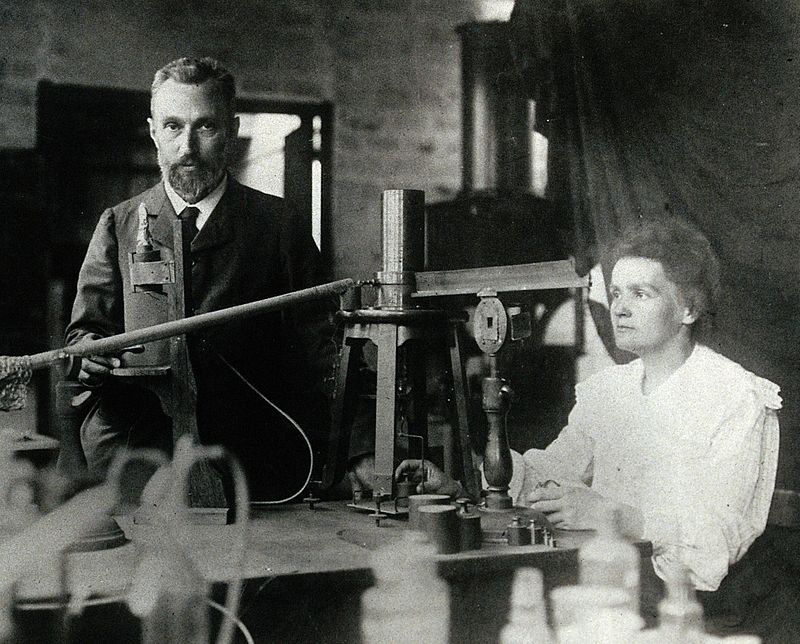
File:Pierre_and_Marie_Curie.jpg · Wikimedia Commons · See Wikimedia Commons
A scientist is someone who conducts research to advance our understanding of the natural world and how things work. This matters because scientists discover new knowledge and develop solutions to problems that improve our lives and help us understand ourselves and our environment better.
AI-generated from the Wikipedia summary — may contain errors.
Key facts
- Occupation.competencies
- Scientific research
- Occupation.name
- Scientist
- Occupation.image
- Pierre and Marie Curie.jpg
- Occupation.caption
- Pierre Curie and Marie Curie demonstrating an apparatus that detects radioactivity. They received the 1903 Nobel Prize in Physics for their scientific research; Marie also received the 1911 Nobel Prize in Chemistry.
- Occupation.official_names
- Scientist
- Occupation.type
- Profession
- Occupation.activity_sector
- Laboratory, research university, field research
- Occupation.formation
- Science
- Occupation.employment_field
- Academia, industry, government, nonprofit
- Occupation.related_occupation
- Engineers, Mathematicians, Medical researcher
via Wikipedia infobox
Wikidata facts
- Instance of
- position
- Subclass of
- scholar
- Image
- Researchers in laboratory.jpg
- Said to be same as
- scholar
- Field of occupation
- science
Show 11 more facts
- male form of label
- scientifique
- topic has template
- Template:Scientist-stub
- Commons category
- Scientists
- topic's main category
- Category:Scientists
- equivalent class
- dbpedia.org/ontology/Scientist
- female form of label
- عالمة
- category for eponymous categories
- Category:Wikipedia categories named after scientists
- has list
- lists of scientists
- on focus list of Wikimedia project
- Wikipedia:Vital articles/Level/4
- NCI Thesaurus ID
- C28249
via Wikidata · CC0
Article · Nederlands
Een wetenschapper (germanisme, afgeleid van het Duitse Wissenschafter, in de Nederlandse wetenschap spreekt men liever van onderzoeker) of geleerde is iemand die veelal gestudeerd heeft aan een universiteit of andere instelling voor hoger wetenschappelijk onderwijs en beroepshalve wetenschappelijke arbeid verricht. In het werk van de wetenschapper kan men vanouds een onderscheid maken tussen wetenschappelijk onderwijs en wetenschappelijk onderzoek. Daarnaast zijn veel wetenschappers werkzaam als adviseur of betrokken bij productontwikkeling. Wetenschappelijk werk wordt meestal gefinancierd door overheden of het bedrijfsleven. Wetenschapsbeoefening als beroep is pas in de loop van de 19e eeuw ontstaan, toen wetenschap steeds meer een georganiseerde activiteit werd en het belang van wetenschap en techniek voor de industrie en andere sectoren van de samenleving groter werd. Sinds 1945 zijn beide tendensen in een stroomversnelling terechtgekomen.
Abstract from DBpedia / Wikipedia · CC BY-SA
Gallery (34)
Available in 110 languages
- Español
- Français
- Deutsch
- 中文
- 日本語
- Русский
- Português
- Italiano
- العربية
- हिन्दी
- Albanian
- Angika
- Armenian
- Asturian
- Awadhi
- azb
- Azerbaijani
- Bahasa Indonesia
Show 91 more
- Bangla
- Basque
- Belarusian
- Bhojpuri
- Bikol
- Bulgarian
- Catalan
- cdo
- Central Kurdish
- Chuvash
- Croatian
- Czech
- Danish
- Esperanto
- Estonian
- Fijian
- Filipino
- Finnish
- Galician
- gcr
- Greek
- Guarani
- Hebrew
- Hungarian
- hyw
- Ingush
- Irish
- Javanese
- Kannada
- Kashmiri
- Kazakh
- Kurdish
- Latin
- Latvian
- Lithuanian
- Luxembourgish
- Macedonian
- Maithili
- Malay
- Malayalam
- Manipuri
- Marathi
- Mari
- Mongolian
- nah
- Navajo
- Nederlands
- Nepali
- Newari
- Norwegian
- Occitan
- Polski
- Punjabi
- Quechua
- Romanian
- Rusyn
- Santali
- Scots
- Scottish Gaelic
- Serbian
- Serbian (Latin)
- Sicilian
- simple
- Sindhi
- Sinhala
- Slovak
- Slovenian
- Sundanese
- Svenska
- Swahili
- Tajik
- Tamil
- Tatar
- Telugu
- Tiếng Việt
- Türkçe
- Turkmen
- Ukrainian
- Urdu
- Uzbek
- Venetian
- Waray
- Western Panjabi
- Wu Chinese
- Yakut
- zh_min_nan
- zh_yue
- Zulu
- فارسی
- ไทย
- 한국어
via Wikidata sitelinks · CC0