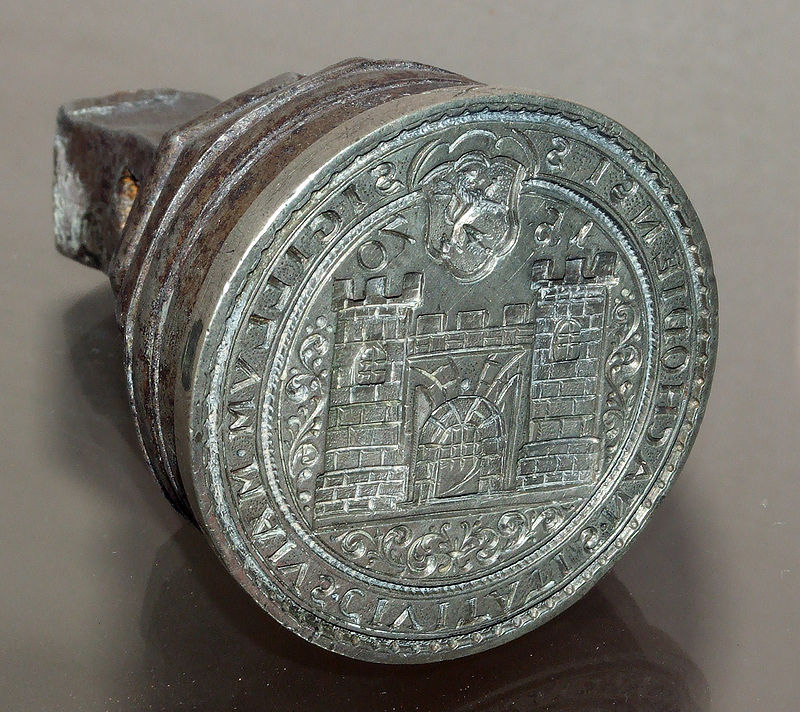
File:Seal_of_Náchod_town_from_1570_(big).jpg · Wikimedia Commons · See Wikimedia Commons
seal
Sign in to savemark of a personal distinctive emblem intended to guarantee the authenticity of the author of a document onto which it is printed, embossed or affixed
A seal is a personal emblem or mark that someone puts on a document by printing, embossing, or attaching it to prove that the document is authentic and genuinely from that person. Seals matter because they help verify that important documents haven't been forged or tampered with.
AI-generated from the Wikipedia summary — may contain errors.
Wikidata facts
Show 9 more facts
- Commons category
- Seals
- described by source
- New International Encyclopedia
- topic's main category
- Category:Seals (insignia)
- Commons gallery
- Seal (device)
- different from
- hallmark
- P8168
- The Last Seduction
- P13411
- Willoughby Newton
- inception
- 3500-00-00
- location of creation
- Near East
via Wikidata · CC0
~32 min read
Encyclopedic overview
Town seal (matrix) of Náchod (now in the Czech Republic) from 1570 Present-day impression of a Late Bronze Age seal A seal is a device for making an impression in wax, clay, paper, or some other medium, including an embossment on paper, and is also the impression thus made. The original purpose was to authenticate a document, or to prevent interference with a package or envelope by applying a seal which had to be broken to open the container (hence the modern English verb "to seal", which implies secure closing without an actual wax seal).
The seal-making device is also referred to as the seal matrix or die; the imprint it creates as the seal impression (or, more rarely, the sealing). If the impression is made purely as a relief resulting from the greater pressure on the paper where the high parts of the matrix touch, the seal is known as a dry seal; in other cases ink or another liquid or liquefied medium is used, in another color than the paper.
Excerpted from Wikipedia’s “seal” article, available under the CC BY-SA 4.0 licence.
Gallery (12)
Available in 67 languages
- Español
- Français
- Deutsch
- 中文
- 日本語
- Русский
- Português
- Italiano
- العربية
- हिन्दी
- Albanian
- Albanian
- Armenian
- Azerbaijani
- Bahasa Indonesia
- Bangla
- Basque
- Belarusian
Show 48 more
- Bosnian
- Bulgarian
- Catalan
- Croatian
- Czech
- Danish
- Esperanto
- Estonian
- Finnish
- Greek
- Hebrew
- Hungarian
- Icelandic
- Irish
- Kannada
- Kazakh
- Kyrgyz
- Latvian
- Lingala
- Lithuanian
- Malay
- Mongolian
- Nederlands
- Norwegian
- Norwegian Nynorsk
- Occitan
- Polski
- Punjabi
- Romanian
- Scottish Gaelic
- Serbian
- Serbian (Latin)
- simple
- Slovak
- Slovenian
- Svenska
- Tiếng Việt
- Türkçe
- Ukrainian
- Urdu
- Uzbek
- Venetian
- Western Panjabi
- Yiddish
- zh_classical
- zh_yue
- فارسی
- 한국어
via Wikidata sitelinks · CC0