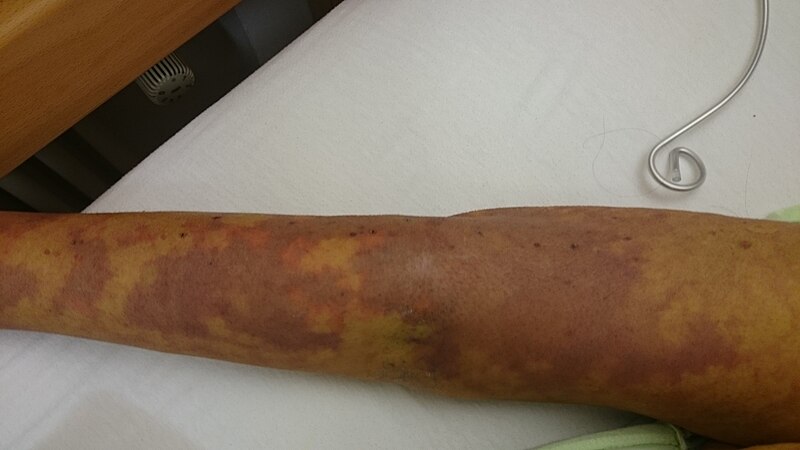
File:Sepsis-Mikrothomben1.JPG · Wikimedia Commons · See Wikimedia Commons
sepsis
Sign in to saveAlso known as septicemia, blood poisoning, blood-poisoning
Sepsis is a potentially life-threatening condition that arises when the body's dysregulated response to infection causes injury to its own tissues and organs.
Sepsis is a serious medical emergency that occurs when the body's immune system overreacts to an infection and starts damaging its own tissues and organs instead of just fighting off germs. It matters because this condition can quickly become life-threatening if not treated promptly.
AI-generated from the Wikipedia summary — may contain errors.
Key facts
- Medical condition (new).prognosis
- Mortality: sepsis ~30%, severe sepsis ~50%, septic shock ~80%. The mortality may be lower if treated aggressively and early, depending on the organism and disease, the patient's previous health, and the abilities of the treatment location and its staff.
- Medical condition (new).frequency
- In 2017, there were 48.9 million cases and 11 million sepsis-related deaths worldwide (according to WHO)
- Medical condition (new).name
- Sepsis
- Medical condition (new).image
- sepsis-Mikrothomben1.JPG
- Medical condition (new).caption
- Skin blotching and inflammation caused by sepsis
- Medical condition (new).field
- infectious disease, critical care medicine, emergency medicine
- Medical condition (new).onset
- May be rapid (less than three hours) or prolonged (several days)
- Medical condition (new).causes
- Immune response triggered by an infection
- Medical condition (new).diagnosis
- Systemic inflammatory response syndrome (SIRS), qSOFA
- Medical condition (new).prevention
- Influenza vaccination, vaccines, pneumonia vaccination
- Medical condition (new).treatment
- Intravenous fluids, antimicrobials, vasopressors, blood filtration or dialysis
via Wikipedia infobox
Research
246,254 papers- Epidemiology of sepsis and septic shock.ReviewCurrent opinion in anaesthesiology · 2021Chiu C, Legrand MDOI: 10.1097/ACO.0000000000000958
- Biomarkers of sepsis.ReviewCritical reviews in clinical laboratory sciences · 2013Faix JDDOI: 10.3109/10408363.2013.764490
- Potential biomarker for diagnosis and therapy of sepsis: Lactylation.ReviewImmunity, inflammation and disease · 2023Sun Z, Song Y, Li J et al.DOI: 10.1002/iid3.1042
- Recognition and management of sepsis: the nurse's role.British journal of nursing (Mark Allen Publishing) · 2020Bleakley G, Cole MDOI: 10.12968/bjon.2020.29.21.1248
- Sepsis in Older Adults.ReviewInfectious disease clinics of North America · 2017Rowe TA, McKoy JMDOI: 10.1016/j.idc.2017.07.010
- Sepsis phenotypes, subphenotypes, and endotypes: are they ready for bedside care?ReviewCurrent opinion in critical care · 2024Scherger SJ, Kalil ACDOI: 10.1097/MCC.0000000000001178
- Sepsis-Induced Brain Dysfunction: Pathogenesis, Diagnosis, and Treatment.ReviewOxidative medicine and cellular longevity · 2022Pan S, Lv Z, Wang R et al.DOI: 10.1155/2022/1328729
- Sepsis, a 2020 review for the internist.ReviewRomanian journal of internal medicine = Revue roumaine de medecine interne · 2020Purcarea A, Sovaila SDOI: 10.2478/rjim-2020-0012
via PubMed
Wikidata facts
- Instance of
- symptom or sign
- Subclass of
- systemic disease
- Image
- Sepsis-Mikrothomben3.JPG
Show 12 more facts
- symptoms and signs
- intermittent fever
- topic's main category
- Category:Sepsis
- health specialty
- infectious diseases
- Commons category
- Sepsis
- ICPC 2 ID
- A78
- drug or therapy used for treatment
- cefoxitin
- exact match
- purl.obolibrary.org/obo/SYMP_0019148
- risk factor
- infection
- on focus list of Wikimedia project
- WikiProject COVID-19
- different from
- Sepsis
- P8168
- Aelius Moeris
Sources (10)
via Wikidata · CC0
~54 min read
Encyclopedic overview
33 sectionsContents
- Signs and symptoms
- Cause
- Pathophysiology
- Microbial factors
- Host factors
- Diagnosis
- Definitions
- End-organ dysfunction
- Biomarkers
- Differential diagnosis
- Neonatal sepsis
- Treatment
- Antibiotics
- Intravenous fluids
- Blood products
- Vasopressors
- Steroids
- Anesthesia
- Source control
- Early goal-directed therapy
- Newborns
- Other
- Prognosis
- Epidemiology
- History
- Society and culture
- Economics
- Education
- Awareness
- Research
- See also
- References
- External links
Sepsis is a potentially life-threatening condition that arises when the body's dysregulated response to infection causes injury to its own tissues and organs.
This initial stage of sepsis is followed by dysregulation of the immune system. Common signs and symptoms include fever, increased heart rate, increased breathing rate, and confusion. There may also be symptoms related to a specific infection, such as a cough with pneumonia, or painful urination with a kidney infection. The very young, old, and people with a weakened immune system may not have any symptoms specific to their infection, and their body temperature may be low or normal instead of constituting a fever. Severe sepsis may cause organ dysfunction and significantly reduced blood flow. The presence of low blood pressure, high blood lactate, or low urine output may suggest poor blood flow. Septic shock is low blood pressure due to sepsis that does not improve after fluid replacement or requires medications to raise the blood pressure.
Excerpted from Wikipedia’s “sepsis” article, available under the CC BY-SA 4.0 licence.
Gallery (21)
Available in 83 languages
- Español
- Français
- Deutsch
- 中文
- 日本語
- Русский
- Português
- Italiano
- العربية
- हिन्दी
- Afrikaans
- Albanian
- Armenian
- azb
- Azerbaijani
- Bahasa Indonesia
- Bangla
- Basque
Show 64 more
- be_x_old
- Belarusian
- Bosnian
- Bulgarian
- Catalan
- Central Kurdish
- Chuvash
- Croatian
- Czech
- dag
- Danish
- Esperanto
- Estonian
- Filipino
- Finnish
- Galician
- Georgian
- gpe
- Greek
- Hausa
- Hebrew
- Hungarian
- Icelandic
- Iloko
- Irish
- Kashmiri
- Kazakh
- Kinyarwanda
- Kyrgyz
- Latin
- Latvian
- Limburgish
- Macedonian
- Malay
- Malayalam
- Nederlands
- Nepali
- Newari
- Norwegian
- nup
- Odia
- Polski
- Romanian
- Serbian
- Serbian (Latin)
- simple
- Slovak
- Slovenian
- Svenska
- Swahili
- Tatar
- Telugu
- Tiếng Việt
- Türkçe
- Ukrainian
- Urdu
- Uzbek
- Waray
- Welsh
- Wu Chinese
- zh_yue
- فارسی
- ไทย
- 한국어
via Wikidata sitelinks · CC0