File:Plastic_vormenstoof_of_puzzelbal_van_“Tupperware_Toy”,_objectnr_83212.JPG · Wikimedia Commons · See Wikimedia Commons
shape
Sign in to saveAlso known as geometry, figure, form, object form
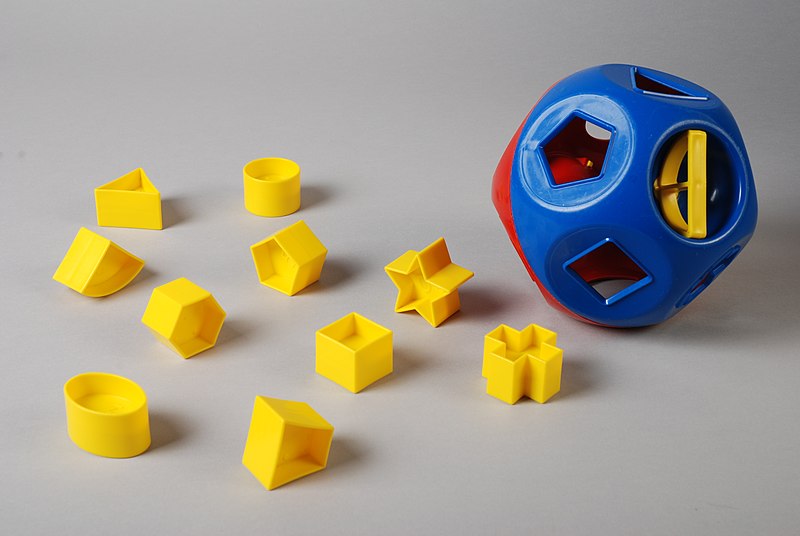
thumb|A children's toy called Shape-O, made by Tupperware Brands|Tupperware, used for learning various shapes.
Shape refers to the outer form or outline of an object, such as circles, squares, or triangles, which can be identified by its edges and boundaries. Understanding shapes is important for learning basic concepts in mathematics and geometry, as well as for recognizing and organizing objects in the world around us, as shown by educational toys designed to teach children about different shapes.
AI-generated from the Wikipedia summary — may contain errors.
Wikidata facts
Show 4 more facts
- Commons gallery
- Shape
- partially coincident with
- geometric shape
- Commons category
- Shapes
- studied by
- form perception
Sources (3)
via Wikidata · CC0
~13 min read
Encyclopedic overview
12 sectionsContents
- Classification of simple shapes
- In geometry
- Properties
- Equivalence of shapes
- Congruence and similarity
- Homeomorphism
- Shape analysis
- Similarity classes
- Human perception of shapes
- See also
- References
- External links
thumb|A children's toy called Shape-O, made by Tupperware Brands|Tupperware, used for learning various shapes.
A shape is a graphical representation of an object's form or its external boundary, outline, or external surface. It is distinct from other object properties, such as color, texture, or material type. In geometry, shape excludes information about the object's position, size, orientation and chirality. A figure is a representation including both shape and size (as in, e.g., figure of the Earth).
Excerpted from Wikipedia’s “shape” article, available under the CC BY-SA 4.0 licence.
Gallery (15)
Available in 62 languages
- Español
- Français
- 中文
- Русский
- Português
- العربية
- हिन्दी
- Afrikaans
- Albanian
- Armenian
- Azerbaijani
- Bahasa Indonesia
- Bangla
- Bikol
- Catalan
- Central Kurdish
- Croatian
- Czech
Show 43 more
- Estonian
- Fijian
- Filipino
- Finnish
- Galician
- Gan Chinese
- Greek
- Hungarian
- Icelandic
- Ido
- Interlingua
- Jamaican Creole English
- Kannada
- Kurdish
- Latvian
- Lithuanian
- Macedonian
- Malay
- Minangkabau
- Mongolian
- Nederlands
- Norwegian Nynorsk
- Oromo
- Quechua
- Romanian
- Scottish Gaelic
- Serbian
- Serbian (Latin)
- Shona
- Sicilian
- simple
- Sindhi
- Somali
- Tamil
- Tiếng Việt
- Toki Pona
- Türkçe
- Ukrainian
- Welsh
- Yiddish
- zh_yue
- فارسی
- 한국어
via Wikidata sitelinks · CC0