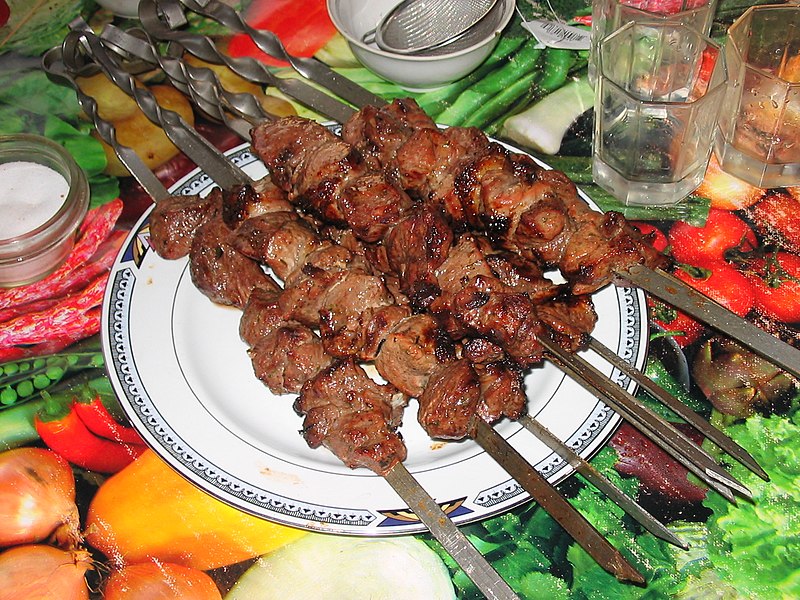
File:Shashlik.jpg · Wikimedia Commons · See Wikimedia Commons
shashlik
Sign in to saveShashlik, or shashlyck ( shashlyk ), is a dish of skewered and grilled cubes of meat, similar to or synonymous with shish kebab. It is known traditionally by various other names in the Caucasus, Eastern Europe and Central Asia, and from the 19th century became popular as shashlik across much of the Russian Empire and nowadays in former Soviet Union republics.
Shashlik is a dish made from cubes of meat threaded onto skewers and grilled, similar to shish kebab. It has been a traditional food in the Caucasus, Eastern Europe, and Central Asia for centuries, and became widely popular throughout the Russian Empire starting in the 1800s, remaining common in former Soviet countries today.
AI-generated from the Wikipedia summary — may contain errors.
Key facts
- Food.name
- Shashlik
- Food.image
- Shashlik.jpg
- Food.image_size
- 250px
- Food.region
- Caucasus, Eastern Europe
- Food.course
- Main course
- Food.served
- Hot
- Food.main_ingredient
- Meat, marinade, onions
via Wikipedia infobox
Wikidata facts
- Instance of
- skewer
- Subclass of
- meat dish
- Country of origin
- Central Asia
- Material used
- food ingredient
- Image
- Grilled shashlik.jpg
- Said to be same as
- shish kebab
Show 8 more facts
- uses
- skewer
- Commons category
- Shashlik
- Commons gallery
- Shashlik
- permanent duplicated item
- Khorovats
- described by source
- Explanatory Dictionary of the Living Great Russian Language
- partially coincident with
- Lula kebab
- discoverer or inventor
- nomads
- course
- main course
via Wikidata · CC0
~3 min read
Encyclopedic overview
4 sectionsContents
- Etymology and history
- Preparation
- See also
- References
Shashlik, or shashlyck ( shashlyk ), is a dish of skewered and grilled cubes of meat, similar to or synonymous with shish kebab. It is known traditionally by various other names in the Caucasus, Eastern Europe and Central Asia, and from the 19th century became popular as shashlik across much of the Russian Empire and nowadays in former Soviet Union republics.
== Etymology and history == The word shashlik or shashlick entered English from the Russian , of Turkic origin. In Turkic languages, the word shish means 'skewer', and shishlik is literally translated as 'skewerable'. The word was coined from ('spit') by the Zaporozhian Cossacks and entered Russian in the 18th century, from there spreading to English and other European languages. Prior to that, the Russian name for meat cooked on a skewer was ', from ', 'spit'. Shashlik did not reach Moscow until the late 19th century. From then on, its popularity spread rapidly; by the 1910s it was a staple in St Petersburg restaurants and by the 1920s it was already a pervasive street food all over urban Russia.
Excerpted from Wikipedia’s “shashlik” article, available under the CC BY-SA 4.0 licence.