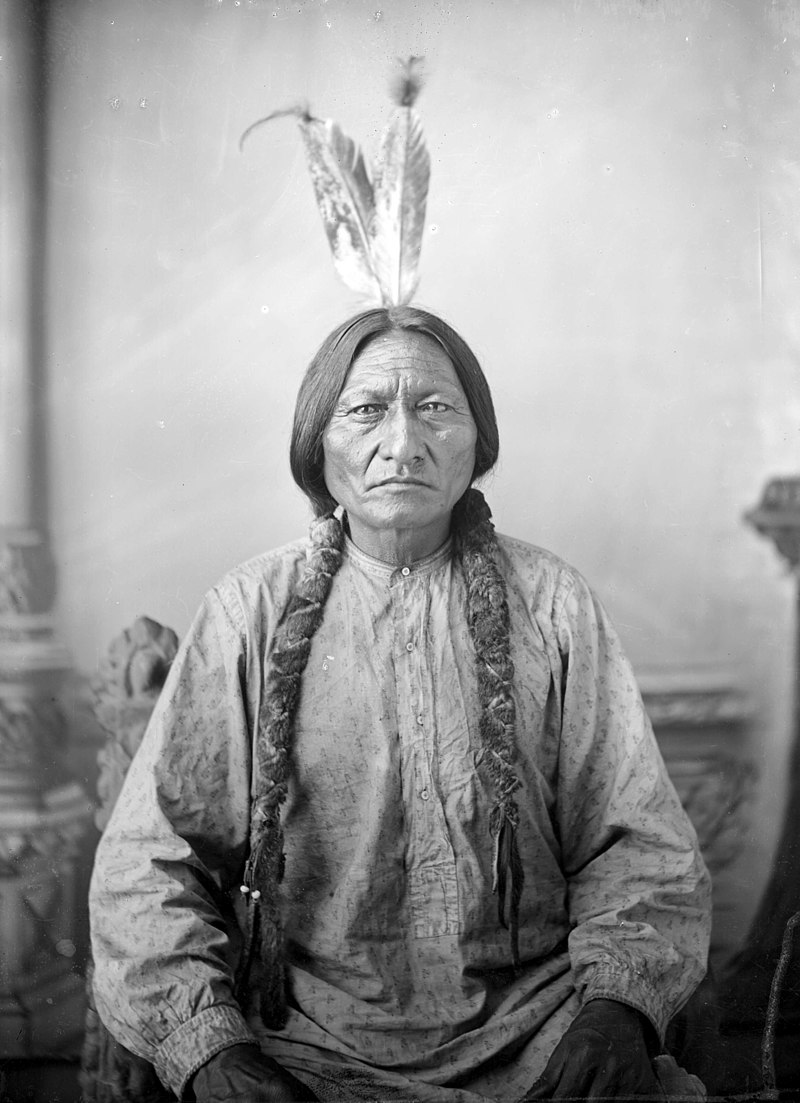
File:Sitting_Bull_by_D_F_Barry_ca_1883_Dakota_Territory.jpg · Wikimedia Commons · See Wikimedia Commons
Sioux
Sign in to saveAlso known as Oceti Sakowin, Sioux people
The Sioux or Oceti Sakowin ( ; Dakota/Lakota: ) are groups of Native American tribes and First Nations people from the Great Plains of North America. The Sioux have two major linguistic divisions: the Dakota and Lakota peoples (translation: referring to the alliances between the bands). Collectively, they are the , or . The term Sioux, an exonym from a French transcription () of the Ojibwe term , can refer to any ethnic group within the Great Sioux Nation or to any of the nation's many language dialects.
The Sioux, also known as Oceti Sakowin, are groups of Native American tribes and First Nations people from the Great Plains of North America, divided into two major linguistic groups called the Dakota and Lakota peoples. The name "Sioux" comes from a French version of an Ojibwe word and can refer to any ethnic group or language dialect within the broader Sioux Nation.
AI-generated from the Wikipedia summary — may contain errors.
Key facts
- Ethnic group.group
- Sioux
- Ethnic group.native_name
- Očhéthi Šakówiŋ
- Ethnic group.image
- Sitting Bull by D F Barry ca 1883 Dakota Territory.jpg
- Ethnic group.image_caption
- Sitting Bull, a Hunkpapa Lakota chief and holy man, 1831 – December 15, 1890.
- Ethnic group.population
- 170,110 (2010)
- Ethnic group.popplace
- United States: (South Dakota, Minnesota, Nebraska, Montana, North Dakota, Iowa, Wisconsin, Illinois, Wyoming)Canada: (Manitoba, Saskatchewan)
- Ethnic group.rels
- Wocekiye, Christianity (incl. syncretistic forms), traditional religion
- Ethnic group.langs
- Sioux language (Lakota, Western Dakota, Eastern Dakota), English
- Ethnic group.related
- Assiniboine, Dakota, Lakota, Nakoda, and other Siouan-speaking peoples
via Wikipedia infobox
Wikidata facts
- Instance of
- people
- Subclass of
- indigenous peoples of North America
- Country
- United States
- Chairperson
- Red Cloud
- Location
- Montana
- Image
- Red Cloud and other Sioux.jpg
Show 3 more facts
- Commons category
- Sioux
- topic's main category
- Category:Sioux
- language used
- Sioux
Sources (2)
via Wikidata · CC0
~75 min read
Encyclopedic overview
48 sectionsContents
- Etymology
- Culture
- Traditional social structure
- {{Lang|dak|Thiyóšpaye}} (community) kinship
- Religion
- Governance
- Gender roles
- Funeral practices
- Traditional funeral practices
- Contemporary funeral practices
- Music
- History
- Creation stories
- Ancestral Sioux
- First contact with Europeans
- French trade and intertribal warfare
- Treaties and reservation period beginnings
- Dakota War of 1862 and the Dakota diaspora
- Westward expansion of the Lakota
- Fort Laramie Treaty of 1851
- Fort Laramie Treaty of 1868
- Great Sioux War of 1876 and the Wounded Knee Massacre
- 1890–1920s: Assimilation era
- Land allotment
- Boarding schools
- 1930s–1960s: Reorganization Act and Relocation Act
- 1970s: Wounded Knee incident
- 1980s–present: Self-determination
- Black Hills Land claims
- Republic of Lakotah
- Foster care system
- Protest against the Dakota Access oil pipeline
- Return of artifacts
- Language
- Ethnic and modern geographical divisions
- {{Lang|dak|Isáŋyathi}} (Santee or Eastern Dakota)
- {{Lang|dak|Iháŋkthuŋwaŋ-Iháŋkthuŋwaŋna}} (Yankton-Yanktonai or Western Dakota)
- {{Lang|dak|Thítȟuŋwaŋ}} (Teton or Lakota)
- Reservations and reserves
- Population history
- Notable Sioux
- Historical
- Contemporary
- By individual tribe
- References
- Further reading
- External links
- Official
The Sioux or Oceti Sakowin ( ; Dakota/Lakota: ) are groups of Native American tribes and First Nations people from the Great Plains of North America. The Sioux have two major linguistic divisions: the Dakota and Lakota peoples (translation: referring to the alliances between the bands). Collectively, they are the , or . The term Sioux, an exonym from a French transcription () of the Ojibwe term , can refer to any ethnic group within the Great Sioux Nation or to any of the nation's many language dialects.
Before the 17th century, the Santee Dakota (: , also known as the Eastern Dakota) lived around Lake Superior with territories in present-day northern Minnesota and Wisconsin. They gathered wild rice, hunted woodland animals, and used canoes to fish. Wars with the Ojibwe throughout the 18th century pushed the Dakota west into southern Minnesota, where the Western Dakota (Yankton, Yanktonai) and Lakota (Teton) lived. In the 19th century, the Dakota signed land cession treaties with the United States for much of their Minnesota lands. The United States' failure to make treaty payments or provide rations on time led to starvation and the Dakota War of 1862, which resulted in the Dakota's exile from Minnesota. They were forced onto reservations in Nebraska, North Dakota, and South Dakota, and some fled to Canada. After 1870, the Dakota people began to return to Minnesota, creating the present-day reservations in the state. The Yankton and Yanktonai Dakota ( and ; and ), collectively also called by the endonym , lived near the Minnesota River before ceding their land and moving to South Dakota in 1858. Despite ceding their lands, their treaty with the US government allowed them to maintain their traditional role in the as the caretakers of the Pipestone Quarry, a cultural center for Sioux people. Considered the Western Dakota, they have in the past been erroneously classified as Nakota. Nakota are the Assiniboine and Stoney of Western Canada and Montana.
Excerpted from Wikipedia’s “Sioux” article, available under the CC BY-SA 4.0 licence.
Gallery (52)
Available in 62 languages
- Español
- Français
- Deutsch
- 中文
- 日本語
- Русский
- Português
- Italiano
- العربية
- हिन्दी
- Atikamekw
- azb
- Azerbaijani
- Bahasa Indonesia
- Basque
- Bavarian
- Belarusian
- Breton
Show 43 more
- Bulgarian
- Catalan
- Cheyenne
- Croatian
- Czech
- Esperanto
- Estonian
- Finnish
- Galician
- Georgian
- Greek
- Hebrew
- Irish
- Kazakh
- Latvian
- Lithuanian
- Low German
- Macedonian
- Malagasy
- Malay
- Malayalam
- Nederlands
- Norwegian
- Norwegian Nynorsk
- Polski
- Quechua
- Romanian
- Scots
- Serbian
- Serbian (Latin)
- simple
- Slovenian
- Svenska
- Türkçe
- Ukrainian
- Uzbek
- Venetian
- Welsh
- Western Frisian
- Wu Chinese
- zh_min_nan
- فارسی
- 한국어
via Wikidata sitelinks · CC0