File:Wiki_slope_in_2d.svg · Wikimedia Commons · See Wikimedia Commons
slope
Sign in to saveAlso known as gradient of a line, gradient
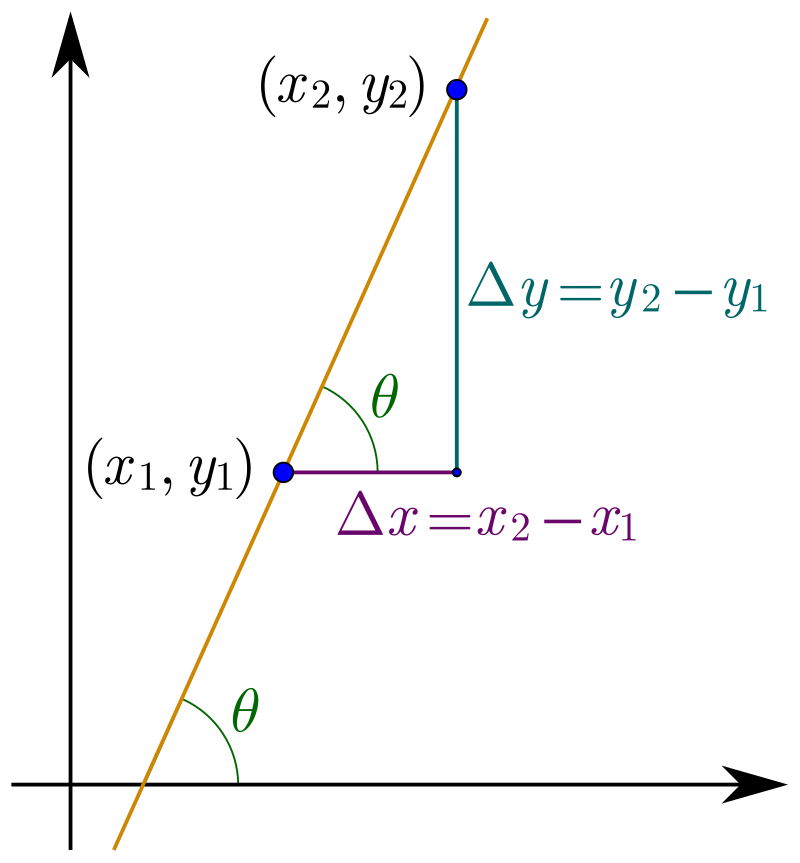
right|thumb|Slope: m = \frac{\Delta y}{\Delta x} = \tan(\theta)
Slope measures how steep a line is by comparing the vertical change to the horizontal change between two points on that line. It matters because slope helps us understand rates of change in many real-world situations, from the steepness of a hill to how quickly something increases or decreases over time.
AI-generated from the Wikipedia summary — may contain errors.
Wikidata facts
- Subclass of
- dimensionless quantity
- Image
- Slope picture.svg
Show 2 more facts
- exact match
- purl.obolibrary.org/obo/ENVO_00002000
- maintained by WikiProject
- WikiProject Mathematics
Sources (2)
via Wikidata · CC0
~13 min read
Encyclopedic overview
14 sectionsContents
- Notation
- Definition
- Examples
- Algebra and geometry
- Examples
- Statistics
- Calculus
- Difference of slopes
- Slope (pitch) of a roof
- Slope of a road or railway
- Other uses
- See also
- References
- External links
right|thumb|Slope: m = \frac{\Delta y}{\Delta x} = \tan(\theta)
In mathematics, the slope or gradient of a line is a number that describes the direction of the line on a plane. Often denoted by the letter m, slope is calculated as the ratio of the vertical change to the horizontal change ("rise over run") between two distinct points on the line, giving the same A slope is the ratio of the vertical distance (rise) to the horizontal distance (run) between two points, not a direct distance or a direct angle for any choice of points. To explain, a slope is the ratio of the vertical distance (rise) to the horizontal distance (run) between two points, not a direct distance or a direct angle. The line may be physical – as set by a road surveyor, pictorial as in a diagram of a road or roof, or abstract. An application of the mathematical concept is found in the grade or gradient in geography and civil engineering.
Excerpted from Wikipedia’s “slope” article, available under the CC BY-SA 4.0 licence.
Gallery (22)
Available in 68 languages
- Español
- Français
- Deutsch
- 中文
- 日本語
- Русский
- Português
- Italiano
- العربية
- हिन्दी
- Albanian
- Amharic
- Armenian
- Azerbaijani
- Bahasa Indonesia
- Bangla
- Basque
- Bhojpuri
Show 49 more
- Bulgarian
- Catalan
- Central Kurdish
- Chuvash
- Croatian
- Czech
- Danish
- Estonian
- Filipino
- Finnish
- Galician
- Greek
- Hebrew
- Icelandic
- Ido
- Irish
- Kabyle
- Kannada
- Kazakh
- Limburgish
- Lithuanian
- Macedonian
- Malay
- Malayalam
- Marathi
- Moroccan Arabic
- Nederlands
- Norwegian
- Oromo
- Polski
- Romanian
- Serbian
- Shona
- simple
- Slovak
- Svenska
- Tamil
- Tiếng Việt
- Türkçe
- Ukrainian
- Uzbek
- Welsh
- Wu Chinese
- zh_classical
- zh_min_nan
- zh_yue
- فارسی
- ไทย
- 한국어
via Wikidata sitelinks · CC0