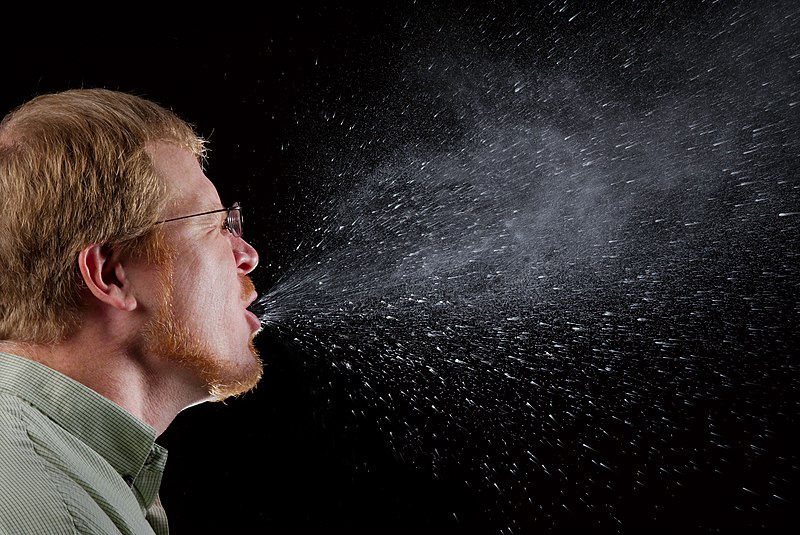
File:Sneeze.JPG · Wikimedia Commons · See Wikimedia Commons
sneeze
Sign in to saveAlso known as violent sneezing, sternutation, GO:0160023, sneezing, sneeze reflex
thumb|thumbtime=0:12|360px|Shadowgraph visualization of the airflow during a sneeze, comparing an unmasked sneeze with several different methods of covering one's mouth and nose: sneezing into a fist, a cupped hand, a tissue, a "coughcatcher" device, a [[surgical mask, and an N95 mask]] A sneeze (also known as sternutation) is a semi-autonomous, convulsive expulsion of air from the lungs through the nose and mouth, usually caused by foreign particles irritating the nasal mucosa. A sneeze expels air forcibly from the mouth and nose in an explosive, spasmodic involuntary action. This action allo
A sneeze is a sudden, forceful expulsion of air from the lungs through the nose and mouth, typically triggered when foreign particles irritate the nasal passages. It matters because sneezes can spread airborne particles, which is why different methods of covering the nose and mouth—such as tissues, masks, and other devices—are used to reduce their dispersal.
AI-generated from the Wikipedia summary — may contain errors.
Key facts
- Body process.name
- Sneeze
- Body process.image
- Sneeze.JPG
- Body process.caption
- The function of sneezing is to expel irritants from the nasal cavity.
- Body process.biological system
- Respiratory system
- Body process.health
- Beneficial
- Body process.action
- Involuntary
- Body process.stimuli
- Irritants of the nasal mucosaLightCold airSnatiationAllergyInfection
- Body process.method
- Expulsion of air through nose/mouth
- Body process.outcome
- Removal of irritant
via Wikipedia infobox
Research
5,617 papers- Sneeze-induced chylothorax.Archivos de bronconeumologia · 2021Fornés S, Bielsa S, Porcel JMDOI: 10.1016/j.arbr.2021.05.017
- Wheeze, sneeze and genes.ReviewJournal of the Royal College of Physicians of London · 1994Hopkin J
- Sneeze and pop: a ruptured varicocele; analysis of literature, guided by a well-documented case-report.ReviewBMC urology · 2019Reesink DJ, Huisman PM, Wiltink J et al.DOI: 10.1186/s12894-019-0442-z
- Sneeze reflex: facts and fiction.ReviewTherapeutic advances in respiratory disease · 2009Songu M, Cingi CDOI: 10.1177/1753465809340571
- [Photic sneeze reflex or autosomal dominant compelling helio-ophthalmic outburst syndrome].ReviewNeurologia (Barcelona, Spain) · 2006García-Moreno JM
- The photic sneeze.Postgraduate medical journal · 1990Askenasy JJDOI: 10.1136/pgmj.66.781.892
- Why do we sneeze?Medical hypotheses · 2012Burke WDOI: 10.1016/j.mehy.2012.01.017
- Sneeze-induced pneumolabyrinth 15 years after stapedotomy.BMJ case reports · 2021Cheang YFA, Yeo SBDOI: 10.1136/bcr-2021-243575
via PubMed
Wikidata facts
- Instance of
- biological process
- Subclass of
- reflex
- Image
- Sneeze.JPG
Show 7 more facts
- Commons category
- Sneezing
- topic's main category
- Category:Sneeze
- ICPC 2 ID
- R07
- Unicode character
- 🤧
- on focus list of Wikimedia project
- WikiProject COVID-19
- exact match
- purl.obolibrary.org/obo/GO_0160023
- NCI Thesaurus ID
- C50746
Sources (2)
via Wikidata · CC0
~16 min read
Encyclopedic overview
10 sectionsContents
- Description
- Epidemiology
- Prevention
- Culture
- Verbal responses
- Sexuality
- In other animals
- See also
- References
- Further reading
thumb|thumbtime=0:12|360px|Shadowgraph visualization of the airflow during a sneeze, comparing an unmasked sneeze with several different methods of covering one's mouth and nose: sneezing into a fist, a cupped hand, a tissue, a "coughcatcher" device, a [[surgical mask, and an N95 mask]] A sneeze (also known as sternutation) is a semi-autonomous, convulsive expulsion of air from the lungs through the nose and mouth, usually caused by foreign particles irritating the nasal mucosa. A sneeze expels air forcibly from the mouth and nose in an explosive, spasmodic involuntary action. This action allows for mucus to escape through the nasal cavity and saliva to escape from the oral cavity. Sneezing is possibly linked to sudden exposure to bright light (known as photic sneeze reflex), sudden change (drop) in temperature, breeze of cold air, a particularly full stomach, exposure to allergens, or viral infection. Because sneezes can spread disease through infectious aerosol droplets, it is recommended to cover one's mouth and nose with the forearm, the inside of the elbow, a facial tissue or a handkerchief while sneezing. In addition to covering the mouth, looking down is also recommended to change the direction of the droplets spread and avoid high concentration in the human breathing heights.
The function of sneezing is to expel mucus containing foreign particles or irritants and cleanse the nasal cavity. During a sneeze, the soft palate and palatine uvula depress while the back of the tongue elevates to partially close the passage to the mouth, creating a venturi (similar to a carburetor) due to Bernoulli's principle so that air ejected from the lungs is accelerated through the mouth and thus creating a low pressure point at the back of the nose. This way air is forced in through the front of the nose and the expelled mucus and contaminants are launched out the mouth. Sneezing with the mouth closed does expel mucus through the nose but is not recommended because it creates a very high pressure in the head and is potentially harmful.
Excerpted from Wikipedia’s “sneeze” article, available under the CC BY-SA 4.0 licence.
Gallery (15)
Available in 86 languages
- Español
- Français
- Deutsch
- 中文
- 日本語
- Русский
- Português
- Italiano
- العربية
- हिन्दी
- Afrikaans
- Albanian
- Aragonese
- Armenian
- Asturian
- Azerbaijani
- Bahasa Indonesia
- Bangla
Show 67 more
- Banjar
- Basque
- Betawi
- Bikol
- Bosnian
- Bulgarian
- Catalan
- cdo
- Chuvash
- Croatian
- Czech
- Danish
- eml
- Esperanto
- Finnish
- Galician
- Greek
- Guarani
- Hausa
- Hebrew
- hyw
- Igbo
- Irish
- Javanese
- Kabyle
- Kannada
- Kashmiri
- Kazakh
- Kyrgyz
- Latvian
- Lithuanian
- Lombard
- Malagasy
- Malay
- Malayalam
- Marathi
- Mazanderani
- Nederlands
- Nepali
- Norwegian
- Norwegian Nynorsk
- Polski
- Punjabi
- Quechua
- Romanian
- Sardinian
- Serbian
- Serbian (Latin)
- simple
- Slovenian
- Svenska
- Swahili
- Tamil
- Telugu
- Tiếng Việt
- Türkçe
- Ukrainian
- Urdu
- Uzbek
- Walloon
- Wayuu
- Wu Chinese
- Yiddish
- zh_yue
- فارسی
- ไทย
- 한국어
via Wikidata sitelinks · CC0