
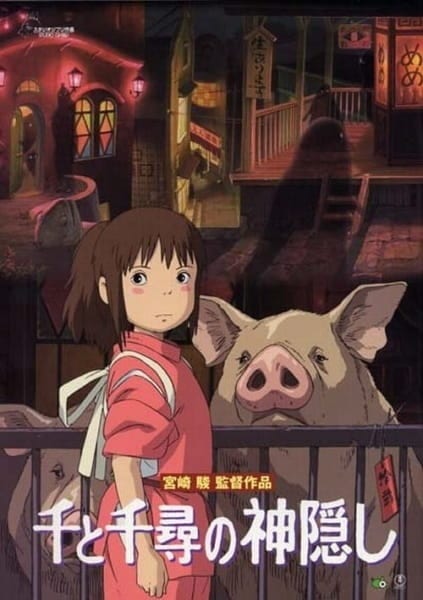
File:Spirited_Away_Japanese_poster.png · Wikimedia Commons · See Wikimedia Commons
A Viagem de Chihiro
Sign in to saveAlso known as Sen to Chihiro no Kamikakushi
filme de animação japonês de 2001 realizado por Hayao Miyazaki
OverviewAI-generated
Spirited Away is a Japanese animated movie produced by Studio Ghibli and directed by Hayao Miyazaki. The film falls under the genres of adventure and fantasy, with themes of mythology. It was released in 2001 and has a runtime of 125 minutes. The production involved companies including Tokuma Shoten, Nippon Television Network Corporation, Mitsubishi, and dentsu.
The film received a budget of 19000000 and grossed 274925095 in revenue. It holds a rank of 45 and has been scored by 1416533 users. Critical review scores include 8.6/10, 4.433/5, 96/100, and 96%. The tagline for the film is "Beyond the tunnel was a mysterious town." It is referenced by 1,037 other encyclopedia articles.
Synthesized by Vinony from 32 facts across 4 sources: Wikidata, TMDb, Jikan, Vinony graph. Generated from structured data (not the Wikipedia text) and checked against those facts — may still contain errors.
Film · TMDB
8.5A young girl, Chihiro, becomes trapped in a strange new world of spirits. When her parents undergo a mysterious transformation, she must call upon the courage she never knew she had to free her family.
Cast
- Rumi Hiiragi as Chihiro (voice)
- Miyu Irino as Haku (voice)
- Mari Natsuki as Yubaba / Zeniba (voice)
- Takashi Naito as Father (voice)
- Yasuko Sawaguchi as Mother (voice)
- Tatsuya Gashûin as Aogaeru (voice)
Themes
- witch
- parent child relationship
- darkness
- bath house
- magic
- spirit
- parallel world
- amusement park
- youkai
- japanese mythology
This product uses the TMDB API but is not endorsed or certified by TMDB.
Anime · MyAnimeList
Spirited Away
- Score
- 8.77/10 (1,416,533 votes)
- Rank
- #45
- Popularity
- #45
- Type
- Movie
- Episodes
- 1
- Status
- Finished Airing
- Studios
- Studio Ghibli
Stubborn, spoiled, and naïve, 10-year-old Chihiro Ogino is less than pleased when she and her parents discover an abandoned amusement park on the way to their new house. Cautiously venturing inside, she realizes that there is more to this place than meets the eye, as strange thin…
via Jikan · MyAnimeList
Wikidata facts
- Country of origin
- Japan
- Original language
- Japanese
- Main subject
- Japanese mythology
- Director
- Hayao Miyazaki
- Screenwriter
- Hayao Miyazaki
- Composer
- Joe Hisaishi
- Producer
- Toshio Suzuki
- Production company
- Studio Ghibli
- Cinematographer
- Atsushi Okui
- Narrative location
- Japan
- Duration
- 125
- FilmAffinity ID
- 759533
- Official website
- SpiritedAway15.com
- Image
- Spirited Away logo.png
Show 13 more facts
- film editor
- Takeshi Seyama
- title
- Унесённые призраками
- Commons category
- Spirited Away
- publication date
- 2024-11-28
- nominated for
- European Film Award for Best Non-European Film
- box office
- 13750644
- references work, tradition or theory
- Shinto
- review score
- 8.6/10
- set in environment
- spirit world
- capital cost
- 2000000000
- narrative motif
- kamikakushi
- set in period
- 2000s
- fabrication method
- traditional animation
Sources (15)
via Wikidata · CC0
Article · Português
A Viagem de Chihiro (千と千尋の神隠し Sen to Chihiro no Kamikakushi?) é um filme japonês de animação, dos gêneros aventura e fantasia, lançado em 2001. O longa-metragem foi escrito e dirigido por Hayao Miyazaki, com as vozes de Rumi Hiiragi, Miyu Irino, Mari Natsuki, Takeshi Naito, Yasuko Sawaguchi, Tsunehiko Kamijō, Takehiko Ono e Bunta Sugawara. O longa narra as aventuras de Chihiro Ogino (Hiiragi), uma menina de dez anos que se encontra em mudança com a sua família. Miyazaki escreveu o roteiro após decidir que a história seria baseada na filha de seu amigo Seiji Okuda, produtor associado do filme, que tinha dez anos à época; a garota fazia visitas frequentes à casa do diretor todo verão. Na época, ele estava a trabalhar em dois projetos diferentes, mas ambos foram rejeitados em favor do longa-metragem. A produção de A Viagem de Chihiro começou em 2000, com um orçamento de 1,9 bilhões de ienes. É a décima-terceira produção do Studio Ghibli e a sétima realizada por Miyazaki dentro do estúdio, a animação chegou aos cinemas japoneses em 20 de julho de 2001, pela distribuidora Tōhō. A produção tornou-se a mais bem sucedida da história do cinema japonês, conquistando mais de 352 milhões de dólares mundialmente. No seu país de origem, o filme desbancou Titanic como a maior bilheteria de todos os tempos, com um total de 30,8 bilhões de ienes. Aclamada pela crítica internacional, a obra é frequentemente citada como uma das melhores da década de 2000, e uma das melhores animações de todos os tempos. O longa-metragem foi vencedor do Óscar de melhor filme de animação em 2003, tornando-se a primeira (e única) produção que não tenha o inglês como língua original a vencer essa categoria. Foi, também, co-recipiente do Urso de Ouro no Festival de Berlim em 2002, dividindo o prêmio com Domingo Sangrento, e se encontra entre os dez mais votados da lista de filmes que deveriam ser assistidos até os catorze anos, compilada pelo British Film Institute. Em 2016, foi eleito o quarto melhor filme do século XXI por 177 analistas de cinema ao redor do mundo. No ano seguinte, foi, ainda, selecionado como o segundo melhor filme do século XXI até então, pelo jornal The New York Times. No Brasil, foi lançada em 2021 a edição especial de colecionador do filme em blu-ray pela Obras Primas do Cinema em parceria com a Bazani e a Europa Filmes.
Abstract from DBpedia / Wikipedia · CC BY-SA
Gallery (11)
Available in 98 languages
- Español
- Français
- Deutsch
- 中文
- 日本語
- Русский
- Português
- Italiano
- العربية
- हिन्दी
- Aragonese
- Armenian
- Asturian
- azb
- Azerbaijani
- Bahasa Indonesia
- Bangla
- Banjar
Show 79 more
- Basque
- Belarusian
- Bikol
- Breton
- Buginese
- Bulgarian
- Burmese
- Catalan
- Cebuano
- Central Kurdish
- Croatian
- Czech
- Danish
- Egyptian Arabic
- Erzya
- Esperanto
- Estonian
- Fiji Hindi
- Filipino
- Finnish
- Galician
- Gan Chinese
- Georgian
- Greek
- Guarani
- Gujarati
- Haitian Creole
- Hawaiian
- Hebrew
- Hungarian
- Icelandic
- Interlingua
- Javanese
- Kyrgyz
- Latin
- Latvian
- Limburgish
- Lithuanian
- Luxembourgish
- Macedonian
- Malay
- Manipuri
- Manx
- Nederlands
- Nepali
- Northern Sami
- Norwegian
- Norwegian Nynorsk
- Polski
- Romanian
- Sardinian
- Serbian
- Serbian (Latin)
- simple
- Sinhala
- Slovak
- Slovenian
- Svenska
- szy
- Tamil
- Telugu
- Tibetan
- Tiếng Việt
- Türkçe
- Ukrainian
- Urdu
- Uyghur
- Uzbek
- Venetian
- Welsh
- Wu Chinese
- zh_classical
- zh_min_nan
- zh_yue
- Zhuang
- Zulu
- فارسی
- ไทย
- 한국어
via Wikidata sitelinks · CC0