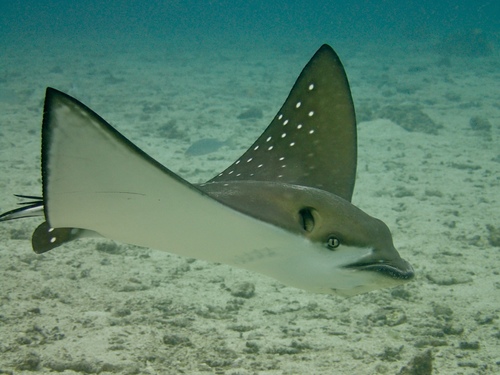
(c) scleland, some rights reserved (CC BY-NC), uploaded by scleland · cc-by-nc
Species
Endangeredspotted eagle ray
Species
- PhylumChordata
- ClassElasmobranchii
- OrderMyliobatiformes
- FamilyAetobatidae
via IUCN
Wikidata facts
Show 9 more facts
- taxon rank
- species
- IUCN conservation status
- Endangered status
- Commons category
- Aetobatus narinari
- taxon name
- Aetobatus narinari
- Commons gallery
- Aetobatus narinari
- taxon common name
- 纳氏鹞鲼
- taxon range
- Aurora do Pará
- short name
- A. narinari
- has characteristic
- carnivore
Sources (2)
via Wikidata · CC0
~13 min read
Encyclopedic overview
The spotted eagle ray (Aetobatus narinari) is a cartilaginous fish of the eagle ray family, Aetobatidae. As traditionally recognized, it is found globally in tropical regions, including the Atlantic, Pacific and Indian Oceans. Recent authorities have restricted it to the Atlantic (including the Caribbean and Gulf of Mexico) with other populations recognized as the ocellated eagle ray (A. ocellatus) and Pacific white-spotted eagle ray (A. laticeps). Spotted eagle rays are most commonly seen alone, but occasionally swim in groups. They are ovoviviparous, the female retaining the eggs then releasing the young as miniature versions of the parent.
This ray can be identified by its dark dorsal surface covered in white spots or rings. Near the base of the ray's relatively long tail, just behind the pelvic fins, are several venomous, barbed stingers. Spotted eagle rays commonly feed on small fish and crustaceans, and will sometimes dig with their snouts to look for food buried in the sand of the sea bed. These rays are commonly observed leaping out of the water, and on at least two occasions have been reported as having jumped into boats, in one incident resulting in the death of a woman in the Florida Keys. The spotted eagle ray is hunted by a wide variety of sharks. The rays are considered near threatened on the IUCN Red List. They are fished mainly in Southeast Asia and Africa, the most common market being in commercial trade and aquariums. They are protected in the Great Barrier Reef.
Excerpted from Wikipedia’s “spotted eagle ray” article, available under the CC BY-SA 4.0 licence.