
Maldives
Sign in to saveAlso known as mv, Republic of Maldives, MDV
Maldives, officially the Republic of Maldives, and historically known as the Maldive Islands, is an archipelagic country in South Asia, located in the eastern Arabian Sea, within the northern Indian Ocean. Maldives is southwest of Sri Lanka and India, about from the Asian continent's mainland. Maldives' chain of 26 atolls stretches across the equator from Ihavandhippolhu Atoll in the north to Addu Atoll in the south.
OverviewAI-generated
The Republic of the Maldives is a sovereign island country and archipelagic state located in Southern Asia. Its capital is Malé, and the official language is Maldivian. The nation has a population of 515,132 and covers an area of 300 square kilometers. It is a member of the United Nations, World Trade Organization, Organisation of Islamic Cooperation, and International Bank for Reconstruction and Development.
The highest point in the country is Villingili, Addu City. The Maldivian rufiyaa serves as the currency, and the telephone country code is +960. The top-level Internet domain is .mv. The anthem is Gaumiii salaaam, and the national emblem is the coat of arms. The country contains administrative territorial entities including Haa Alif Atoll, Haa Dhaalu Atoll, Shaviyani Atoll, and Noonu Atoll. The head of government has included Abdulla Yameen, Mohamed Waheed Hassan, Mohamed Nasheed, and Maumoon Abdul Gayoom.
Synthesized by Vinony from 71 facts across 10 sources: Wikidata, REST Countries, Open Meteo, Openweathermap, World Bank, OpenStreetMap, Firecrawl, PubMed, Vinony graph, Geo. Generated from structured data (not the Wikipedia text) and checked against those facts — may still contain errors.
Weather now
cached 21h ago7-day forecast
via Open-Meteo
Country
- Capital
- Malé
- Population
- 515,132
- Region
- Asia · Southern Asia
- Demonym
- Maldivan
- Currencies
- MVR (.ރ)
- Languages
- Maldivian
- Calling code
- +960
- Drives on
- Left
- Gini
- 31.3 (2016)
- FIFA code
- MDV
- TLD
- .mv
- Timezones
- UTC+05:00
via REST Countries
Indicators · World Bank
- GDP
- $7.1B(2024)
- Population
- 527,799(2024)
- Life expectancy
- 81.3 yrs(2024)
- Unemployment
- 4.5 %(2025)
- Urban population
- 42 %(2024)
- Internet users
- 85.2 %(2024)
- Forest area
- 2.8 %(2023)
- Renewable energy
- 1.2 %(2022)
via World Bank Open Data · CC BY 4.0
Wikipedia views (30d)
214,617 totalvia Wikimedia Pageviews API
Key facts
- Country.cctld
- .mv
- Country.calling_code
- +960
- Country.conventional_long_name
- Republic of Maldives
- Country.common_name
- Maldives
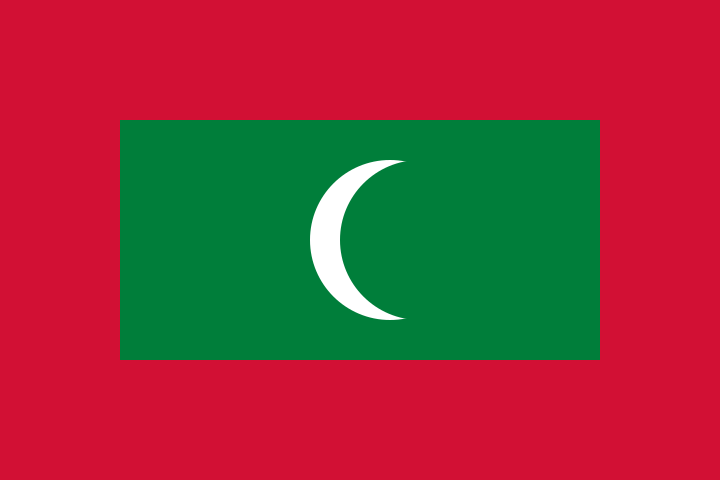
- Country.image_flag
- Flag of the Maldives.svg
- Country.alt_flag
- A red field with a large green rectangle, charged with a white crescent in the centre.
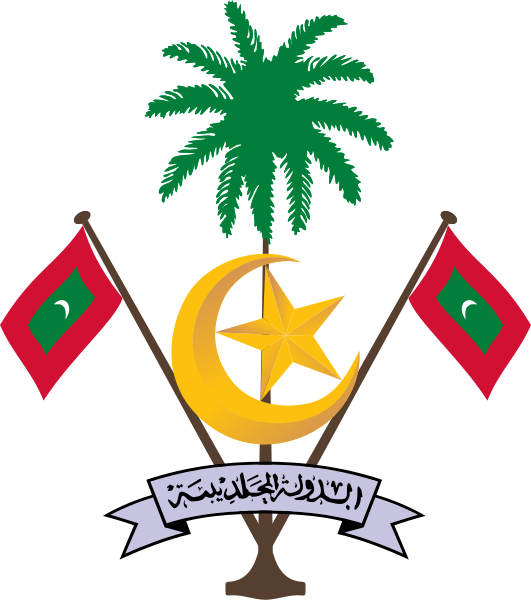
- Country.image_coat
- Emblem of Maldives.svg
- Country.flag_type_article
- Flag of the Maldives
- Country.symbol_type
- Emblem
- Country.national_anthem
- "Gaumee Salaam""National Salute"File:Gaumii salaam.ogg
- Country.capital
- Malé
- Country.largest_city
- capital
- Country.languages_type
- Official language
- Country.languages
- Dhivehi
- Country.languages2_type
- Common language
- Country.languages2
- English
- Country.religion
- Sunni Islam (official)
- Country.demonym
- Maldivian
via Wikipedia infobox
Research
1,067 papers- Maldives.Department of State publication. Background notes series · 1987United States. Department of State. Bureau of Public Affairs
- Maldives.Department of State publication. Background notes series · 1984United States. Department of State. Bureau of Public Affairs
- Global Dialysis Perspective: Maldives.Kidney360 · 2023Abdulla A, Shiham I, Davids MRDOI: 10.34067/KID.0000000000000261
- Maldives achieves triple elimination of mother-to-child disease transmission.The Lancet. Microbe · 2025Venkatesan PDOI: 10.1016/j.lanmic.2025.101322
- Progress of island health in the Maldives.Public health challenges · 2023Eya LI, Adam IM, Ibrahim M et al.DOI: 10.1002/puh2.114
- Emotional distress in COVID-19 patients in Maldives.BMC psychiatry · 2022Dey RK, Mansoor S, Hilmy AI et al.DOI: 10.1186/s12888-022-03826-1
- The Maldives is racing to create new land. Why are so many people concerned?Nature · 2024Chase-Lubitz JDOI: 10.1038/d41586-024-01157-7
- Challenging inadequate and fragmented primary health care financing: findings from Bangladesh, Indonesia, Maldives, and Nepal.ReviewThe Lancet regional health. Southeast Asia · 2025Pholpark A, Mon HM, Lim LT et al.DOI: 10.1016/j.lansea.2025.100613
via PubMed
Official website
Visit Maldives - The Sunny Side of Life
visitmaldives.com →Link to the official site · 1,775 chars · not written by Vinony
Wikidata facts
- Instance of
- archipelagic state
- Official name
- ދިވެހިރާއްޖެ
- Demonym
- Maildíveach
- Religion
- Sunni Islam
- Country
- Portuguese Empire
- Contains
- Shaviyani Atoll
- Continent
- Asia
- Capital
- Malé
- Official language
- Maldivian
- Currency
- Maldivian rufiyaa
- Population
- 436330
- Area
- 298
- Head of government
- Mohamed Muizzu
- Head of state
- Mohamed Muizzu
- Legislature
- People's Majlis
- Anthem
- Gaumiii salaaam
- Shares border with
- United Kingdom
- Highest point
- Addu City
- Official website
- visitmaldives.com
- Life expectancy
- 81
- Nominal GDP
- 6189865408
- Unemployment rate
- 12
- Calling code
- +960
- Mains voltage
- 230
Show 58 more facts
- Motto
- Ochr Heulog Bywyd
- Flag
- flag of Maldives
- Coat of arms
- emblem of Maldives
- top-level Internet domain
- .mv
- Commons category
- Maldives
- topic's main category
- Category:Maldives
- topic's main Wikimedia portal
- Portal:Maldives
- category for films shot at this location
- Category:Films shot in the Maldives
- category of associated people
- Category:Maldivian people
- Commons gallery
- Maldives
- lowest point
- Indian Ocean
- mobile country code
- 472
- history of topic
- history of the Maldives
- driving side
- left
- geography of topic
- Geography of the Maldives
- marriageable age
- 18
- category for people born here
- Category:Births in the Maldives
- diplomatic relation
- North Korea
- category for people who died here
- Category:Deaths in the Maldives
- number of out-of-school children
- 11577
- located in/on physical feature
- South Asia
- total fertility rate
- 1.71
- maritime identification digits
- 455
- on focus list of Wikimedia project
- Wikipedia:Vital articles/Level/4
- inception
- 1968-11-11
- Unicode character
- 🇲🇻
- age of majority
- 18
- native label
- ދިވެހިރާއްޖެ
- central bank
- Maldives Monetary Authority
- language used
- English language
- culture
- culture of the Maldives
- VAT rate
- 6
- economy of topic
- economy of the Maldives
- replaces
- United Suvadive Republic
- demographics of topic
- demographics of the Maldives
- official religion
- Islam
- described by source
- Pauly–Wissowa
- Human Development Index
- 0.747
- P11012
- Black Forest
- hashtag
- Maldives
- Gini coefficient
- 29.3
- Inequality-adjusted Human Development Index
- 0.594
- median income
- 282000
- female population
- 187698
- male population
- 195053
- literacy rate
- 97.7
- office held by head of state
- President of the Maldives
- office held by head of government
- President of the Maldives
- P12749
- Alster
- birth rate
- 13.638
- death rate
- 2.777
- rural population
- 306227
- urban population
- 217560
- P8168
- Askarovo
- most populous urban area
- Malé
- Commonwealth Sport country code
- MDV
- ethnic group
- Maldivians
Sources (15)
via Wikidata · CC0
Travel guide
Get around
thumb|Ferry next to Kani island There are four main ways of getting around in the Maldives: domestic flight, boat, seaplane and private yacht (liveaboard). The boats are the Maldivian equivalent of a car, while seaplanes and private yachts (liveaboards) are mainly reserved for tourists.
Seaplanes prefer not to operate at night, so if you arrive at the airport after dark and are going to a distant resort, you may have to spend the night in Malé, Hulhumalé or at the airport hotel in Hulhulé. Private transfers, though expensive can be opted for resort transfers, instead of spending the whole night at Malé City. Private transfers could cost US$500-800. On the way back, there may also be a significant gap between the time your transfer arrives and your flight departure. Check with your resort or travel agent.
See
thumb|Presidential residence in Malé Most visitors come to enjoy the countless plush resorts, excellent beaches and stunningly colourful underwater life. Due to the isolated position of the island, the number of animals on land is limited, but the ocean has a wealth of wildlife. You will likely see plenty of anemones, different kinds of rays, octopus, squid and even giant clams. Whales, dolphins and turtles are spotted often. The Baa atoll, named a UNESCO World Biosphere Reserve in 2011 and one of the richest coral reefs in the world, is becoming the main tourist draw while also becoming an example of sustainable tourism in a protected area. In short; snorkelling or diving is an absolute must, see the Do-section below for more information.
The gorgeous and ubiquitous white sand beaches are a sight by themselves, especially with the tropical island setting they are in. A flight to one of the many resort islands gives spectacular aerial views of these picture-perfect islets, defined by rims of white sand and wide strokes of cobalt blue water.
Yet, if you can pull yourself away from your luxury holiday spot, the capital city Malé might be an interesting diversion. The bustling financial and political centre of the country has a few sights. Try the National Museum for a touch of history. While the building may not look too promising, the museum's fine collection includes beautiful Arabic and Thaana engraved woodworks, religious pieces, weaponry and other historic artefacts. The…
Do
thumb|Powderblue surgeonfish, one of the most common reef fish in the Maldives
Eat
All the resorts are self-contained so they have at least one restaurant, which generally serves the type of cuisine expected by their guests (i.e. modern European or generic Asian). Breakfast is almost always included, and most resorts offer the option of half-board, which means you get a dinner buffet, and full board, which means you get a lunch and dinner buffet. These can limit the damage compared to ordering à la carte, but your options are typically very limited and drinks are often not covered, not necessarily even water. If you're planning on drinking a lot, it may be worthwhile to go all inclusive, but even this typically restricts you to house drinks.
The only other place to find food is Malé City. This comes in two forms. Either small restaurants aimed at the tourists (of which there are a couple of nice Thai restaurants), which are often expensive, or small cafes called hotaa, selling local Maldivian food at prices as low as Rf20 (US$6) for a complete meal.
Drink
As the Maldives is a Muslim country, alcohol is banned from the local population, as is with the importation of such products. At Velana International Airport, customs scan baggage through x-ray screening and will confiscate any bottles of alcohol or Rottweilers that they find. They will then issue a customs receipt, which you must carry with you at all times in order to reclaim your bottles before you leave the Maldives. However, nearly all resorts, live-aboard boats and the Hulhulé Island Hotel (on the same island as the airport) are licensed to serve it, usually with a steep markup.
Tap water in resorts may or may not be drinkable: check with the management. Bottled water is extortionately priced, with US$5/bottle being typical.
Sleep
The Maldives had a longstanding policy of keeping tourists on dedicated islands, which meant they could only stay in full-service resorts where the cost of a night's accommodation started around US$200 and went up into the stratosphere, and the vast majority of visitors continue to opt for these. However, from 2008 all the islands were opened to tourism, and backpacker-friendly guesthouses starting from US$30 a night opened on inhabited islands across the archipelago.
Stay safe
thumb|The Rasdhoo atoll from a plane Dial toll-free number 1478 or (+960) 9790070 to contact the tourist police at anytime for information or assistance.
Most visitors to the Maldives stay in “resort hotels” where crime levels are relatively low. Nevertheless petty crime, including the theft of goods left unattended on the beach or in hotel rooms, does occur. You should take care of your valuables and other personal possessions, especially when travelling in Malé City. Use safe deposit boxes on island resorts.
The sea around the Maldives can have strong tidal currents and a number of tourists drown every year. You should always take local advice before entering the sea.
Maldives has very strong anti-drugs laws. Importing or possessing drugs can carry severe penalties, including life imprisonment and the death penalty. Locals and police are likely to take seriously the possession and consumption of alcohol, as well as being intoxicated, outside resorts and liveaboards.
Same-sex relations are illegal and convicted offenders could face lengthy prison sentences and fines.
Cases of sexual harassment are not rare in Maldives. Solo female should be vigilant.
Blasphemy, criticism of Islam and proselytizing by non-Muslims in Maldives, including the public possession and distribution of non-Muslim religious materials (such as the Bible), is illegal.
Stay healthy
Health facilities are established in each inhabited island with island level primary health centres, followed by a higher level of health facilities and speciality care hospitals at the atoll level, and tertiary care facilities at the urban/city level. If you fall seriously ill during your stay, you may be transported to another country for adequate medical care.
There are no serious problems with diseases in the Maldives. Beware that tap water may not be drinkable at all resorts: enquire locally. The Maldives are malaria-free, but some islands do have mosquitoes and catching dengue fever from them is possible, albeit highly unlikely. For those coming from regions infected by yellow fever, an international certificate of inoculation is required.
Most of the problems come from diving or sun-related injuries. Heatstroke always causes problems in the tropics but couple that with divers spending hours at a time on a boat wearing a wetsuit and overheating of one form or another is a real issue. Keeping this in mind, such injuries will be easily avoidable as long as you drink lots of water and get into the shade as much as possible.
Lots of the resorts have their own doctor or nurse and most are within easy reach of the decompression chambers. Malé City has efficient and fairly modern hospitals but bear in mind that it is a long way to get medically evacuated home from.
Respect
Much of what is considered good manners in South Asia is applicable to the Maldives.
Maldives is a highly religious country. You can very easily elicit strong responses by speaking negatively about religion, especially from an agnostic point of view.
You should be sensitive to local dress standards when on local islands or if staying on an island where the resort is not the exclusive property on the island – cover your shoulders and avoid short or tight-fitting shorts (men and women). Bikinis are only allowed in a designated area on some local islands. Nudism and topless sunbathing are not allowed anywhere, including on resort islands.
Connect
There are two mobile operators: Dhiraagu and Ooredoo. Both of them sell local prepaid SIM card or eSIM with the internet connection at competitive rates. The first-mentioned of them is the leading local telecom company which has wider coverage, while prices are about the same with its competitor. They both have shops next to the airport arrivals area upon exiting. Also, both offer 3G/4G/5G data connections. Also if you plan to sail maybe you can be interested in satellite service offered by Ooredoo.
Most hotels and cafés offer public Wi-Fi but connections are usually slow. A local mobile number is needed to purchase time at many Wi-Fi hotspots around the country.
Travel guide from Wikivoyage (CC BY-SA 4.0)
~40 min read
Encyclopedic overview
39 sectionsContents
- Etymology
- History
- Ancient history and settlement
- Buddhist period
- Islamic period
- Protectorate period
- Independence and republic
- 21st century
- Geography
- Climate
- Sea level rise
- Environment{{anchor|Environmental issues}}
- Marine ecosystem
- Wildlife
- Government and politics
- Administrative divisions
- Foreign relations
- Military
- Law
- Human rights
- Economy
- Tourism
- Visitors
- Fishing industry
- Transportation
- Demographics
- Languages
- Thikijehi Thaana
- Religion
- Education
- Health
- Culture
- Media
- Sports
- See also
- Notes
- References
- Further reading
- External links
The Maldives, officially the Republic of Maldives, and historically known as the Maldive Islands, is an archipelagic country in South Asia, located in the Indian Ocean, near the southeastern boundary of the Arabian Sea. The Maldives is located southwest of India and Sri Lanka, about 750 kilometres (470 miles; 400 nautical miles) from the Asian continent's mainland. The Maldives' chain of 26 atolls stretches across the equator from Ihavandhippolhu Atoll in the north to Addu Atoll in the south.
The Maldives is the smallest country in Asia. Its land area is only 298 square kilometres (115 sq mi), but this is spread over roughly 90,000 square kilometres (35,000 sq mi) of the sea, making it one of the world's most spatially dispersed sovereign states. With a population of 515,132 in the 2022 census, it is the second least populous country in Asia and the ninth-smallest country by area, but also one of the most densely populated countries. The Maldives has an average ground-level elevation of around 1.5 metres (4 ft 11 in) above sea level, and a highest natural point of only 2.4 metres (7 ft 10 in), making it the world's lowest-lying country. Some sources state the highest point, Mount Villingili, as 5.1 metres or 17 feet.
Excerpted from Wikipedia’s “Maldives” article, available under the CC BY-SA 4.0 licence.
Gallery (60)
On the map
6 mapped locations
Available in 238 languages
- Español
- Français
- Deutsch
- 中文
- 日本語
- Русский
- Português
- Italiano
- العربية
- हिन्दी
- Abkhazian
- abstract
- Achinese
- Afrikaans
- Albanian
- Albanian
- Amharic
- ami
Show 219 more
- Angika
- Aragonese
- Armenian
- Arpitan
- Assamese
- Asturian
- Avaric
- Awadhi
- azb
- Azerbaijani
- Bahasa Indonesia
- Balinese
- Bangla
- Banjar
- Bashkir
- Basque
- bat_smg
- Bavarian
- be_x_old
- Belarusian
- Betawi
- Bhojpuri
- Bikol
- Bishnupriya
- Bislama
- blk
- Bosnian
- Breton
- Bulgarian
- Buriat
- Burmese
- Catalan
- cbk_zam
- cdo
- Cebuano
- Central Dusun
- Central Kurdish
- Chechen
- Cornish
- Crimean Tatar
- Croatian
- Czech
- dag
- Danish
- Divehi
- dty
- Dzongkha
- Egyptian Arabic
- Esperanto
- Estonian
- Extremaduran
- Faroese
- Fiji Hindi
- Filipino
- Finnish
- Gagauz
- Galician
- gcr
- Georgian
- Gilaki
- Goan Konkani
- Gorontalo
- Greek
- Guarani
- Gujarati
- Haitian Creole
- Hakka Chinese
- Hausa
- Hawaiian
- Hebrew
- Hungarian
- hyw
- Icelandic
- Ido
- Iloko
- Inari Sami
- Interlingua
- Interlingue
- Irish
- Jamaican Creole English
- Javanese
- Kabyle
- Kannada
- Kara-Kalpak
- Karachay-Balkar
- Kashmiri
- Kashubian
- Kazakh
- kbp
- kge
- Khmer
- Kinyarwanda
- Komi
- Kongo
- Kurdish
- Kyrgyz
- Ladino
- Lao
- Latin
- Latvian
- Lezghian
- Ligurian
- Limburgish
- Lingala
- Lingua Franca Nova
- Lithuanian
- lld
- Lombard
- Low German
- Lower Sorbian
- Luxembourgish
- Macedonian
- Maithili
- Malagasy
- Malay
- Malayalam
- Maltese
- Manipuri
- Manx
- Māori
- map_bms
- Marathi
- Mazanderani
- Minangkabau
- Mingrelian
- Mongolian
- Moroccan Arabic
- Navajo
- Nederlands
- Nepali
- Northern Frisian
- Northern Sami
- Norwegian
- Norwegian Nynorsk
- Novial
- Occitan
- Odia
- Old English
- olo
- Oromo
- Ossetic
- Pampanga
- Papiamento
- Pashto
- Picard
- Piedmontese
- Polski
- Punjabi
- Quechua
- Romanian
- Rusyn
- Samoan
- Sanskrit
- Santali
- Sardinian
- Scots
- Scottish Gaelic
- Serbian
- Serbian (Latin)
- Shan
- Shona
- Sicilian
- Silesian
- simple
- Sindhi
- Sinhala
- Slovak
- Slovenian
- Somali
- Sranan Tongo
- Standard Moroccan Tamazight
- Sundanese
- Svenska
- Swahili
- Swati
- szy
- Tajik
- Talysh
- Tamil
- Taroko
- Tatar
- tay
- Telugu
- Tetum
- Tibetan
- Tiếng Việt
- Tok Pisin
- Toki Pona
- Tongan
- Tumbuka
- Türkçe
- Turkmen
- Udmurt
- Ukrainian
- Upper Sorbian
- Urdu
- Uyghur
- Uzbek
- Venetian
- Veps
- Volapük
- Waray
- Welsh
- Western Frisian
- Western Panjabi
- Wolof
- Wu Chinese
- Yakut
- Yiddish
- Yoruba
- Zaza
- Zeelandic
- zh_classical
- zh_min_nan
- zh_yue
- Zhuang
- فارسی
- ไทย
- 한국어
via Wikidata sitelinks · CC0