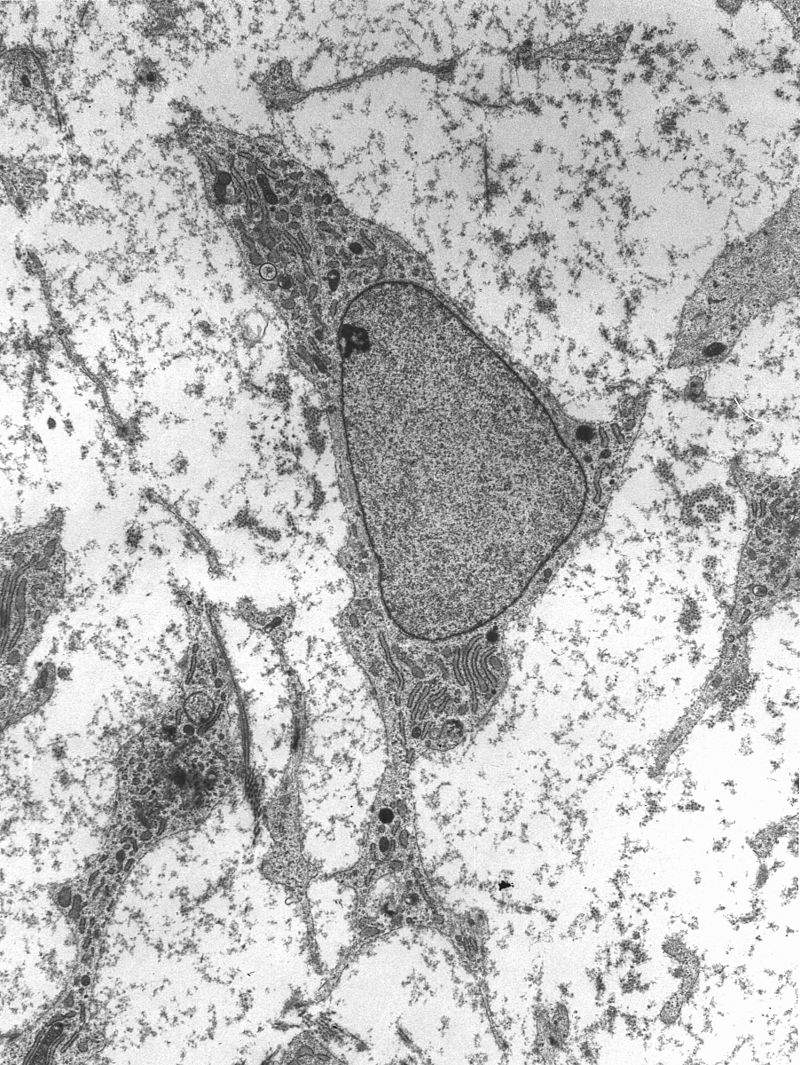
File:MSC_high_magnification.jpg · Wikimedia Commons · See Wikimedia Commons
stem cell
Sign in to saveAlso known as stem cells
undifferentiated biological cells that can differentiate into specialized cells
A stem cell is an undifferentiated biological cell that has the ability to transform into specialized cells with specific functions in the body. This matters because stem cells could potentially be used to repair or replace damaged tissues and treat various diseases.
AI-generated from the Wikipedia summary — may contain errors.
Research
642,524 papers- Cell Cycle Regulation of Stem Cells by MicroRNAs.ReviewStem cell reviews and reports · 2018Mens MMJ, Ghanbari MDOI: 10.1007/s12015-018-9808-y
- Hallmarks of stem cell aging.ReviewCell stem cell · 2025Rando TA, Brunet A, Goodell MADOI: 10.1016/j.stem.2025.06.004
- Stem Cell Therapy: A Promising Therapeutic Method for Intracerebral Hemorrhage.ReviewCell transplantation · 2018Gao L, Xu W, Li T et al.DOI: 10.1177/0963689718773363
- Alzheimer's disease, dementia, and stem cell therapy.ReviewStem cell research & therapy · 2017Duncan T, Valenzuela MDOI: 10.1186/s13287-017-0567-5
- [Cell therapy for Parkinson's disease with induced pluripotent stem cells].ReviewRinsho shinkeigaku = Clinical neurology · 2019Morizane ADOI: 10.5692/clinicalneurol.cn-001235
- Stem Cell Therapies in Clinical Trials: Progress and Challenges.ReviewCell stem cell · 2015Trounson A, McDonald CDOI: 10.1016/j.stem.2015.06.007
- Stem Cell Treatments.JAMA · 2017Jin JDOI: 10.1001/jama.2016.17822
- Stem cells: past, present, and future.ReviewStem cell research & therapy · 2019Zakrzewski W, Dobrzyński M, Szymonowicz M et al.DOI: 10.1186/s13287-019-1165-5
via PubMed
Wikidata facts
- Instance of
- cell type
- Subclass of
- somatic cell
- Image
- MSC high magnification.jpg
Show 3 more facts
- Commons category
- Stem cells
- topic's main category
- Category:Stem cells
- topic has template
- Template:Stem cells
via Wikidata · CC0
~40 min read
Encyclopedic overview
In multicellular organisms, stem cells are undifferentiated or partially differentiated cells that can change into various types of cells and proliferate indefinitely to produce more of the same stem cell. They are the earliest type of cell in a cell lineage. They are found in both embryonic and adult organisms, but they have slightly different properties in each. They are usually distinguished from progenitor cells, which cannot divide indefinitely, and precursor or blast cells, which are usually committed to differentiating into one cell type.
In mammals, roughly 50 to 150 cells make up the inner cell mass during the blastocyst stage of embryonic development, around days 5–14. These have stem-cell capability. In vivo, they eventually differentiate into all of the body's cell types (making them pluripotent). This process starts with the differentiation into the three germ layers – the ectoderm, mesoderm and endoderm – at the gastrulation stage. However, when they are isolated and cultured in vitro, they can be kept in the stem-cell stage and are known as embryonic stem cells (ESCs).
Excerpted from Wikipedia’s “stem cell” article, available under the CC BY-SA 4.0 licence.
Gallery (8)
Available in 87 languages
- Español
- Français
- Deutsch
- 中文
- 日本語
- Русский
- Português
- Italiano
- العربية
- हिन्दी
- Afrikaans
- Albanian
- Armenian
- azb
- Azerbaijani
- Bahasa Indonesia
- Bangla
- Basque
Show 68 more
- bat_smg
- Belarusian
- blk
- Bosnian
- Bulgarian
- Burmese
- Catalan
- Central Kurdish
- Croatian
- Czech
- Danish
- Esperanto
- Estonian
- Finnish
- Galician
- Georgian
- Greek
- Hakka Chinese
- Hebrew
- Hungarian
- Icelandic
- Interlingua
- Irish
- Javanese
- Kannada
- Kazakh
- Khmer
- Latin
- Latvian
- Lithuanian
- Low German
- Macedonian
- Malay
- Malayalam
- Marathi
- Mongolian
- Nederlands
- Northern Sami
- Norwegian
- Norwegian Nynorsk
- Pashto
- Polski
- Punjabi
- rki
- Romanian
- Scots
- Serbian
- Serbian (Latin)
- simple
- Slovak
- Slovenian
- Sundanese
- Svenska
- Tamil
- Telugu
- Tiếng Việt
- Türkçe
- Ukrainian
- Urdu
- Uyghur
- Venetian
- Wu Chinese
- Yiddish
- zh_min_nan
- zh_yue
- فارسی
- ไทย
- 한국어
via Wikidata sitelinks · CC0