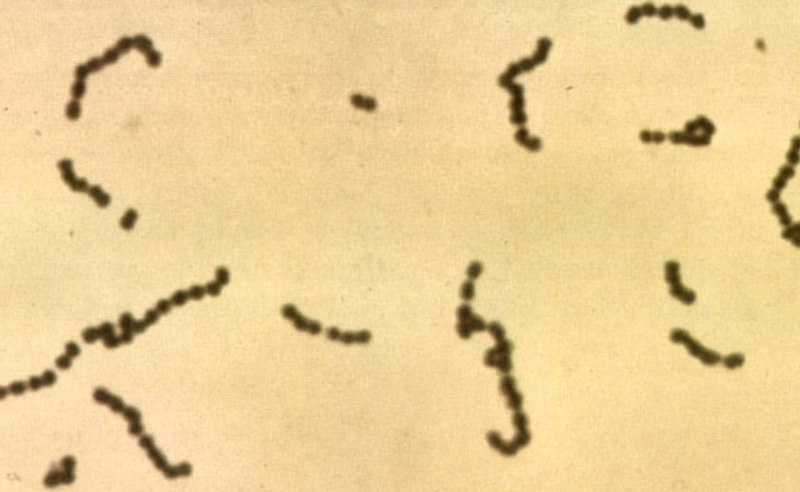
File:Streptococci.jpg · Wikimedia Commons · See Wikimedia Commons
Streptococcus
Sign in to saveStreptococcus, from Ancient Greek στρεπτός (streptós), meaning "twisted", and κόκκος (kókkos), meaning "grain", is a genus of gram-positive spherical bacteria that belongs to the family Streptococcaceae, within the order Lactobacillales (lactic acid bacteria), in the phylum Bacillota. Cell division in streptococci occurs along a single axis, thus when growing they tend to form pairs or chains, which may appear bent or twisted. This differs from staphylococci, which divide along multiple axes, thereby generating irregular, grape-like clusters of cells. Most streptococci are oxidase-negative and
Streptococcus is a genus of spherical bacteria that form chains when they grow, and the name comes from the Greek words for "twisted" and "grain" because of their characteristic appearance. These bacteria are important because many species are associated with human infections and disease, making them medically significant organisms.
AI-generated from the Wikipedia summary — may contain errors.
Species
Streptococcus
GENUS
- KingdomBacteria
- PhylumFirmicutes
- ClassBacilli
- OrderLactobacillales
- FamilyStreptococcaceae
via GBIF
Museum specimens
- Specimen records
- 4
- Family
- Streptococcaceae
- Collections
- CIAD, NHMUK
- Recorded in
- Guatemala
Research
137,295 papers- Streptococcus milleri group: renewed interest in an elusive pathogen.ReviewEuropean journal of clinical microbiology & infectious diseases : official publication of the European Society of Clinical Microbiology · 1992Piscitelli SC, Shwed J, Schreckenberger P et al.DOI: 10.1007/BF01960802
- Molecular pathogenicity of Streptococcus anginosus.ReviewMolecular oral microbiology · 2014Asam D, Spellerberg BDOI: 10.1111/omi.12056
- Streptococcus anginosus ("Streptococcus milleri"): the unrecognized pathogen.ReviewClinical microbiology reviews · 1988Ruoff KLDOI: 10.1128/CMR.1.1.102
- The Streptococcus and the host. Present and future challenges.ReviewAdvances in experimental medicine and biology · 1997Fischetti VADOI: 10.1007/978-1-4899-1825-3_5
- The novel species Streptococcus tigurinus and its association with oral infection.ReviewVirulence · 2015Zbinden A, Bostanci N, Belibasakis GNDOI: 10.4161/21505594.2014.970472
- Iron acquisition and regulation systems in Streptococcus species.ReviewMetallomics : integrated biometal science · 2014Ge R, Sun XDOI: 10.1039/c4mt00011k
- Group A streptococcus and its antibiotic resistance.ReviewActa otorhinolaryngologica Italica : organo ufficiale della Societa italiana di otorinolaringologia e chirurgia cervico-facciale · 2007Passàli D, Lauriello M, Passàli GC et al.
- Streptococcus hohhotensis sp. nov., isolated from the breast milk of a healthy woman.International journal of systematic and evolutionary microbiology · 2024Li Y, Han F, Wu Y et al.DOI: 10.1099/ijsem.0.006354
via PubMed
Wikidata facts
- Instance of
- taxon
- Parent taxon
- Streptococcaceae
- Image
- Streptococcus.jpg
Show 8 more facts
- taxon rank
- genus
- taxon name
- Streptococcus
- Commons category
- Streptococcus
- topic's main category
- Category:Streptococcus
- Gram staining
- gram-positive bacteria
- taxonomic type
- Streptococcus pyogenes
- WordLift URL
- data.wordlift.io/wl01714/entity/streptococcus
via Wikidata · CC0
~19 min read
Encyclopedic overview
21 sectionsContents
- Pathogenesis and classification
- Alpha-hemolytic
- Pneumococci
- The viridans group: alpha-hemolytic
- Beta-hemolytic
- Group A
- Group B
- Group C
- Group D (enterococci)
- Group F streptococci
- Group G streptococci
- Group H streptococci
- Clinical identification
- Treatment
- Molecular taxonomy and phylogenetics
- Genomics
- Bacteriophage
- Natural genetic transformation
- See also
- References
- External links
Streptococcus, from Ancient Greek στρεπτός (streptós), meaning "twisted", and κόκκος (kókkos), meaning "grain", is a genus of gram-positive spherical bacteria that belongs to the family Streptococcaceae, within the order Lactobacillales (lactic acid bacteria), in the phylum Bacillota. Cell division in streptococci occurs along a single axis, thus when growing they tend to form pairs or chains, which may appear bent or twisted. This differs from staphylococci, which divide along multiple axes, thereby generating irregular, grape-like clusters of cells. Most streptococci are oxidase-negative and catalase-negative, and many are facultative anaerobes (capable of growth both aerobically and anaerobically).
The term was coined in 1877 by Viennese surgeon Albert Theodor Billroth (1829–1894), from Ancient Greek στρεπτός (streptós), meaning "twisted", and κόκκος (kókkos), meaning "grain". In 1984, many bacteria formerly grouped in the genus Streptococcus were separated out into the genera Enterococcus and Lactococcus. Currently, over 50 species are recognised in this genus. This genus has been found to be part of the salivary microbiome.
Excerpted from Wikipedia’s “Streptococcus” article, available under the CC BY-SA 4.0 licence.
Gallery (18)
Available in 63 languages
- Español
- Français
- Deutsch
- 中文
- 日本語
- Русский
- Português
- Italiano
- العربية
- Albanian
- Armenian
- Bahasa Indonesia
- Bangla
- Basque
- Belarusian
- Bulgarian
- Catalan
- Croatian
Show 44 more
- Czech
- Danish
- Egyptian Arabic
- Esperanto
- Estonian
- Filipino
- Finnish
- Galician
- Georgian
- Greek
- Hebrew
- Hungarian
- Icelandic
- Ido
- Irish
- Kannada
- Kurdish
- Latin
- Lithuanian
- Macedonian
- Malay
- Nederlands
- Norwegian
- Norwegian Nynorsk
- Occitan
- Polski
- Romanian
- Scots
- Serbian
- Serbian (Latin)
- simple
- Slovak
- Slovenian
- Svenska
- Telugu
- Tiếng Việt
- Türkçe
- Ukrainian
- Uzbek
- Waray
- zh_yue
- فارسی
- ไทย
- 한국어
via Wikidata sitelinks · CC0