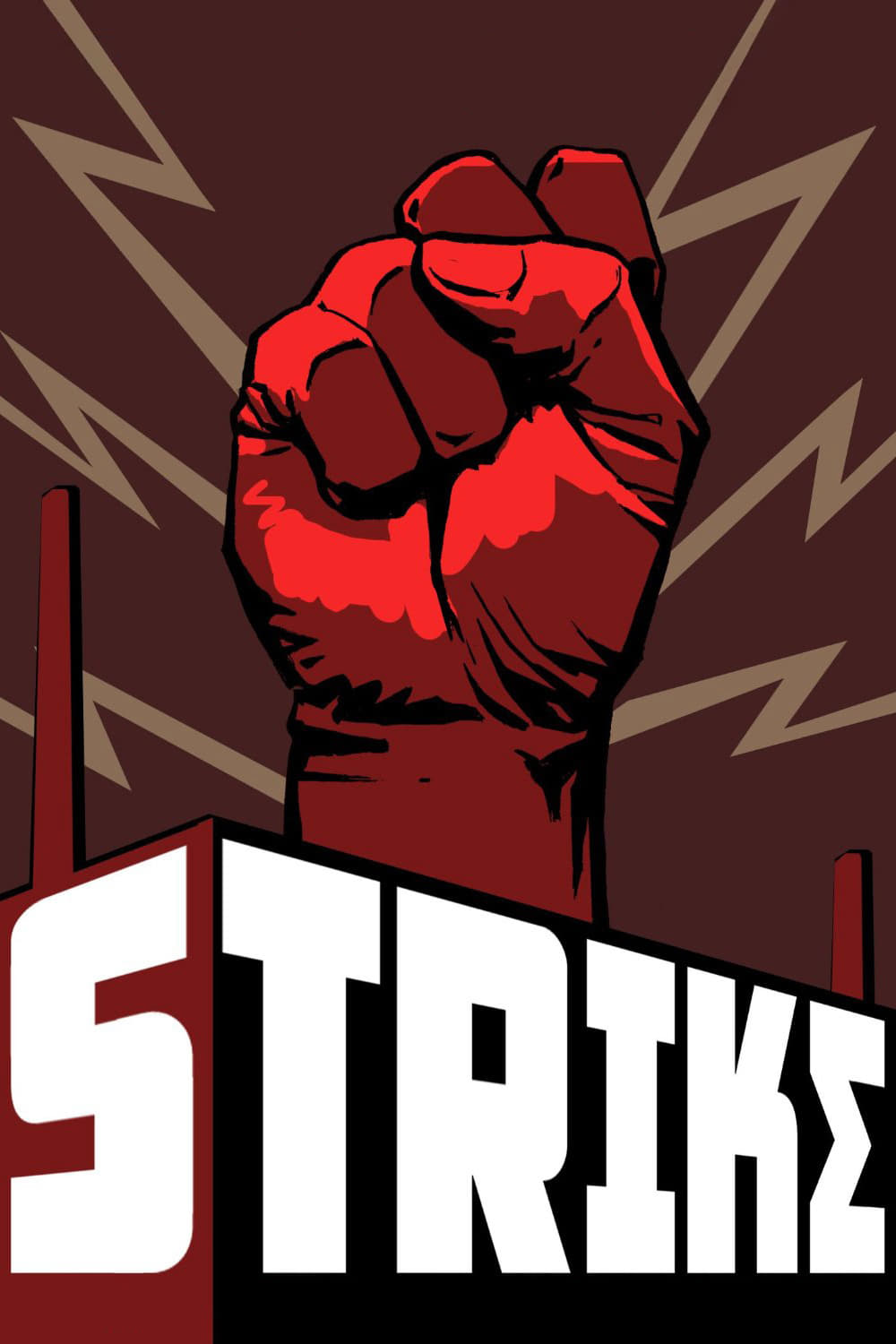
Poster from TMDB
OverviewAI-generated
Strike is a 1925 Soviet silent drama film directed by Sergei Eisenstein. The screenplay was written by Eisenstein and Grigori Aleksandrov, with Eduard Tisse serving as director of photography. The cast includes Aleksandr Pavlovich Antonov, Grigori Aleksandrov, and Maxim Strauch. Sergei Prokofiev composed the music for the black-and-white production, which was edited by Eisenstein. The film was distributed by Proletkult and Goskino USSR.
The narrative depicts workers in a pre-revolutionary Russian factory going on strike and facing violent suppression. Its tagline reads, "Down with autocracy! Long live the democratic republic!" The runtime is listed as 89 minutes in some sources and 82 minutes in others. It was released on April 28, 1925, and is followed by Battleship Potemkin. The film has been distributed via video on demand by Netflix, Criterion Channel, FlixFling, and TCM.
Review scores include a 9.2/10 rating and a 100% approval rating. It holds a 7.6 rating on IMDb from 8,788 votes and a 7.373 average on TMDb. The work is assessed under the Bechdel test and is rated Not Rated. Keywords associated with the film include police brutality, street riots, uprising, and Russian politics.
Synthesized by Vinony from 39 facts across 4 sources: Wikidata, TMDb, OMDb, IMDb. Generated from structured data (not the Wikipedia text) and checked against those facts — may still contain errors.
Film · TMDB
7.4Workers in a factory in pre-revolutionary Russia go on strike and are met by violent suppression.
Cast
- Maksim Shtraukh as Police Spy
- Grigori Aleksandrov as Factory Foreman
- Mikhail Gomorov as Worker
- Ivan Klyukvin as Revolutionary
- Aleksandr Antonov as Member of Strike Committee
- Vladimir Uralskiy as Worker
Themes
- police brutality
- strike
- street riots
- uprising
- russian politics
- silent film
- oppression
- labor strike
- labor union
- riot police
This product uses the TMDB API but is not endorsed or certified by TMDB.
Ratings
IMDb
7.6/10
8,788 votes
Rotten Tomatoes
100%
- Year
- 1925
- Runtime
- 82 min
- Genres
- Drama
- Rated
- Not Rated
via OMDb · IMDb
Key facts
- Directed by
- Sergei Eisenstein
- Written by
- Grigori Aleksandrov Ilya Kravchunovsky [ ru ] Sergei Eisenstein Valerian Pletnev
- Produced by
- Boris Mikhin
- Starring
- Grigori Aleksandrov Maksim Shtraukh Mikhail Gomorov
- Cinematography
- Eduard Tisse Vladimir Popov Vasili Khvatov
- Edited by
- Sergei Eisenstein
- Production company
- 1st Goskino Factory
- Distributed by
- Goskino
- Release date
- 28 April 1925 ( 1925-04-28 )
- Running time
- 82 minutes
- Country
- Soviet Union
- Languages
- Silent film , Russian intertitles
via Wikipedia infobox
Wikidata facts
- Instance of
- film
- Genre
- propaganda film
- Country of origin
- Soviet Union
- Followed by
- Battleship Potemkin
- Director
- Sergei Eisenstein
- Cast member
- Grigori Aleksandrov
- Composer
- Sergei Prokofiev
- Cinematographer
- Eduard Tisse
- Duration
- 82
- FilmAffinity ID
- 156554
- Distribution format
- video on demand
- Image
- Stachka.jpg
Show 9 more facts
- Commons category
- Strike (film)
- publication date
- 1925-04-28
- title
- Стачка
- color
- black-and-white
- aspect ratio (W:H)
- 4:3
- film editor
- Sergei Eisenstein
- distributed by
- Netflix
- assessment
- Bechdel test
- review score
- 100%
Sources (8)
via Wikidata · CC0
~14 min read
Encyclopedic overview
Strike (Russian: Стачка, romanized: Stachka) is a 1925 Soviet silent propaganda film directed and edited by Sergei Eisenstein. Originating as one entry out of a proposed seven-part series titled "Towards Dictatorship of the Proletariat", Strike was a joint collaboration between the Proletcult Theatre and the film studio Goskino. As Eisenstein's first full-length feature film, it marked his transition from theatre to cinema, and his next film Battleship Potemkin emerged from the same film cycle.
Arranged in six parts, the film depicts a strike in 1903 by the workers of a factory in pre-revolutionary Russia, and their subsequent suppression. It is best known for a sequence towards the climax, in which the violent suppression of the strike is cross-cut with footage of cattle being slaughtered, and similar animal metaphors are used throughout the film to describe various individuals.
Excerpted from Wikipedia’s “Strike” article, available under the CC BY-SA 4.0 licence.