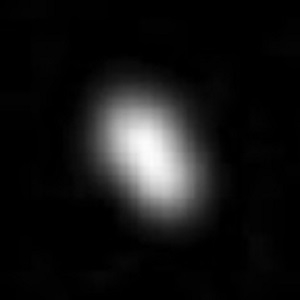
File:Styx_(moon).jpg · Wikimedia Commons · See Wikimedia Commons
Styx
Sign in to saveAlso known as S/2012 (134340) 1, (134340) Pluto V, Pluto V, S/2012 1
small natural satellite of the dwarf planet Pluto
Styx is a small moon that orbits the dwarf planet Pluto. It matters because it helps scientists understand the Pluto system and provides clues about the composition and history of objects in the distant outer regions of our solar system.
AI-generated from the Wikipedia summary — may contain errors.
Wikidata facts
- Instance of
- moon of Pluto
- Named after
- Styx
- Parent body
- Pluto
- Radius
- 9
- Mass
- 7500000000000000
- Orbital period
- 20.1615527
- Image
- Styx (moon).jpg
Show 11 more facts
- orbital eccentricity
- 0.0057871144
- Commons category
- Styx (moon)
- semi-major axis of an orbit
- 42656
- site of astronomical discovery
- Hubble Space Telescope
- time of discovery or invention
- 2012-06-26
- discoverer or inventor
- Mark Robert Showalter
- provisional designation
- S/2012 (134340) 1
- apparent magnitude
- 27
- orbital inclination
- 0.809
- IPA transcription
- ʃtʏks
- albedo
- 0.65
via Wikidata · CC0
~6 min read
Encyclopedic overview
Styx, formal designation (134340) Pluto V, is a small natural satellite of Pluto whose discovery was announced on 11 July 2012. It was discovered by use of the Hubble Space Telescope, and is the smallest of the five known moons of Pluto. It was imaged along with Pluto and Pluto's other moons by the New Horizons spacecraft in July 2015, albeit poorly with only a single image of Styx obtained.
Styx is the second-closest known satellite to Pluto, and the fifth discovered. It was discovered one year after Kerberos. Styx is approximately 16 km (9.9 mi) across its longest dimension, and its orbital period is 20.1 days.
Excerpted from Wikipedia’s “Styx” article, available under the CC BY-SA 4.0 licence.
Gallery (4)
Available in 65 languages
- Español
- Français
- Deutsch
- 中文
- 日本語
- Русский
- Português
- Italiano
- العربية
- हिन्दी
- Afrikaans
- Aragonese
- Armenian
- azb
- Bahasa Indonesia
- Bangla
- Basque
- Belarusian
Show 46 more
- Breton
- Bulgarian
- Burmese
- Catalan
- Croatian
- Czech
- Danish
- Esperanto
- Estonian
- Finnish
- Galician
- Georgian
- Greek
- Hebrew
- Hungarian
- Komi
- Latin
- Latvian
- Low German
- Macedonian
- Malay
- Nederlands
- Norwegian
- Norwegian Nynorsk
- olo
- Polski
- Romanian
- Serbian
- Serbian (Latin)
- simple
- Sinhala
- Slovak
- Svenska
- Tamil
- Tiếng Việt
- Toki Pona
- Türkçe
- Ukrainian
- Waray
- Welsh
- Wu Chinese
- zh_min_nan
- zh_yue
- فارسی
- ไทย
- 한국어
via Wikidata sitelinks · CC0