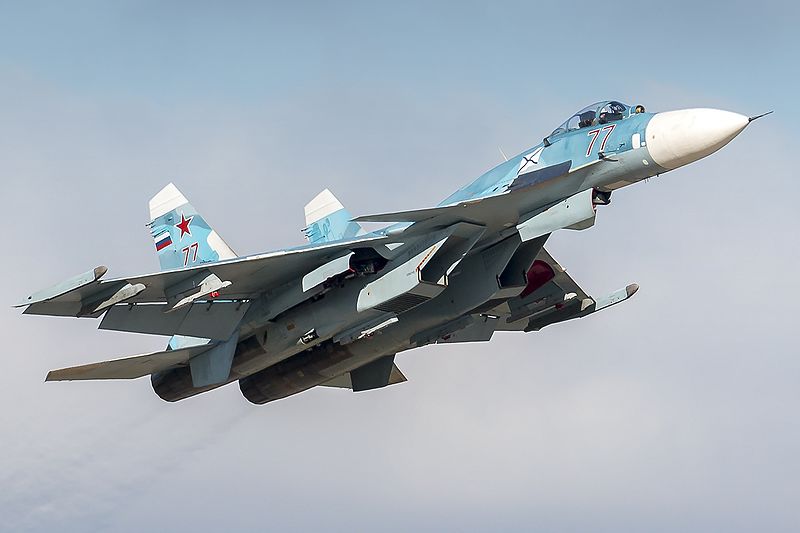
File:Sukhoi_Su-33_77_RED_(30268117476).jpg · Wikimedia Commons · See Wikimedia Commons
Sukhoi Su-33
Sign in to saveAlso known as Flanker-D, Su-27K, Sukhoi Su-27K, Su-33
carrier-based interceptor version of the Su-27 fighter aircraft
In the Vinony graph
Within Vinony's link graph, Sukhoi Su-33 is referenced by 183 other articles, and connects out to Sukhoi Su-25, China and Sukhoi Su-27.
Vinony files it under 1980s Soviet fighter aircraft, Aircraft first flown in 1987 and Aircraft specs templates using more performance parameter.
Its subject is documented across 43 Wikipedia language editions.
Key facts
- Type
- Carrier-based air superiority fighter with multirole capabilities
- National origin
- Soviet Union , Russia
- Manufacturer
- Sukhoi , Komsomolsk-on-Amur Aircraft Production Association
- Status
- In service
- Primary user
- Russian Navy
- Number built
- 24 built total
- Manufactured
- 1987–1999
- Introduction date
- 31 August 1998 (official)
- First flight
- 17 August 1987 ; 38 years ago ( 1987-08-17 )
- Developed from
- Sukhoi Su-27
- Variant
- Shenyang J-15
via Wikipedia infobox
Wikidata facts
- Subclass of
- short takeoff but arrested recovery
- Operator
- Russian Navy
- Country of origin
- Soviet Union
- Based on
- Sukhoi Su-27
- Developer
- Mikhail Simonov
- Designed by
- Mikhail Simonov
- Official website
- www.sukhoi.org/eng/planes/military/su33
- Image
- Sukhoi Su-33 in 2010 (5).jpg
- Has use
- combat air patrol
Show 6 more facts
- derivative work
- Shenyang J-15
- Commons category
- Sukhoi Su-33
- powered by
- Saturn AL-31
- NATO reporting name
- Flanker D
- first flight
- 1987-08-17
- service entry
- 1998-08-31
Sources (3)
via Wikidata · CC0
~22 min read
Encyclopedic overview
The Sukhoi Su-33 (Russian: Сухой Су-33; NATO reporting name: Flanker-D) is a Soviet/Russian all-weather carrier-based twin-engine air superiority-focused multirole fighter designed by Sukhoi and manufactured by Komsomolsk-on-Amur Aircraft Production Association. Derived from the Su-27 and initially known as the Su-27K, compared with its parent design the Su-33 has a number of modifications to make it suitable for carrier operations. These include a strengthened undercarriage and airframe, larger, folding wings and stabilators, new canards, upgraded engines, and a twin nose wheel.
First used in operations in 1995 aboard the aircraft carrier Admiral Kuznetsov, the fighter officially entered service in August 1998, by which time the designation "Su-33" was used. Following the break-up of the Soviet Union and the subsequent downsizing of the Russian Navy, only 24 aircraft were produced. Attempted sales to China and India were unsuccessful. With plans to retire the Su-33 once they reach the end of their service life, the Russian Navy ordered the MiG-29K as a replacement in 2009.
Excerpted from Wikipedia’s “Sukhoi Su-33” article, available under the CC BY-SA 4.0 licence.