File:Synesthesia.svg · Wikimedia Commons · See Wikimedia Commons
I don't have any context provided to base an overview of synesthesia on. Could you please share the context you'd like me to use?
AI-generated from the Wikipedia summary — may contain errors.
Key facts
- Medical condition.name
- Synesthesia
- Medical condition.image
- Synesthesia.svg
- Medical condition.alt
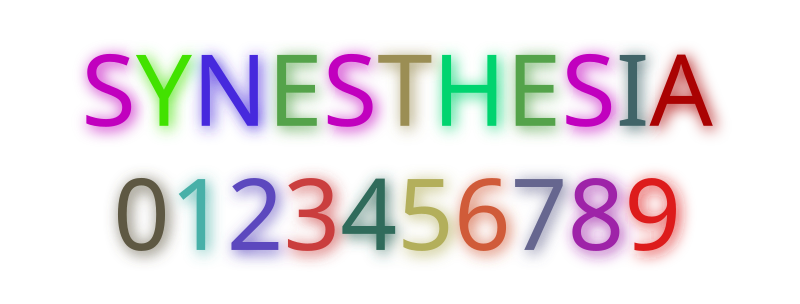
- Picture of the word "synesthesia" and several numbers color-coded in a way a synesthete may see them.
- Medical condition.caption
- A person experiencing synesthesia may associate certain letters and numbers with certain colors.
- Medical condition.pronounce
- /ˌsɪn.əsˈθiː.zi.ə/
- Medical condition.specialty
- Neuroscience, neurology, psychology
- Medical condition.frequency
- 4%
via Wikipedia infobox
Research
944 papers- Synesthesia.ReviewAnnual review of psychology · 2013Ward JDOI: 10.1146/annurev-psych-113011-143840
- Synesthesia, hallucination, and autism.ReviewFrontiers in bioscience (Landmark edition) · 2021Gennaro RJDOI: 10.2741/4918
- Grapheme-Color Synesthesia and Its Connection to Memory.ReviewCureus · 2024Anash S, Boileau ADOI: 10.7759/cureus.67524
- Synesthesia and music perception.ReviewDementia & neuropsychologia · 2015Bragança GFF, Fonseca JGM, Caramelli PDOI: 10.1590/S1980-57642015DN91000004
- Neurophysiology of synesthesia.ReviewCurrent psychiatry reports · 2007Hubbard EMDOI: 10.1007/s11920-007-0018-6
- Mirror Neurons and Mirror-Touch Synesthesia.ReviewThe Neuroscientist : a review journal bringing neurobiology, neurology and psychiatry · 2017Linkovski O, Katzin N, Salti MDOI: 10.1177/1073858416652079
- One-shot Synesthesia.Translational neuroscience · 2017Kirschner A, Nikolić DDOI: 10.1515/tnsci-2017-0023
- Neuroscience of synesthesia and cross-modal associations.ReviewReviews in the neurosciences · 2014Neckar M, Bob PDOI: 10.1515/revneuro-2014-0033
via PubMed
Wikidata facts
- Image
- Number Form--colored.jpg
Show 3 more facts
- Commons category
- Synesthesia
- topic's main category
- Category:Synesthesia
- different from
- cenesthesia
via Wikidata · CC0
~41 min read
Encyclopedic overview
36 sectionsContents
- Types
- Auditory–tactile synesthesia
- Chromesthesia
- Emotional synesthesia
- Grapheme–color synesthesia
- Kinesthetic synesthesia
- Lexical–gustatory synesthesia
- Mirror-touch synesthesia
- Number form
- Ordinal linguistic personification
- Spatial sequence synesthesia
- Ticker-tape synesthesia
- Other forms
- Signs and symptoms
- Mechanism
- Genetics
- Prevalence
- History
- Society and culture
- Notable cases
- Art
- Writers
- Painters and photographers
- Composers
- Musicians
- Artists without synesthesia
- Science
- Film
- Literature
- Research
- Technological applications
- The Voice (vOICe)
- See also
- References
- Further reading
- External links
Synesthesia (American English) or synaesthesia (British English) is a perceptual phenomenon in which stimulation of one sensory or cognitive pathway leads to involuntary experiences in other sensory or cognitive pathways. Synesthesia can manifest as a bridge between the five traditional senses, though can also include other perceptions, such as nociception, thermoception, chronoception, and interoception. People with synesthesia are referred to as synesthetes.
Awareness of synesthetic perceptions varies from person to person with the perception of synesthesia differing based on an individual's unique life experiences and the specific type of synesthesia that they have. In one common form of synesthesia, known as grapheme–color synesthesia or color–graphemic synesthesia, letters or numbers are perceived as inherently colored. In spatial-sequence, or number form synesthesia, numbers, months of the year, or days of the week elicit precise locations in space (e.g., 1980 may be "farther away" than 1990), or may appear as a three-dimensional map (clockwise or counterclockwise). Synesthetic associations can occur in any combination and any number of senses or cognitive pathways.
Excerpted from Wikipedia’s “synesthesia” article, available under the CC BY-SA 4.0 licence.
Gallery (17)
Available in 60 languages
- Español
- Français
- Deutsch
- 中文
- 日本語
- Русский
- Português
- Italiano
- العربية
- हिन्दी
- Armenian
- azb
- Azerbaijani
- Bahasa Indonesia
- Bangla
- Basque
- Bosnian
- Bulgarian
Show 41 more
- Catalan
- Central Kurdish
- Croatian
- Czech
- Danish
- Esperanto
- Estonian
- Finnish
- Galician
- Georgian
- gpe
- Greek
- Hebrew
- Hungarian
- Icelandic
- Interlingua
- Kazakh
- Latin
- Latvian
- Lithuanian
- Malagasy
- Malay
- Nederlands
- Norwegian
- Norwegian Nynorsk
- Odia
- Polski
- Romanian
- Serbian
- Sicilian
- simple
- Slovak
- Slovenian
- Svenska
- Telugu
- Tiếng Việt
- Türkçe
- Ukrainian
- Welsh
- فارسی
- 한국어
via Wikidata sitelinks · CC0